
ARN first reported the agreement, saying it is Macquarie Cloud Services’ third under Microsoft’s Datacenter Optimization, or DCO, initiative. Microsoft describes DCO as a global partner program offering incentives, tooling, engineering support and guidance to hosting and managed-service providers that are moving customers from on-premises infrastructure into Azure and hybrid operations.
The figure deserves careful reading. Microsoft is forecasting Macquarie’s Azure consumption spend over three years; neither company has publicly described it as a guaranteed minimum commitment, disclosed the currency, or published the milestones that would determine whether the forecast is reached. The announcement also provides no breakdown between customer migrations, existing customer expansion, AI services, Marketplace purchases, reservations, or ordinary pay-as-you-go consumption.
That leaves the agreement meaningful, but narrower than the headline number suggests. It gives Macquarie a commercial target and Microsoft-backed framework to sell and operate more Azure. It does not, on the public record, announce a $278 million investment in Australian infrastructure, a data-centre build, or a pool of dedicated Azure capacity for Macquarie customers.
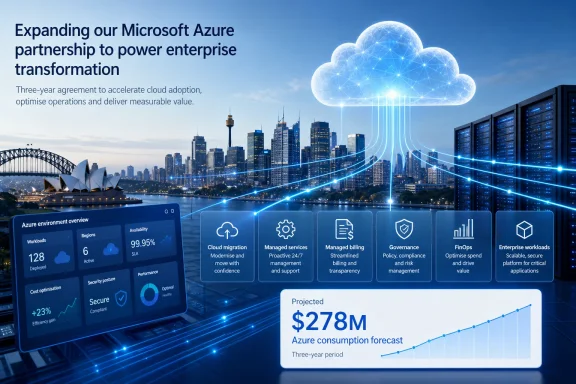 The $278 million is a consumption forecast
ARN reports that Microsoft expects Macquarie Cloud Services’ Azure consumption to reach $278 million over the next three years. That wording places the number in the category of cloud usage expected to be billed through or associated with the partner, rather than a lump-sum payment made at signing.
In Azure’s partner channel, that distinction is material. A managed provider can earn Azure consumption through migrations from physical servers, transfers of existing subscriptions into its Cloud Solution Provider relationship, new application development, data-platform work, security services and ongoing optimization. Customer workloads remain the underlying source of the spend, even when Macquarie becomes the billing and support partner.
Macquarie’s own public documentation describes a transfer from Azure pay-as-you-go billing to its CSP model as a billing-relationship change with no resource migration and no downtime. The workloads, configurations and resources remain in place, while the customer receives Azure invoices and support through Macquarie. A partner can therefore add significant Azure consumption without every customer undertaking a traditional lift-and-shift migration.
This is why the most consequential detail for enterprise customers is the provider relationship, not the forecast total. A Macquarie-managed Azure customer is likely to see its commercial administration, first-line support, governance processes and cost-optimization engagement move closer to Macquarie’s operating model. The underlying Azure service remains Microsoft’s, including the Microsoft Customer Agreement and Microsoft service-level terms.
Macquarie’s published public-cloud terms make that division explicit. Macquarie is the “Partner” for Microsoft Online Services it sells, but Microsoft retains discretion over service availability and operates the platform itself. Customers remain responsible for their Azure usage charges, while SLA credit claims are routed through Macquarie and passed on after Microsoft provides the corresponding rebate.
DCO is Microsoft’s channel-growth machinery
Calling this the third DCO agreement matters because it shows a continuing partner-development program rather than a sudden decision to enter Azure. Macquarie launched its Azure practice in partnership with Microsoft years ago, positioning Azure as its sole public-cloud focus. Its current marketing still identifies the company as a Tier 1 direct cloud services provider with Azure Expert MSP status.
Microsoft’s DCO program is built around a familiar cloud-channel calculation: a hosting company or MSP has customers with legacy infrastructure, licensing, operational support and compliance needs; Microsoft supplies commercial and technical support designed to help the partner move or extend those customers into Azure; the partner turns Azure consumption into recurring managed-services work.
The incentive is broader than reselling virtual machines. Once a customer’s subscriptions are administered by a managed provider, the provider has an opening to sell landing-zone design, identity and security work, backup, monitoring, FinOps, Windows Server and SQL Server licensing optimization, Azure Arc, managed detection and response, and modernization projects. The DCO program describes its purpose as helping partners retain on-premises business while adding cloud services, which is a more accurate description of the commercial goal than the announcement’s general references to AI readiness.
For Microsoft, a partner such as Macquarie offers reach into Australian organizations that may want local support, consolidated billing, regulated-industry experience and someone accountable for operational work around the platform. For Macquarie, Azure consumption creates the base from which higher-margin managed and professional services can be sold.
The agreement therefore ties Macquarie’s next three years of growth more directly to Microsoft’s Azure platform and commercial programs. Its public material emphasizes deep Azure specialization rather than multi-cloud management; customers looking for active AWS or Google Cloud competition inside the same provider relationship should treat that as a deliberate strategic limitation, not an incidental omission.
Cost optimization claims need a baseline
Macquarie says it has delivered average cloud cost savings of 26 percent, according to the announcement cited by ARN. That is a substantial claim, but the underlying calculation has not been published: no customer count, time period, workload mix, starting baseline, methodology, or breakdown of savings from reservations, Azure Hybrid Benefit, right-sizing, shutdown schedules and contract discounts has been provided.
Those inputs determine whether a percentage is useful to a prospective customer. Savings generated by turning off unused development VMs or replacing pay-as-you-go compute with reservations are real, but they are not equivalent to reducing the cost of an already optimized production estate. A Windows Server-heavy environment may also show a different result from a containerized estate using variable compute consumption across several regions.
Macquarie’s service documentation points to the likely mechanisms. It offers Savings Plans based on Azure Advisor recommendations, identifies Azure Hybrid Benefit, supports reservations and provides FinOps guidance. Those are standard Azure cost-control tools, but the value depends on having predictable usage, accurate licensing records and enough governance to avoid locking into commitments that no longer fit the workload.
Customers evaluating a move should ask for an account-specific model rather than apply the 26 percent claim to their own forecast. It should identify present consumption by service and region, expected committed-use coverage, Windows Server and SQL Server licensing eligibility, Marketplace charges, data-egress exposure, management fees, and the treatment of future AI or GPU workloads. The headline percentage is not a substitute for that exercise.
Macquarie’s public terms add another operational cost consideration: Azure charges can be affected by usage, term, offer type and the USD-AUD exchange rate when Microsoft prices a service in US dollars. Its terms also allow it to pass through changes in Microsoft pricing, discounts and terms. For Australian buyers, a three-year partner agreement does not automatically mean a three-year fixed price for every Azure resource.
What the announcement does not establish
Neither ARN’s report nor the public material reviewed from Microsoft and Macquarie identifies participating customers, covered Azure services, geographical deployment requirements, a spending floor, or any discount structure. There is also no public indication that Microsoft has earmarked Azure GPU capacity, sovereign-cloud capacity or Australian datacentre capacity for Macquarie under this agreement.
That omission matters amid rising demand for AI infrastructure. Macquarie’s statement places data, AI and next-generation applications at the center of the agreement, but the record contains no named AI platform, model service, Microsoft Foundry commitment, Copilot service, GPU SKU or capacity reservation. For now, the AI language establishes the intended direction of customer demand rather than a deliverable that an IT department can procure from this announcement.
The source record also contains a date discrepancy. The submitted report metadata lists publication on August 10, 2026 and modification on August 11, 2026, while ARN’s live article page is dated August 12, 2026. As of August 11, no separate Microsoft or Macquarie press release detailing the new agreement was located. That does not invalidate ARN’s reporting, but it means the available public account is still a thin one and the commercial specifics remain unconfirmed outside that outlet.
For existing Macquarie Azure customers, there is no announced requirement to migrate workloads or alter Windows Server, SQL Server, Azure Arc or Azure Marketplace deployments. For prospective customers, the concrete consequence is simpler: Macquarie now has a renewed three-year Microsoft-backed incentive to bring Azure subscriptions under its management and to expand the services attached to them. The real test will be visible in customer terms, pricing proposals and the workloads that actually move into Azure—not in the forecasted consumption number alone.