
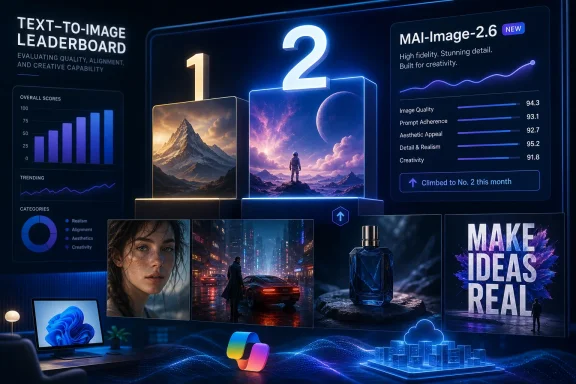
TheWinCentral reported the ranking on August 11, and Microsoft confirmed the MAI-Image-2.6 launch in a post dated August 10. Arena’s live board, dated August 10, lists the preview model second out of 77 systems with a 1336 Elo score from 3,488 votes. GPT-Image-2 remains first at 1381, based on 70,065 votes.
Microsoft says MAI-Image-2.6 gained 79 Elo points over MAI-Image-2.5 overall, including a 91-point increase in text rendering. But the details on Arena reveal a more useful conclusion for Windows users and IT buyers: Microsoft’s progress is substantial, while the No. 2 position is still a fresh, lightly sampled result rather than a settled ordering of the entire market.
 Arena Confirms the Ranking, With an Important Warning
Arena’s leaderboard is a blind human-preference system. Users submit prompts, receive outputs from competing models, and select the image they prefer; the platform turns those head-to-head outcomes into Elo-style scores. It measures what people tend to choose when looking at results, not a fixed technical benchmark for resolution, latency, pricing, factual grounding, safety behavior, or production reliability.
As of August 10, MAI-Image-2.6-preview sits at 1336 Elo with a listed uncertainty of plus or minus 11. The next model, xAI’s Grok Imagine Image 2.0 in its low setting, is at 1316 plus or minus 12 and is marked preliminary. Google’s Nano Banana 2 web-search variant is seventh at 1264, while Meta’s Muse Image is fifth at 1282. The older MAI-Image-2.5 model remains tenth at 1256.
That validates the basic claim that Microsoft has moved in front of the named Google, Meta, and xAI entries on Arena’s overall text-to-image board. It does not prove that MAI-Image-2.6 will reliably beat every one of those models for a specific job. A product-shot workflow, an infographic with small type, a multi-reference edit, a photoreal portrait, and an image grounded in web data are different workloads. Arena’s top-level rank compresses them into one crowd-preference score.
The closer issue is Grok. MAI-Image-2.6’s 1336-plus-or-minus-11 range overlaps narrowly with Grok Imagine Image 2.0’s 1316-plus-or-minus-12 range. Arena itself gives MAI-Image-2.6 a rank spread from second to third. In plain terms, Microsoft is ahead on the current central score, but its lead over Grok is not yet statistically clean. The gap over GPT-Image-2, by contrast, is 45 Elo points, with no overlap in the displayed confidence intervals.
Microsoft’s announcement calls the result a firm establishment ahead of Meta, Google, and xAI. The board supports the broad placement, but the vote count is the part Microsoft did not emphasize: MAI-Image-2.6 has roughly one-twentieth as many Arena votes as Nano Banana, and about one-sixth as many as MAI-Image-2.5. The ranking can move as more people use it.
The Jump From MAI-Image-2.5 Is the Actual Story
MAI-Image-2.6 is not Microsoft’s first recent leaderboard success. On June 2, Microsoft launched MAI-Image-2.5, which ranked third for text-to-image and second for image editing on the then-current Arena board. That model was a major product-oriented release, adding text-to-image generation and controlled image editing, including object removal, replacement, text changes, cleanup, and composition preservation.
Microsoft’s MAI-Image-2.5 model card described a 20-billion-parameter diffusion model with both text and image inputs, a 32,000-token context window, and a maximum image area of 1,048,576 pixels. It was placed in Microsoft Foundry, MAI Playground, PowerPoint, and OneDrive Photos integrations. Microsoft also published token-based Foundry pricing for the standard and Flash versions.
For MAI-Image-2.6, Microsoft has announced something materially narrower. The company says the model improves text rendering, portraits, 3D imaging, photorealistic and cinematic work, plus product and commercial imagery. It also says the release will support multiple references, richer grounding, and more control over reasoning, image format, and resolution.
However, those latter capabilities are promises rather than documented release features. Microsoft has not yet published a MAI-Image-2.6 model card, API reference, pricing schedule, supported image dimensions, latency figures, regional availability list, Foundry SKU, or a safety report comparable to the material supplied for 2.5. It has also not said whether 2.6 changes the one-megapixel output limit published for MAI-Image-2.5.
That missing information matters more to an administrator or developer than a leaderboard position. A model that wins blind preference voting but has unknown quotas, unclear deployment regions, unannounced commercial terms, or no tested API contract is not ready to be dropped into a production asset pipeline.
“Available Now” Means Arena, Not Microsoft Foundry
TheWinCentral report says MAI-Image-2.6 is available to try through Arena, which Microsoft confirms. But readers should not mistake this for a general Microsoft product release.
Microsoft’s own August 10 announcement says MAI-Image-2.6 is available for text-to-image use in Arena today. It says MAI Playground access is coming later this week, with Microsoft Foundry and other product rollouts following soon. As of August 11, Microsoft has not announced a date for Foundry access, listed supported Azure regions, or said whether the model will arrive as a preview-only endpoint.
That distinction has practical consequences. Arena is useful for seeing blind comparisons and trying prompts, but it is not a dependable acceptance-testing environment for an enterprise workflow. The identity of models may be concealed during voting, prompt handling is governed by Arena’s service conditions rather than a customer’s Azure tenancy, and the site does not supply the deployment controls a company expects around logging, retention, content filtering, access policy, billing, and support.
MAI-Image-2.5, meanwhile, remains Microsoft’s documented implementation path for production work. It is already in Foundry and has stated pricing, documented model behavior, safety information, and Microsoft product integration. Anyone planning PowerPoint image generation, OneDrive editing, or an Azure AI Foundry application should treat 2.6 as a high-performing preview until Microsoft provides equivalent operational documentation.
Microsoft Is Building Leverage Against Its Own Partners
The strategic significance is not simply that Microsoft has an image model near the top of a public leaderboard. Microsoft has spent years packaging generative AI through a close relationship with OpenAI. GPT-Image-2 still holds the No. 1 Arena slot, yet MAI-Image-2.6 now gives Microsoft an in-house alternative that is close enough in preference scores to be credible for a broad class of imaging tasks.
That gives Microsoft more than an advertising line. It gives the company optionality in the products Windows and Microsoft 365 users actually touch: PowerPoint, OneDrive, Designer-style creative experiences, Copilot surfaces, and the Foundry catalog. A first-party model can be tuned for Microsoft’s product needs, deployed where the company wants it, and priced around Microsoft’s own infrastructure economics instead of a partner’s roadmap.
Microsoft has already made that direction clear with MAI-Image-2.5, which it positioned as a quality-and-cost model for developers and product teams. The 2.6 announcement continues the same hill-climbing narrative: frequent, targeted iterations that pursue measurable improvements in the categories Arena voters select for, particularly text rendering and polished commercial imagery.
There is one important limit to that argument. The current No. 1 is still OpenAI’s GPT-Image-2, and Microsoft is 45 Elo points behind it on Arena’s August 10 board. Microsoft has narrowed the contest, but it has not taken the lead.
What to Watch Before Treating 2.6 as a Production Model
Microsoft has demonstrated an impressive quality jump in less than three months, moving from MAI-Image-2.5’s No. 3 text-to-image position in June to MAI-Image-2.6’s No. 2 position in August. The current Arena board independently confirms the placement and the models it passed.
But the near-term test is not whether Microsoft can put another image model into Arena. It is whether the company can convert this preview into a usable Foundry offering with published pricing, model limits, regional availability, safety documentation, and a stable interface before the relatively small Arena sample reshuffles the leaderboard.
For now, MAI-Image-2.6 is the most capable public preview in Microsoft’s image-model line, and a legitimate second-place contender on Arena. MAI-Image-2.5 remains the version Windows, Microsoft 365, and Azure customers can actually plan around.