
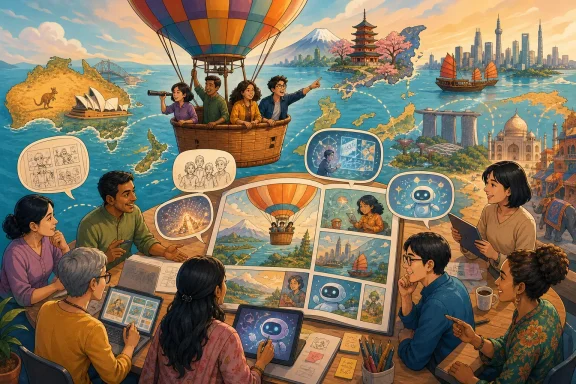
Microsoft Digital’s Asia organization has turned an internal AI adoption exercise into a regional comic book, using a fictional hot-air-balloon journey to connect employees across Australia, New Zealand, Japan, China, Singapore, and India. The project is not a Microsoft 365 Copilot product launch, nor evidence of a new feature: it is a case study in how Microsoft’s own IT organization used creative, low-stakes activities to make AI experimentation feel less intimidating after years of reduced in-person contact.
The account, published by Microsoft Inside Track on August 6, describes a comic in which regional leaders Alan Stone and Wai Leong Chan travel from country to country, meeting local teams and learning about their cultures. Each country group produced a chapter, sharing prompts and iterating on generated material with colleagues. Microsoft says the work became popular enough that people joined sessions voluntarily, and that it encouraged participants to use Copilot more broadly in their day jobs.
The important finding is less about the comic itself than the adoption mechanism behind it. Microsoft’s teams did not begin with a productivity mandate, a cost-saving target, or a difficult business process. They began with social interaction: small cultural games, brief cross-region conversations, shared images, then a collective storytelling project. The AI tool was treated as a reason to collaborate, rather than as the thing employees were being ordered to learn.
That may sound cosmetic, but it addresses a persistent enterprise deployment problem. Employees can be given a Copilot license, training materials, and a list of approved use cases and still avoid the service if they fear producing poor output, exposing their lack of expertise, or simply adding another tool to an already crowded workday. A comic book removes much of that pressure. The output is deliberately imperfect, the stakes are low, and the learning happens in public.
Microsoft frames the project as an attempt to rebuild community in a region whose employees had previously met regularly through regional gatherings and global conferences. COVID-19 disrupted that rhythm, and the company says the teams sought ways to recreate the informal connection that had once occurred around in-person events.
The first step was an initiative called “Hello There.” Every six months, the organization would randomly group three people from different locations, ask them to find 30 minutes for a conversation, and suggest a discussion topic. Participants then used AI to generate an image reflecting what they discussed and posted it to a Viva Engage channel.
That format matters because it creates a simple loop: a scheduled human conversation produces shared context; AI turns that context into an artifact; and the artifact gives other employees something concrete to react to. In many remote-work programs, the social event ends when the Teams call does. Microsoft’s use of a shared image channel gave the conversation a second life and created a visible archive of participation.
The later comic book project scaled the same idea. Instead of asking employees to demonstrate individual proficiency with prompts, it gave country teams a shared chapter to complete. The leaders became characters, team members supplied cultural material and jokes, and groups compared outputs. That arrangement also made prompt-writing a collaborative activity rather than a private test of technical skill.
Microsoft calls the effort a “runaway success,” but the published account does not provide participation rates, the number of employees involved, the number of sessions held, before-and-after Copilot usage figures, or any measurement of whether the project improved adoption beyond anecdotal enthusiasm. No independent outlet appears to have reported those figures or independently evaluated the program. The result should therefore be read as an internal adoption anecdote, not a quantified demonstration that creative events increase Microsoft 365 Copilot use.
That distinction is practical for IT teams. Microsoft 365 Copilot is primarily an organizational service grounded in Microsoft Graph data and Microsoft 365 applications, while image creation can involve different services, permissions, terms, and content controls. A case study that says a team “used AI” may sound reproducible, but the details that determine whether it is reproducible inside another tenant are absent.
There is also no description of the organization’s review process for images, text, likenesses, cultural references, or generated material involving the leaders’ families. One leader, Stephen Kerametlian, said the team included his wife and young son in a personalized AI-generated comic. That may have been welcome in this internal setting, but it is a reminder that a playful project can move quickly into personal data and image-rights territory.
For a company attempting something similar, approval needs to precede the creative prompt. Teams should establish whether participants may use personal photos, whether executives have consented to being depicted, whether generated material may be posted on internal social platforms, and whether country-specific cultural references require local review. A project intended to strengthen belonging can have the opposite effect if employees feel that their identity, location, or family life is being used as material without clear boundaries.
Formal AI enablement often focuses on explaining features: summarize a document, draft an email, analyze a spreadsheet, prepare meeting notes. Those are useful exercises, yet they can make adoption feel like a performance review. An employee who receives a poor result may conclude the technology is unreliable, or that they are using it incorrectly, and quietly stop experimenting.
A group project changes the social cost of failure. Weak outputs become material for a laugh and a revised prompt. A colleague’s better result becomes a lesson. Local teams can explain references that people elsewhere would miss. The project is also naturally multilingual and cross-cultural because the goal is to represent regional variation rather than eliminate it.
This model has limits. It works best where the project is voluntary, outputs are meant for internal audiences, and managers permit time for experimentation. It will not replace governed training for departments handling regulated data, customer records, source code, financial material, or sensitive HR content. A safe sandbox still needs a fence around it.
Microsoft’s own article does not say whether the comic project used production business data, whether prompts were retained, whether specific content safety controls were used, or whether the project was conducted under any formal responsible-AI policy. Those omissions are unsurprising for a culture story, but they are the details a Windows administrator, Microsoft 365 admin, or security team would need before turning the concept into a program.
Microsoft Digital Asia’s experiment suggests that adoption campaigns may work better when they give people a reason to create with each other. That could mean an internal illustrated guide to a new office, a cross-team onboarding story, a fictional incident-response narrative, or a short visual history of a department. The theme does not need to be a comic book. It does need a bounded purpose, an audience, and enough room for people to contribute without feeling exposed.
A workable internal version would include a few rules:
The durable lesson is straightforward: an AI rollout becomes more credible when employees can learn in a setting where failure is harmless, colleagues can help, and the output belongs to a group rather than a dashboard. Microsoft Digital Asia’s balloon comic did not prove that Copilot makes teams more productive. It showed that an organization can make AI less solitary—and that may be the prerequisite for getting employees to use it at all.
The important finding is less about the comic itself than the adoption mechanism behind it. Microsoft’s teams did not begin with a productivity mandate, a cost-saving target, or a difficult business process. They began with social interaction: small cultural games, brief cross-region conversations, shared images, then a collective storytelling project. The AI tool was treated as a reason to collaborate, rather than as the thing employees were being ordered to learn.
That may sound cosmetic, but it addresses a persistent enterprise deployment problem. Employees can be given a Copilot license, training materials, and a list of approved use cases and still avoid the service if they fear producing poor output, exposing their lack of expertise, or simply adding another tool to an already crowded workday. A comic book removes much of that pressure. The output is deliberately imperfect, the stakes are low, and the learning happens in public.
 The comic book was a cultural intervention, not an AI benchmark
Microsoft frames the project as an attempt to rebuild community in a region whose employees had previously met regularly through regional gatherings and global conferences. COVID-19 disrupted that rhythm, and the company says the teams sought ways to recreate the informal connection that had once occurred around in-person events.The first step was an initiative called “Hello There.” Every six months, the organization would randomly group three people from different locations, ask them to find 30 minutes for a conversation, and suggest a discussion topic. Participants then used AI to generate an image reflecting what they discussed and posted it to a Viva Engage channel.
That format matters because it creates a simple loop: a scheduled human conversation produces shared context; AI turns that context into an artifact; and the artifact gives other employees something concrete to react to. In many remote-work programs, the social event ends when the Teams call does. Microsoft’s use of a shared image channel gave the conversation a second life and created a visible archive of participation.
The later comic book project scaled the same idea. Instead of asking employees to demonstrate individual proficiency with prompts, it gave country teams a shared chapter to complete. The leaders became characters, team members supplied cultural material and jokes, and groups compared outputs. That arrangement also made prompt-writing a collaborative activity rather than a private test of technical skill.
Microsoft calls the effort a “runaway success,” but the published account does not provide participation rates, the number of employees involved, the number of sessions held, before-and-after Copilot usage figures, or any measurement of whether the project improved adoption beyond anecdotal enthusiasm. No independent outlet appears to have reported those figures or independently evaluated the program. The result should therefore be read as an internal adoption anecdote, not a quantified demonstration that creative events increase Microsoft 365 Copilot use.
Microsoft leaves the actual AI stack unclear
One notable omission is exactly which tools generated which parts of the project. Microsoft says employees were encouraged to incorporate Microsoft 365 Copilot into daily workflows, and it repeatedly refers to Copilot’s role in normalizing AI use. But the Inside Track report describes the comic and related images more generally as being made with “AI-driven tools” and does not identify a specific Copilot product, model, image-generation service, tenant configuration, or licensing tier.That distinction is practical for IT teams. Microsoft 365 Copilot is primarily an organizational service grounded in Microsoft Graph data and Microsoft 365 applications, while image creation can involve different services, permissions, terms, and content controls. A case study that says a team “used AI” may sound reproducible, but the details that determine whether it is reproducible inside another tenant are absent.
There is also no description of the organization’s review process for images, text, likenesses, cultural references, or generated material involving the leaders’ families. One leader, Stephen Kerametlian, said the team included his wife and young son in a personalized AI-generated comic. That may have been welcome in this internal setting, but it is a reminder that a playful project can move quickly into personal data and image-rights territory.
For a company attempting something similar, approval needs to precede the creative prompt. Teams should establish whether participants may use personal photos, whether executives have consented to being depicted, whether generated material may be posted on internal social platforms, and whether country-specific cultural references require local review. A project intended to strengthen belonging can have the opposite effect if employees feel that their identity, location, or family life is being used as material without clear boundaries.
The strongest idea is peer learning, not image generation
Microsoft’s narrative is built around generative AI, but its most transferable element is peer-to-peer learning. The organization describes employees sharing prompts, comparing output, and building on each other’s ideas. That is closer to an internal community of practice than to conventional software training.Formal AI enablement often focuses on explaining features: summarize a document, draft an email, analyze a spreadsheet, prepare meeting notes. Those are useful exercises, yet they can make adoption feel like a performance review. An employee who receives a poor result may conclude the technology is unreliable, or that they are using it incorrectly, and quietly stop experimenting.
A group project changes the social cost of failure. Weak outputs become material for a laugh and a revised prompt. A colleague’s better result becomes a lesson. Local teams can explain references that people elsewhere would miss. The project is also naturally multilingual and cross-cultural because the goal is to represent regional variation rather than eliminate it.
This model has limits. It works best where the project is voluntary, outputs are meant for internal audiences, and managers permit time for experimentation. It will not replace governed training for departments handling regulated data, customer records, source code, financial material, or sensitive HR content. A safe sandbox still needs a fence around it.
Microsoft’s own article does not say whether the comic project used production business data, whether prompts were retained, whether specific content safety controls were used, or whether the project was conducted under any formal responsible-AI policy. Those omissions are unsurprising for a culture story, but they are the details a Windows administrator, Microsoft 365 admin, or security team would need before turning the concept into a program.
A useful pattern for Microsoft 365 administrators
The practical takeaway is to separate two decisions that organizations often bundle together: deploying an AI service and persuading people to use it well. The first is an administrative, security, licensing, and data-governance task. The second is a workplace-design task.Microsoft Digital Asia’s experiment suggests that adoption campaigns may work better when they give people a reason to create with each other. That could mean an internal illustrated guide to a new office, a cross-team onboarding story, a fictional incident-response narrative, or a short visual history of a department. The theme does not need to be a comic book. It does need a bounded purpose, an audience, and enough room for people to contribute without feeling exposed.
A workable internal version would include a few rules:
- The project should use approved accounts, approved services, and fictional or non-sensitive material unless the organization has explicitly cleared another use.
- Participation should remain voluntary, with no expectation that employees use personal photos, family details, or identifiable likenesses.
- A local reviewer should check cultural references and language before material is shared broadly across regions.
- Administrators should measure adoption separately from enthusiasm, tracking whether a social event changes meaningful use of approved tools in normal work.
The durable lesson is straightforward: an AI rollout becomes more credible when employees can learn in a setting where failure is harmless, colleagues can help, and the output belongs to a group rather than a dashboard. Microsoft Digital Asia’s balloon comic did not prove that Copilot makes teams more productive. It showed that an organization can make AI less solitary—and that may be the prerequisite for getting employees to use it at all.
References
- Primary source: microsoft.com
Published: 2026-08-06T16:05:00+00:00
Loading…
www.microsoft.com - Related coverage: news.microsoft.com
Loading…
news.microsoft.com - Related coverage: microsoft.com
Loading…
www.microsoft.com - Related coverage: learn.microsoft.com
Loading…
learn.microsoft.com - Related coverage: news.microsoft.com
Loading…
news.microsoft.com - Related coverage: learn.microsoft.com
Loading…
learn.microsoft.com - Related coverage: blogs.microsoft.com
Loading…
blogs.microsoft.com - Related coverage: techcommunity.microsoft.com
Loading…
techcommunity.microsoft.com - Related coverage: download.microsoft.com
Loading…
download.microsoft.com - Related coverage: marketingassets.microsoft.com
Loading…
marketingassets.microsoft.com