
Lancashire County Council’s social workers are using Microsoft 365 Copilot to turn spoken visit accounts into structured case notes and draft reports, cutting a piece of paperwork that previously consumed hours or, for some adult-services assessments, up to two days. The practical gain is straightforward: practitioners begin with a formatted draft, then check, amend and own the final record instead of reconstructing each case from scratch after a visit.
But the August 3 THINK Digital Partners feature is not a new deployment announcement. Lancashire publicly described the programme on March 23, while Microsoft published a closely matching customer story on June 30. What is new in the latest coverage is a broader narrative around adoption across the council, not evidence of a new tool, a new safeguarding capability, or an independently measured outcome.
For Windows and Microsoft 365 administrators, Lancashire is a useful example of where Copilot delivers a concrete operational benefit: it is being applied to a bounded workflow with existing templates, an explicit human review step and a clear owner for the final output. It is also a reminder that the most eye-catching productivity totals in vendor case studies remain estimates until the organisation publishes its measurement method.
The council’s model is deliberately narrow. A practitioner records a spoken account of a visit through a work tool such as Microsoft Teams or Facilitator on a phone, then Microsoft 365 Copilot helps convert that material into case notes or another document format used by the service. The social worker reviews the draft, cross-references it against the case and makes the final decision.
That distinction is material. Lancashire is not describing an automated system that recommends whether a child is safe, determines an adult’s care entitlement, or submits records without professional sign-off. Microsoft’s June customer story says Children’s Services uses AI strictly to support professional judgement, and Lancashire’s March announcement likewise said the practitioner remains responsible for the submitted report.
The process aims at the point where generative AI is most defensible in a high-stakes service: drafting and formatting material from information already gathered by the professional. In adult social care, Lancashire said its social circumstance reports had fallen from as long as two days of work to roughly three or four hours when Copilot and a purpose-built prompt generate the first draft. The worker still has to meet the person, consult relevant relatives and professionals, and verify the finished account.
That is a meaningful change to a social worker’s day, but it should not be confused with artificial intelligence doing social work. The system’s output is only as complete as the source account and records supplied to it, and an articulate draft can still omit context, misunderstand a fact or make a weak inference sound authoritative. The human review requirement is therefore the control that determines whether the workflow saves time safely or merely moves the burden into correcting polished errors.
All three figures are explicitly framed as early estimates, rather than independently audited reductions in workload. The council has not published the baseline activity volumes, the calculation model, the proportion of time expected to be reallocated to resident-facing work, or whether the totals include the time spent training staff, writing prompts, checking drafts and correcting outputs.
The difference is not proof that the programme is failing. It may simply reflect a growing deployment, refined assumptions or more use cases being included. Yet the progression from 200,000 to 235,000 hours in a little over three months illustrates why readers should treat the annual number as a planning estimate, not a completed outcome.
There is a more concrete operational metric underneath it. Lancashire said in March that it had trained more than 1,400 social workers, educational psychologists and support officers in responsible AI use across Adult Services and Education and Children’s Services. By June, the council said more than 6,500 staff—about 68% of its workforce—had been supported to use tools including Microsoft 365 Copilot.
Those figures describe different populations: specialised frontline users in March versus staff supported across the wider organisation in June. They should not be read as proof that 6,500 staff hold paid Microsoft 365 Copilot licences or use it daily for sensitive case documentation. Microsoft’s feature says the council has rolled Copilot out to thousands of staff and that around two-thirds of its workforce actively uses AI tools through a mixture of free and paid licences. It does not disclose how many have the paid Microsoft 365 Copilot add-on, how licences are allocated by service, or what the programme costs.
That omission matters for councils and enterprises trying to reproduce the result. Copilot Chat, which can be available under a Microsoft 365 business subscription, is a substantially different procurement proposition from Microsoft 365 Copilot, whose value depends on access to tenant data, compliant configurations and well-defined work processes. “Two-thirds of staff use AI tools” is an adoption statistic; it is not a licence count or a return-on-investment calculation.
Those controls fit the problem presented by voice-led social work documentation. A visit account can include health information, family relationships, safeguarding concerns, disability information and other highly sensitive facts. A workflow that begins on a phone needs clarity over device management, account identity, recording consent where applicable, transcription handling, retention and where generated content is stored before it enters the council’s formal case-management record.
The public case studies do not provide that detail. Neither THINK Digital Partners, Microsoft nor Lancashire’s news releases identify the data-protection impact assessment for this use, the retention settings for recordings and transcripts, the precise Copilot configuration used, integrations with social-care case systems, or a formal error-rate audit of generated notes. That does not establish that the controls are absent; it means the assurances available to residents and peer organisations are limited to the council’s published policy and its statement that practitioners retain responsibility.
Lancashire’s broader Digital Strategy had already committed the authority to establish AI governance, experiment with generative AI and provide prompt-engineering support and training. The social-work programme appears to be the most visible expression of that strategy, rather than an isolated pilot introduced after the latest publicity.
The department has also published work from the National Workload Action Group on AI in case recording. Its direction is similar to Lancashire’s stated approach: reduce unnecessary administrative work, preserve professional accountability and treat case recording as a high-risk process requiring governance, workforce involvement and evidence rather than a generic productivity experiment.
Lancashire’s co-design claim is important here. The council says it worked with frontline teams to find the heaviest administrative pressures and shape prompts around current templates, language and reporting requirements. That is more likely to produce useful output than asking a general-purpose assistant to “write a case note,” because social-care records have local conventions, statutory context and a strong need to separate observed fact, reported information and professional analysis.
It also creates a maintenance obligation. Templates, reporting standards and policy language change. So do Microsoft features and the model behaviours behind them. A prompt that is safe and helpful at rollout can become misleading if staff treat it as an approved decision framework, or if changes to the underlying service alter how it responds. The ongoing work is not merely training people to use Copilot; it is versioning prompts, sampling outputs, tracking corrections and making sure staff can challenge the technology without pressure to accept its wording.
What remains unpublished is the evidence needed to convert the success story into a replicable public-sector model. The council should be able to show how much time is actually saved after review, whether documentation quality has improved, how often drafts need substantial correction, how staff and people receiving services experience the change, and what the paid licences and governance measures cost.
Until then, Lancashire’s strongest claim is the narrow one: Copilot can remove some repetitive drafting from social-care documentation when it is constrained by templates and checked by accountable professionals. The larger claim—hundreds of thousands of hours returned to frontline care—remains an estimate that needs a transparent audit trail.
For Windows and Microsoft 365 administrators, Lancashire is a useful example of where Copilot delivers a concrete operational benefit: it is being applied to a bounded workflow with existing templates, an explicit human review step and a clear owner for the final output. It is also a reminder that the most eye-catching productivity totals in vendor case studies remain estimates until the organisation publishes its measurement method.
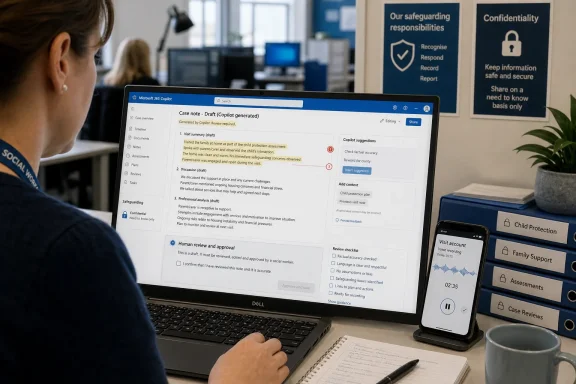 From voice capture to a reviewable case record
The council’s model is deliberately narrow. A practitioner records a spoken account of a visit through a work tool such as Microsoft Teams or Facilitator on a phone, then Microsoft 365 Copilot helps convert that material into case notes or another document format used by the service. The social worker reviews the draft, cross-references it against the case and makes the final decision.That distinction is material. Lancashire is not describing an automated system that recommends whether a child is safe, determines an adult’s care entitlement, or submits records without professional sign-off. Microsoft’s June customer story says Children’s Services uses AI strictly to support professional judgement, and Lancashire’s March announcement likewise said the practitioner remains responsible for the submitted report.
The process aims at the point where generative AI is most defensible in a high-stakes service: drafting and formatting material from information already gathered by the professional. In adult social care, Lancashire said its social circumstance reports had fallen from as long as two days of work to roughly three or four hours when Copilot and a purpose-built prompt generate the first draft. The worker still has to meet the person, consult relevant relatives and professionals, and verify the finished account.
That is a meaningful change to a social worker’s day, but it should not be confused with artificial intelligence doing social work. The system’s output is only as complete as the source account and records supplied to it, and an articulate draft can still omit context, misunderstand a fact or make a weak inference sound authoritative. The human review requirement is therefore the control that determines whether the workflow saves time safely or merely moves the burden into correcting polished errors.
Lancashire’s headline savings have risen three times
The clearest unresolved issue in the public record is the scale of the claimed benefit. Lancashire’s March announcement put early estimated savings at more than 200,000 staff hours per year. Microsoft’s June 30 story increased that figure to “at least” 225,000 hours. Four days later, Lancashire’s own report from its AI Expo put the estimate at 235,000 hours annually.All three figures are explicitly framed as early estimates, rather than independently audited reductions in workload. The council has not published the baseline activity volumes, the calculation model, the proportion of time expected to be reallocated to resident-facing work, or whether the totals include the time spent training staff, writing prompts, checking drafts and correcting outputs.
The difference is not proof that the programme is failing. It may simply reflect a growing deployment, refined assumptions or more use cases being included. Yet the progression from 200,000 to 235,000 hours in a little over three months illustrates why readers should treat the annual number as a planning estimate, not a completed outcome.
There is a more concrete operational metric underneath it. Lancashire said in March that it had trained more than 1,400 social workers, educational psychologists and support officers in responsible AI use across Adult Services and Education and Children’s Services. By June, the council said more than 6,500 staff—about 68% of its workforce—had been supported to use tools including Microsoft 365 Copilot.
Those figures describe different populations: specialised frontline users in March versus staff supported across the wider organisation in June. They should not be read as proof that 6,500 staff hold paid Microsoft 365 Copilot licences or use it daily for sensitive case documentation. Microsoft’s feature says the council has rolled Copilot out to thousands of staff and that around two-thirds of its workforce actively uses AI tools through a mixture of free and paid licences. It does not disclose how many have the paid Microsoft 365 Copilot add-on, how licences are allocated by service, or what the programme costs.
That omission matters for councils and enterprises trying to reproduce the result. Copilot Chat, which can be available under a Microsoft 365 business subscription, is a substantially different procurement proposition from Microsoft 365 Copilot, whose value depends on access to tenant data, compliant configurations and well-defined work processes. “Two-thirds of staff use AI tools” is an adoption statistic; it is not a licence count or a return-on-investment calculation.
The governance story is stronger than the transparency story
Lancashire’s published acceptable-use rules show that the council has at least placed boundaries around generative AI use. Staff are instructed to use authorised tools, follow the council’s GenAI policy and information-governance rules, disclose only the minimum personal, special-category or sensitive data where there is a lawful basis, and avoid using unauthorised AI services to draft letters containing personal details or analyse customer-data spreadsheets. The policy also says staff must not use AI apps on personal phones to record and summarise work meetings.Those controls fit the problem presented by voice-led social work documentation. A visit account can include health information, family relationships, safeguarding concerns, disability information and other highly sensitive facts. A workflow that begins on a phone needs clarity over device management, account identity, recording consent where applicable, transcription handling, retention and where generated content is stored before it enters the council’s formal case-management record.
The public case studies do not provide that detail. Neither THINK Digital Partners, Microsoft nor Lancashire’s news releases identify the data-protection impact assessment for this use, the retention settings for recordings and transcripts, the precise Copilot configuration used, integrations with social-care case systems, or a formal error-rate audit of generated notes. That does not establish that the controls are absent; it means the assurances available to residents and peer organisations are limited to the council’s published policy and its statement that practitioners retain responsibility.
Lancashire’s broader Digital Strategy had already committed the authority to establish AI governance, experiment with generative AI and provide prompt-engineering support and training. The social-work programme appears to be the most visible expression of that strategy, rather than an isolated pilot introduced after the latest publicity.
This is exactly the use case England is trying to understand
Lancashire’s rollout lands while central government is still assembling evidence on AI in children’s social care. The Department for Education opened a call for evidence in March 2026 because it said it had limited information about where AI is being used in practice, its impact and the barriers that local authorities encounter. That consultation closed on May 1.The department has also published work from the National Workload Action Group on AI in case recording. Its direction is similar to Lancashire’s stated approach: reduce unnecessary administrative work, preserve professional accountability and treat case recording as a high-risk process requiring governance, workforce involvement and evidence rather than a generic productivity experiment.
Lancashire’s co-design claim is important here. The council says it worked with frontline teams to find the heaviest administrative pressures and shape prompts around current templates, language and reporting requirements. That is more likely to produce useful output than asking a general-purpose assistant to “write a case note,” because social-care records have local conventions, statutory context and a strong need to separate observed fact, reported information and professional analysis.
It also creates a maintenance obligation. Templates, reporting standards and policy language change. So do Microsoft features and the model behaviours behind them. A prompt that is safe and helpful at rollout can become misleading if staff treat it as an approved decision framework, or if changes to the underlying service alter how it responds. The ongoing work is not merely training people to use Copilot; it is versioning prompts, sampling outputs, tracking corrections and making sure staff can challenge the technology without pressure to accept its wording.
The immediate test is evidence, not enthusiasm
Lancashire has demonstrated a plausible administrative use of Microsoft 365 Copilot: voice capture followed by structured drafting, with practitioners retaining control of the final record. The council has also put the programme into real operation at a scale beyond a lab demonstration, and its March report provides a specific benchmark for one complex adult-services report.What remains unpublished is the evidence needed to convert the success story into a replicable public-sector model. The council should be able to show how much time is actually saved after review, whether documentation quality has improved, how often drafts need substantial correction, how staff and people receiving services experience the change, and what the paid licences and governance measures cost.
Until then, Lancashire’s strongest claim is the narrow one: Copilot can remove some repetitive drafting from social-care documentation when it is constrained by templates and checked by accountable professionals. The larger claim—hundreds of thousands of hours returned to frontline care—remains an estimate that needs a transparent audit trail.
References
- Primary source: THINK Digital Partners
Published: 2026-08-03T05:45:00+00:00
In the spotlight: Lancashire County Council uses AI to give social workers more time with people | THINK Digital Partners : THINK Digital Partners
Lancashire County Council is using Microsoft 365 Copilot to reduce administrative workloads across social care, helping practitioners spend more time with the people they support.www.thinkdigitalpartners.com
- Related coverage: news.lancashire.gov.uk
AI tool saves time and puts staff back on the frontline | Lancashire County Council News
Staff are completing tasks quicker and getting to spend more time with residents who need their support thanks to a collaboration between Lancashire County Council and Microsoft.news.lancashire.gov.uk
- Related coverage: ukstories.microsoft.com
- Related coverage: news.lancashire.gov.uk
Showcasing the impact of AI with local government staff nationwide | Lancashire County Council News
Around 100 people attended an event hosted by Lancashire County Council on how Artificial Intelligence (AI) is benefitting services including adult and children's social care. - Related coverage: lancashire.gov.uk
Careers in digital services - Lancashire County Council
Join our team and help deliver our five year digital plan. Your work will help improve services for residents and support staff across the county.lancashire.gov.uk
- Related coverage: clickdelegate.lancashire.gov.uk
- Related coverage: lancashire.gov.uk
Careers in children's services - Lancashire County Council
Join our team and we'll offer you excellent opportunities to progress and do new things. - Related coverage: i-network.org.uk
- Related coverage: live.lancashire.gov.uk
Co-production in adult social care - Lancashire County Council
We will work with you to improve supportlive.lancashire.gov.uk
- Related coverage: windowsforum.com
Lancashire Social Workers Use Microsoft 365 Copilot to Cut Paperwork | Windows Forum
Lancashire County Council is using Microsoft 365 Copilot and related AI tools in 2026 to help social workers turn spoken visit notes and case material into...windowsforum.com - Related coverage: clickdelegate.lancashire.gov.uk
- Related coverage: wigan.gov.uk
- Related coverage: gov.uk
AI and other digital technology in children’s social care - GOV.UK
We’re seeking to understand how local authorities use artificial intelligence (AI) and other digital technology in the delivery of children’s social care.www.gov.uk
- Related coverage: gov.uk
UKCIS principles for social work in children’s social care - GOV.UK
A best practice guide for supporting young people’s online safety and experiences - Related coverage: consult.education.gov.uk
AI & technology in children’s social care: Call for evidence - Department for Education - Citizen Space
Find and participate in consultations run by the Department for Educationconsult.education.gov.uk


