
For Windows and Microsoft 365 administrators, the useful takeaway is more concrete than the headline: do not treat an AI model, its memory, its retrieval layer, and your company’s knowledge as the same thing. Microsoft’s own commercial Copilot documentation says prompts, responses, and Microsoft Graph data are not used to train foundation models. But that protection does not eliminate the operational risks Nadella was describing—particularly vendor dependency, data oversharing inside Microsoft 365, and the growing use of third-party model providers.
The distinction matters because a business can have a contractual no-training commitment and still build workflows that are difficult to move, audit, or secure once their context, agent logic, evaluations, and internal data connections are designed around one provider.
 Nadella’s warning was aimed at companies, not ordinary Copilot users
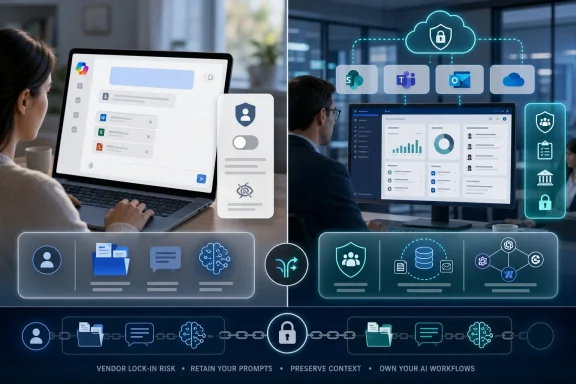
Nadella’s argument was not that every consumer who asks Copilot for recipe ideas or Windows troubleshooting has surrendered their intellectual independence. He was describing the reverse information paradox: a firm uses an external model to process proprietary knowledge, but does not retain the prompts, context, interaction metadata, workflows, or model-independent representations that would let it preserve that learning as its own asset.
TechCrunch’s reporting on the CNN interview captured the central point: Nadella said companies should retain the metadata surrounding model use so they could potentially train their own weights or move to another model. He also argued that keeping the harness—the application layer that orchestrates prompts, tools, policies, and outputs—separate from the model would let organizations use several models rather than become captive to one.
That is a sensible enterprise architecture principle. A company whose customer-support agent, document retrieval system, workflow automations, prompt library, evaluation suite, and conversational history all exist only inside a single provider’s proprietary environment has created a dependency even if its raw documents remain in SharePoint or an internal database.
Nadella used the phrase “token capital” for the AI capability a firm builds and owns. It is an imprecise term, but the practical meaning is clear: a company’s accumulated AI work—task-specific context, carefully tested prompts, proprietary datasets, agents, quality measurements, and user feedback—can become an asset. If it cannot be exported or reused elsewhere, the company has paid to create value that chiefly strengthens its supplier relationship.
Windows Latest is right to point out the tension between that message and Microsoft’s aggressive Copilot push across Windows and Microsoft 365. But the more important finding is that Nadella did not present a consumer data-protection doctrine in that interview. He explicitly separated consumer markets, where he said there can be a data-for-service exchange, from the stricter protections he believes firms require.
That is not a small qualification. It means the CEO’s strongest warning applies to organizations expected to protect commercial knowledge, not automatically to every person using Copilot on a Windows PC.
Microsoft’s consumer and commercial Copilot rules are materially different
Microsoft’s current Copilot privacy documentation draws a hard line between its consumer service and Copilot used with organizational accounts. For Microsoft 365 Copilot and Copilot Chat protected by enterprise data protection, Microsoft says prompts, responses, and data accessed through Microsoft Graph are not used to train the foundation models.
That covers the material most administrators are concerned about: documents, email, Teams chats, meetings, calendars, and other organizational data that Copilot can retrieve according to the user’s existing permissions. Microsoft also states that Copilot inherits Microsoft 365 identity, compliance, retention, and access-control mechanisms.
The caveat is not model training; it is access. Copilot respects the permissions an organization has already configured. If SharePoint sites, Teams channels, shared mailboxes, or OneDrive folders are broadly accessible when they should not be, Copilot can make those longstanding entitlement problems much easier for users to discover. Microsoft itself warns that overshared or poorly governed content can increase risk in Copilot results.
Consumer Copilot works differently. Microsoft’s privacy FAQ says that, for eligible signed-in consumer users, the company may use Copilot conversation and voice activity—including uploaded images and files—for AI training unless the user opts out. Microsoft says it removes or de-identifies certain personal information before training and excludes several categories, including users signed in with an organizational Entra ID account, people under 18, users who opt out, and users in specified countries.
So the statement that Microsoft “does not train on your data” is only accurate if it identifies the product and account type. It is accurate for protected Microsoft 365 commercial Copilot usage. It is not a universal description of consumer Copilot.
Windows users should therefore avoid assuming that the presence of the Copilot app on a work PC means the same privacy terms apply to every chat. Account identity, the Copilot surface being used, regional availability, and the relevant privacy setting all matter.
Model choice is real, but it is not universal portability
Windows Latest also frames Microsoft 365 Copilot as broadly offering businesses their preferred models, including OpenAI and Claude. Microsoft does provide options involving third-party models, but the practical scope is narrower and more conditional than that phrasing suggests.
Microsoft’s documentation says organizations can choose whether certain third-party models are used in Microsoft 365 Copilot experiences, including models supplied by OpenAI and Anthropic under Microsoft’s commercial terms. Yet the availability of Anthropic models in Word, Excel, and PowerPoint is specifically documented for customers in the European Union, European Free Trade Association countries, and the United Kingdom. Administrators control that access through settings for AI providers operating as Microsoft subprocessors.
There is another material detail: Microsoft says processing with Anthropic models in those Office experiences occurs outside the EU Data Boundary. Anthropic remains a Microsoft subprocessor under Microsoft’s product terms and Data Protection Addendum, but the geographic-processing consequence should be assessed by compliance teams rather than treated as a cosmetic model-selection feature.
This is why “multiple models” should not be confused with full portability. A tenant may be able to select a model for some experiences while remaining deeply dependent on Microsoft 365 identity, Graph retrieval, Copilot orchestration, audit tools, retention policies, and the particular feature’s regional availability. Model diversity can reduce one category of dependency; it does not automatically create an interchangeable AI stack.
For most enterprises, that is acceptable. Microsoft 365 Copilot is designed to deliver value precisely by connecting models to Microsoft Graph and Office workflows. The mistake is pretending that the resulting system is provider-neutral by default.
What administrators should check before Copilot becomes institutional memory
Nadella’s broader point becomes useful when turned into governance questions rather than rhetoric. Before expanding Copilot or agent deployments, IT teams should be able to answer a few basic questions in writing:
- Can the organization export its prompts, agent instructions, evaluations, conversation history, and operational telemetry in usable formats?
- Are Copilot responses grounded only in data each employee should be able to access, and have SharePoint, Teams, OneDrive, and Exchange permissions been reviewed for oversharing?
- Which features invoke a Microsoft-hosted model, an OpenAI model, an Anthropic model, web search, or another external service, and where is each category of data processed?
- Do business-critical agents have documented fallback behavior if a model, connector, API, or licensing arrangement changes?
- Are employees clear on when they are signed into a consumer Copilot experience versus a commercially protected Microsoft 365 Copilot experience?
The last point is especially important on Windows PCs where consumer and work tools can coexist. A user may reasonably assume that anything carrying the Copilot name follows the same policy. It does not. Organizations should set an explicit policy for personal accounts, browser-based public AI services, file uploads, and the use of Copilot consumer features on managed endpoints.
Microsoft’s documentation supports a stronger conclusion than the one in the Windows Latest headline: commercial Copilot customers have meaningful contractual and technical protections against foundation-model training on their Microsoft 365 content. But those protections are only one part of AI governance. They do not resolve poor data permissions, supplier concentration, regional processing requirements, or the loss of reusable organizational knowledge inside proprietary workflows.
The consumer issue is consent and clarity, not a slogan about thinking
The consumer concern is still legitimate, just different. A personal Copilot user should know whether conversation activity, voice activity, uploaded files, personalization, and diagnostic data are being retained or used under the account’s available settings. Microsoft says users can control whether eligible consumer conversations are used for model training, while conversation history is stored by default and can be deleted.
But calling ordinary AI use “outsourcing your thinking” risks obscuring the actionable issue. People have always outsourced parts of cognition—to search engines, calculators, spell-checkers, maps, and cloud storage. The new questions are whether a service retains the interaction, whether it uses it to improve models, whether the user can opt out, how long it is kept, and whether the person understands the difference between a personal and work account.
For enterprises, the bar is higher. A firm does not need to build its own frontier model to heed Nadella’s warning. It needs to retain control of the data, context, access rules, quality checks, and business logic that make AI useful in the first place. That is the part of the company’s AI operation worth owning—and the part administrators should verify before Copilot becomes embedded in daily work.