
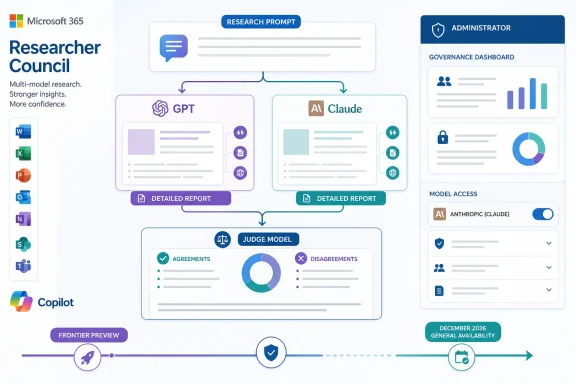
Microsoft’s Microsoft 365 Roadmap now places Researcher Council on a December 2026 general-availability track, but organizations already enrolled in the Copilot Frontier program have been able to use the multi-model comparison mode since March 30. The important operational point is that this is not a new Researcher agent arriving in December: it is a presently experimental mode that sends one research request to OpenAI and Anthropic reasoning models in parallel, keeps the full reports, and adds a machine-generated summary of their agreements and disagreements.
Roadmap item 553213, updated August 4, remains marked “In development” for worldwide standard multi-tenant customers on desktop and web. It lists a March 2026 preview and December 2026 general availability across Preview, Targeted Release, and General Availability rings. That schedule aligns with Microsoft’s broader Frontier-to-preview-to-GA model, but it also means a tenant may see a public roadmap date without being entitled to turn the feature on today.
Microsoft’s March announcement and its current support documentation make the present boundary clearer: Council is a Frontier feature, requires a Microsoft 365 Copilot license, and depends on an administrator allowing Anthropic models in the tenant. The March Message Center notice described the entitlement as “Microsoft 365 Copilot (Premium),” while the current support guidance says only “Microsoft 365 Copilot license.” Microsoft has not used the roadmap entry to explain whether those labels represent a different SKU, a renamed entitlement, or simply imprecise rollout terminology. Admins should verify actual access in their tenant rather than treating the December date as a licensing promise.
Microsoft describes Council as Model Council in the Researcher model picker. A user submits a single prompt, Researcher runs it through GPT and Claude-based deep-reasoning agents at the same time, and each produces a complete standalone report with its own citations and framing. A separate judge model then writes what Microsoft calls a “cover letter,” identifying common conclusions, disagreements, and findings unique to either report.
That makes Council materially different from Microsoft’s paired Critique feature, which uses one model to draft and another to review and refine the result before it is delivered. Critique tries to improve one final answer; Council deliberately preserves competing answers so the user can inspect where the models diverged.
The two functions have been announced and administered together. Microsoft’s Message Center post tied Council to roadmap ID 553213 and Critique to roadmap ID 558538, saying both are enabled when a tenant allows Anthropic and Claude report generation. It also said there are no separate switches to enable one and block the other. That is a significant deployment detail omitted from the public roadmap card: an organization cannot simply trial Council as a narrow feature toggle while leaving Critique out of scope.
The user experience also has a defined limitation. Microsoft’s support documentation says model choice, including Model Council, is available in the Microsoft 365 Copilot desktop and web apps. Researcher itself can be available in other surfaces, including mobile, but the Council picker should not be assumed to follow users wherever the Researcher agent appears. The roadmap’s desktop-and-web platform listing is therefore more meaningful than it first looks.
But agreement between models is not the same as corroboration between sources. The two research agents are independent report generators, yet they start from the same prompt, operate within Microsoft’s Researcher workflow, and may rely on overlapping web results or the same internal tenant material. A judge model’s synthesis can make a convergence look especially persuasive even when both reports inherited the same incomplete source record.
That distinction changes how Council should be used in high-stakes work. The practical value is in reviewing the underlying citations, identifying whether the models used genuinely distinct evidence, and investigating the exact claims where they diverge. The cover letter is a triage layer, not an audit trail sufficient for approving a legal position, material financial decision, security control, or public statement.
Microsoft itself presents Council as a mechanism to compare facts, citations, and analytical framings that one model might overlook or weigh differently. That is a sensible productivity feature. It does not establish that either model’s cited evidence is authoritative, current, or appropriately scoped to the decision at hand.
For Windows and Microsoft 365 administrators, the same caution applies to internal data. Two reports that draw on the same SharePoint libraries, Teams messages, Microsoft Graph content, and connector data can repeat a permissions problem, stale policy document, or bad source file twice. Council makes the inconsistency between models easier to see; it does not cure poor information governance.
Microsoft’s Researcher documentation says the agent remains within the Microsoft 365 commercial data-processing boundary and inherits existing Microsoft 365 security, privacy, and compliance commitments. But that statement should not be mistaken for a blanket finding that every organization’s own policy permits third-party model use. The tenant’s contract terms, regional obligations, data classifications, legal holds, and data-loss-prevention rules still determine whether this is acceptable for a given user population and workload.
The feature also changes the data path in a way that support teams need to understand. A normal Researcher request may now involve a GPT report, a Claude report, and a judge-model synthesis rather than a single answer-generation pass. Microsoft’s public Council material does not specify which exact model versions will be used at general availability, how model selection may evolve before December, or whether all eventual model combinations will have identical data-processing characteristics. Frontier documentation explicitly warns that experimental features can change or be removed before broader release.
That leaves a gap between the roadmap’s broad “worldwide” label and the configuration work needed in real tenants. “Worldwide standard multi-tenant” means Microsoft has placed the planned feature on that cloud-instance track; it does not mean every licensed user in every worldwide tenant will receive Council automatically, nor that regulated sovereign or government environments are included.
A useful pilot should include users who already produce research-heavy deliverables and reviewers who can judge whether the extra report actually improves decisions. The success measure should not be “two models agreed.” It should be whether Council found missing sources, exposed a faulty assumption, reduced rework in a documented review process, or helped an analyst explain why a conclusion remained uncertain.
Administrators should also verify the basics before assigning users:
For tenants that have not enabled Anthropic access, the immediate consequence is simple: Council will remain unavailable regardless of a user’s interest in multi-model research. For tenants that do enable it, the question is whether the added comparison view improves the quality of a controlled research process enough to justify another model provider in that process. December may remove the experimental label, but it will not remove the need to check the evidence behind the consensus.
Microsoft’s March announcement and its current support documentation make the present boundary clearer: Council is a Frontier feature, requires a Microsoft 365 Copilot license, and depends on an administrator allowing Anthropic models in the tenant. The March Message Center notice described the entitlement as “Microsoft 365 Copilot (Premium),” while the current support guidance says only “Microsoft 365 Copilot license.” Microsoft has not used the roadmap entry to explain whether those labels represent a different SKU, a renamed entitlement, or simply imprecise rollout terminology. Admins should verify actual access in their tenant rather than treating the December date as a licensing promise.
 Council is a comparison workflow, not a second opinion from a human reviewer
Microsoft describes Council as Model Council in the Researcher model picker. A user submits a single prompt, Researcher runs it through GPT and Claude-based deep-reasoning agents at the same time, and each produces a complete standalone report with its own citations and framing. A separate judge model then writes what Microsoft calls a “cover letter,” identifying common conclusions, disagreements, and findings unique to either report.That makes Council materially different from Microsoft’s paired Critique feature, which uses one model to draft and another to review and refine the result before it is delivered. Critique tries to improve one final answer; Council deliberately preserves competing answers so the user can inspect where the models diverged.
The two functions have been announced and administered together. Microsoft’s Message Center post tied Council to roadmap ID 553213 and Critique to roadmap ID 558538, saying both are enabled when a tenant allows Anthropic and Claude report generation. It also said there are no separate switches to enable one and block the other. That is a significant deployment detail omitted from the public roadmap card: an organization cannot simply trial Council as a narrow feature toggle while leaving Critique out of scope.
The user experience also has a defined limitation. Microsoft’s support documentation says model choice, including Model Council, is available in the Microsoft 365 Copilot desktop and web apps. Researcher itself can be available in other surfaces, including mobile, but the Council picker should not be assumed to follow users wherever the Researcher agent appears. The roadmap’s desktop-and-web platform listing is therefore more meaningful than it first looks.
Model agreement is useful evidence, but it is not independent verification
The sales pitch for Council is straightforward: if two leading models reach the same conclusion, a user can make a higher-confidence decision; if they disagree, the disagreement is visible rather than concealed behind one polished answer. For a procurement comparison, market brief, policy analysis, or incident postmortem, that can surface assumptions that a single-model workflow would never force the user to confront.But agreement between models is not the same as corroboration between sources. The two research agents are independent report generators, yet they start from the same prompt, operate within Microsoft’s Researcher workflow, and may rely on overlapping web results or the same internal tenant material. A judge model’s synthesis can make a convergence look especially persuasive even when both reports inherited the same incomplete source record.
That distinction changes how Council should be used in high-stakes work. The practical value is in reviewing the underlying citations, identifying whether the models used genuinely distinct evidence, and investigating the exact claims where they diverge. The cover letter is a triage layer, not an audit trail sufficient for approving a legal position, material financial decision, security control, or public statement.
Microsoft itself presents Council as a mechanism to compare facts, citations, and analytical framings that one model might overlook or weigh differently. That is a sensible productivity feature. It does not establish that either model’s cited evidence is authoritative, current, or appropriately scoped to the decision at hand.
For Windows and Microsoft 365 administrators, the same caution applies to internal data. Two reports that draw on the same SharePoint libraries, Teams messages, Microsoft Graph content, and connector data can repeat a permissions problem, stale policy document, or bad source file twice. Council makes the inconsistency between models easier to see; it does not cure poor information governance.
The real deployment decision is whether to permit Anthropic processing
Council carries a more substantive tenant decision than choosing a new button in an AI interface. Microsoft says administrators must allow Anthropic AI models before users can select Claude in Researcher. Its earlier Message Center notice explicitly identified admins managing third-party model access as an affected group and advised them to review their organization’s governance and compliance requirements before enabling the paired Critique and Council capabilities.Microsoft’s Researcher documentation says the agent remains within the Microsoft 365 commercial data-processing boundary and inherits existing Microsoft 365 security, privacy, and compliance commitments. But that statement should not be mistaken for a blanket finding that every organization’s own policy permits third-party model use. The tenant’s contract terms, regional obligations, data classifications, legal holds, and data-loss-prevention rules still determine whether this is acceptable for a given user population and workload.
The feature also changes the data path in a way that support teams need to understand. A normal Researcher request may now involve a GPT report, a Claude report, and a judge-model synthesis rather than a single answer-generation pass. Microsoft’s public Council material does not specify which exact model versions will be used at general availability, how model selection may evolve before December, or whether all eventual model combinations will have identical data-processing characteristics. Frontier documentation explicitly warns that experimental features can change or be removed before broader release.
That leaves a gap between the roadmap’s broad “worldwide” label and the configuration work needed in real tenants. “Worldwide standard multi-tenant” means Microsoft has placed the planned feature on that cloud-instance track; it does not mean every licensed user in every worldwide tenant will receive Council automatically, nor that regulated sovereign or government environments are included.
A small pilot should test evidence quality and support burden
Organizations considering Council before general availability should treat the existing Frontier availability as a controlled evaluation, not as a universal productivity rollout. Microsoft says the Frontier program is early access for experimental features, and its own lifecycle description says such capabilities can change, expand, or be removed based on feedback before they move to preview and then GA.A useful pilot should include users who already produce research-heavy deliverables and reviewers who can judge whether the extra report actually improves decisions. The success measure should not be “two models agreed.” It should be whether Council found missing sources, exposed a faulty assumption, reduced rework in a documented review process, or helped an analyst explain why a conclusion remained uncertain.
Administrators should also verify the basics before assigning users:
- Confirm that the intended users have a Microsoft 365 Copilot license and are eligible for the Frontier program.
- Review and explicitly decide whether Anthropic model access is permitted for the selected cohort.
- Test whether Researcher’s existing web-search and work-data controls yield appropriate source material before evaluating Council’s synthesis.
- Update helpdesk guidance so users understand that Model Council lives in the Researcher model picker and is not a general Copilot Chat setting.
- Require users to retain and inspect both full reports for high-impact work rather than copying the cover letter into a final deliverable.
December 2026 is the support milestone, not the starting gun
The roadmap’s most consequential update is the separation between what is already available experimentally and what Microsoft intends to support broadly in December 2026. Microsoft’s own documentation confirms that Council is live for Frontier users now, while roadmap ID 553213 confirms that the feature has not completed its general-availability journey.For tenants that have not enabled Anthropic access, the immediate consequence is simple: Council will remain unavailable regardless of a user’s interest in multi-model research. For tenants that do enable it, the question is whether the added comparison view improves the quality of a controlled research process enough to justify another model provider in that process. December may remove the experimental label, but it will not remove the need to check the evidence behind the consensus.
References
- Primary source: Microsoft 365 Roadmap
Published: 2026-08-04T22:45:42.5590566Z
Loading…
www.microsoft.com - Related coverage: microsoft.com
Loading…
www.microsoft.com - Related coverage: support.microsoft.com
Loading…
support.microsoft.com - Related coverage: techcommunity.microsoft.com
Loading…
techcommunity.microsoft.com - Related coverage: techcommunity.microsoft.com
Loading…
techcommunity.microsoft.com - Related coverage: office-watch.com
Loading…
office-watch.com - Related coverage: ft.dfs.un.org
Loading…
ft.dfs.un.org - Related coverage: cdn-dynmedia-1.microsoft.com
- Related coverage: learn.microsoft.com
May 2026 announcements - Partner Center announcements | Microsoft Learn
May 2026 announcements for Microsoft Partner Center including new capabilities, promotions, offers, markets, or changes to existing offers.learn.microsoft.com - Related coverage: learn.microsoft.com
Loading…
learn.microsoft.com - Related coverage: support.microsoft.com
Use model choice in the Researcher agent | Microsoft Support
Use model choice in the Researcher agentsupport.microsoft.com