
The agreement, reported by Seoul Economic Daily and attributed to KT, assigns KT responsibility for identifying AI transformation work and building and operating an AI Contact Center. Nonghyup Agribusiness Group is to supply operational data and a test environment, while Microsoft Korea is to provide Azure and associated AI and cloud implementation support.
This is a meaningful Microsoft enterprise win in South Korea’s retail sector, but it is a signed implementation framework rather than evidence of a live autonomous shopping or service system. KT and its partners have not published deployment dates, the Azure AI services or language models to be used, expected transaction volumes, pricing, service-level commitments, or the guardrails that will determine what an AI agent may do when it handles orders and delivery requests.
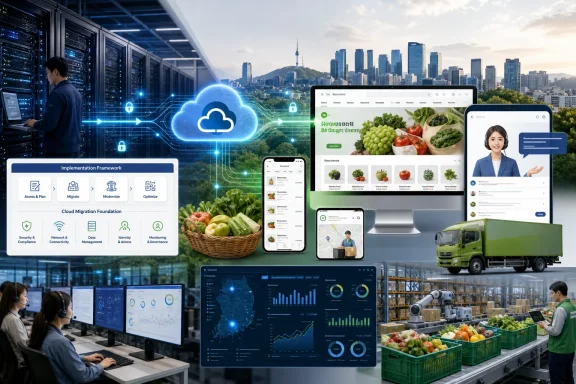 NH Singsing Mall is the foundation, not the finished AI project
The partnership grows out of NH Singsing Mall’s migration from an on-premises environment to Azure. According to Seoul Economic Daily, KT moved the marketplace’s systems, infrastructure, networking and security environment to Microsoft’s public cloud before the renewed mall launched in July.
That sequencing matters. Recommendation engines, customer-service agents and marketing systems require access to dependable product, order and customer data. Moving an e-commerce site to a cloud platform does not automatically create that data foundation, but it can consolidate the operational environment needed to build one.
For Nonghyup, which sells agricultural products through a marketplace rather than operating a conventional general-merchandise storefront, the quality and freshness of product information could become as important as the AI interface itself. Agricultural listings can involve seasonal supply, origin details, delivery constraints and variable inventory. A recommendation or support agent that draws from stale catalog data can create a more expensive customer-service problem than the one it was meant to solve.
The companies have not said whether the new platform includes a unified product-information system, real-time inventory integration, customer identity resolution, or a process for correcting AI-generated answers. Those are not peripheral details. They decide whether a retail assistant becomes a useful transactional service or remains a chat layer over disconnected back-office systems.
The stated AI use cases put the burden on operational controls
KT’s description covers three closely related tasks: personalized recommendations, marketing based on customer and order data, and agents that can understand customer inquiries, confirm orders and provide delivery updates. The first two are familiar retail analytics workloads. The third is the more consequential one because it pushes AI into customer-facing operational processes.
An AI Contact Center can range from a conventional chatbot that answers common questions to a system that retrieves order status from internal databases, initiates service workflows and hands difficult cases to human agents. KT has not clarified where Nonghyup’s planned service will fall on that scale.
The phrase agentic AI should therefore be read carefully. It describes a system designed to pursue multistep tasks, but the announcement does not establish that the planned agents will be authorized to change orders, issue refunds, alter delivery instructions or take other actions with financial consequences. It only says they are intended to handle inquiries, order confirmations and delivery updates.
That distinction will matter to shoppers and administrators. Informational automation generally depends on accurate retrieval and clear escalation. Transactional automation requires permissions, audit trails, identity verification, approval rules, exception handling and an unambiguous way to stop an incorrect action. None of those controls were described by KT, Nonghyup or Microsoft Korea.
For IT leaders watching the project, the important future disclosures will not be the number of AI features announced. They will be whether the partners identify which systems remain the source of truth for orders and logistics, how agents authenticate callers, what data is made available to models, how long conversation and customer data are retained, and when a human agent must take over.
Microsoft’s role follows a wider KT cloud and AI strategy
This deal did not emerge from a one-off Azure sales effort. Microsoft and KT have been building a broader strategic relationship around Korean AI services, cloud infrastructure and enterprise AI transformation.
KT’s 2024 filing with the U.S. Securities and Exchange Commission described its Microsoft strategic partnership as covering joint development of Korean AI models and services, a Korea-specific secure public cloud, an AI transformation services business, research and development, startup investment and talent-development work. The filing also described a $450 million infrastructure supply agreement involving KT and KT Cloud. That agreement is wider than the Nonghyup project, but it explains why KT is positioned here as the prime transformation operator while Microsoft Korea supplies cloud and AI technology.
Microsoft’s partner organization also disclosed earlier this year that KT and Microsoft had jointly won an agricultural-sector e-commerce engagement. In that account, a KT go-to-market executive called it Microsoft Korea’s largest e-commerce deal, while presenting the size characterization as his understanding rather than a formal Microsoft financial disclosure. Neither company has publicly attached a contract value to the Nonghyup work.
The August agreement appears to turn that earlier commercial foothold into a more visible retail AI case study. Microsoft Korea gains a local operator with telecommunications, systems-integration and contact-center capabilities; KT gains Azure-backed AI offerings it can package for Korean enterprises; and Nonghyup gets a route to modernize a marketplace without running a full cloud and AI transformation program alone.
But the division of labor also creates a familiar accountability challenge. A customer whose order status is wrong will see one Nonghyup experience, not separate KT, Microsoft and retailer components. The partners will need to make their operational handoffs invisible in practice, particularly if support spans web commerce, delivery systems and human contact-center staff.
What has not been disclosed is the real implementation checklist
The public announcement is rich in ambition and sparse on operating detail. That is normal for a memorandum or business agreement, but it limits what can be inferred about the maturity of the deployment.
The companies have not disclosed whether the AI services will be available to all NH Singsing Mall customers or launched in a limited pilot. They have not named a launch schedule, target metrics, external AI model provider, data-residency arrangement, support channels, or the number of customer-service interactions expected to be automated.
They also have not said how existing customer information will be used for individualized marketing. South Korea’s Personal Information Protection Act imposes obligations around collection, use, consent and safeguards for personal information. A retail system combining customer profiles, purchase records and delivery data needs governance designed before campaigns and agents move into production, rather than after a consumer complaint or a faulty recommendation exposes a gap.
Microsoft’s Azure platform offers services that could support the project, including cloud hosting, data platforms, AI model hosting and contact-center integrations. Yet the announcement does not name any of them beyond Azure. Readers should not assume that Microsoft 365 Copilot, Azure OpenAI Service, Copilot Studio, Dynamics 365, Fabric or a particular foundation model has been selected simply because those products commonly appear in enterprise AI deployments.
The absence of technical specifics makes this a business-development announcement, not a migration or implementation playbook. It also means there is no basis yet to judge whether the project will reduce service costs, improve conversion, raise average order value or produce better delivery outcomes.
The first measurable test will be whether the cloud move improves service reliability
KT is presenting the NH Singsing Mall Azure migration as the starting point for AI-powered retail innovation. That is a reasonable order of operations, but the partnership will be judged first on ordinary e-commerce reliability: correct inventory, current order information, dependable delivery notices and rapid recovery when a system or integration fails.
A polished AI assistant cannot compensate for a weak order-management link. In fact, it can multiply the effect of inaccurate data by delivering confident but incorrect answers at scale. KT’s planned role operating the AI Contact Center puts it close to the point where those failures become visible.
The next substantive update should therefore include the first production feature, its rollout scope and the controls around it. Until then, the news is that a major Korean agricultural retailer has chosen KT and Microsoft Korea to build toward AI-enabled commerce on Azure—not that autonomous retail service has already arrived.
