
That distinction is easy to lose in a broad announcement about “tool-augmented measurement.” It matters because CARE-X is a unified research vision-language model built around SigLIP2 and Phi-4-mini-instruct, while the measurement work is an inference-time orchestration system around a different model. Neither is a Microsoft product, neither is a cleared medical device, and Microsoft explicitly says neither is intended for diagnosis, screening, patient care, or clinical decision-making.
The underlying CARE-X paper was posted to arXiv on August 4, 2026, and Microsoft Research detailed the work on August 11. The paper’s central contribution is credible as a research direction: bring free-text generation, probability-producing classification heads, and localization heads into a shared model rather than treating them as completely separate systems. But the clinical claims remain retrospective and incomplete in precisely the area that determines whether a high-recall triage system can be useful rather than merely impressive.
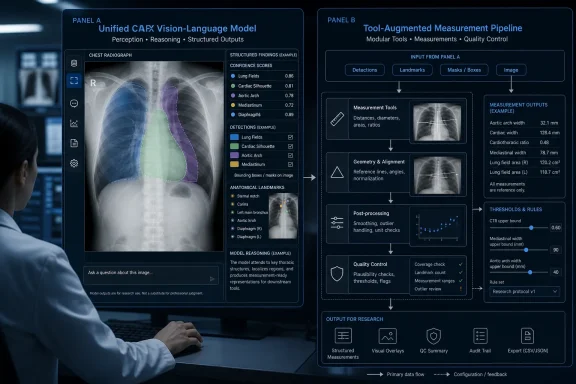 CARE-X tries to give one model two kinds of answers
Most chest X-ray AI falls into one of two categories. A discriminative model returns a predefined label and probability—say, whether a pneumothorax is likely present—while a generative vision-language model writes an answer or a radiology-style report. The former supports a threshold that can be moved toward sensitivity or specificity; the latter is more flexible, but “probably no acute finding” is not an operational confidence score that a hospital can safely route through a workflow.
CARE-X uses what Microsoft calls dual inference for selected tasks. A single pass can generate natural-language output while also feeding task-specific heads that return a structured classification score or a bounding box with a confidence value. The intended advantage is practical: a radiologist could receive a narrative finding while an upstream workflow uses a calibrated score to decide whether the case joins a high-priority worklist.
The model covers report findings and impressions, presence and negation questions, disease locations, multilabel abnormalities, tube and line identification, abnormal device placement, phrase grounding, and localization of 29 anatomical regions. For Windows and IT professionals accustomed to evaluating AI features, the important point is that this is not a single “chat with an X-ray” interface. It is a multi-task model with distinct outputs designed for different downstream uses.
Microsoft Research says the auxiliary heads are co-trained with the language model rather than bolted on after the fact. Its premise is that forcing the shared backbone to learn explicit classification and geometry strengthens the model’s internal representation, improving the generated answer too. The researchers then apply DAPO, or Decoupled Clip and Dynamic Sampling Policy Optimization, to reward task-level results for reporting, visual question answering, and grounding instead of relying solely on token-by-token language-model loss.
That is a sensible target. In radiology, reversing “no” to “yes,” losing a negation, or naming the wrong side of the chest is not comparable to an awkwardly phrased sentence. A language model’s usual training objective is poorly aligned with that difference. CARE-X attempts to make the error signal reflect clinical content and spatial accuracy.
The public leaderboard supports the VQA claim, but not a blanket report-generation lead
Microsoft’s strongest externally checkable result is on ReXrank’s ReXVQA leaderboard. As of August 11, CARE-X sits first in the visual-question-answering challenge, ahead of Stanford’s CheXOne-R1 and Google’s MedGemma-4B-it. The listed overall accuracy is 0.94, versus 0.8803 for CheXOne-R1—consistent with Microsoft’s claim of about a six-percentage-point lead.
The ReXrank result is meaningful because it is a public benchmark rather than a metric available only in Microsoft’s presentation. It also exposes the model’s real strength: it leads across the VQA categories listed by the site, including negation, presence, location, differential diagnosis, and geometric information. Negation and location are exactly where a superficially fluent report can become clinically wrong.
The report-generation picture is more mixed than a casual reading of the announcement suggests. Microsoft’s paper says CARE-X leads on the majority of metrics in its four-benchmark comparison and describes the CRIMSON scoring system as a held-out clinical metric. That is the researchers’ reported evaluation, and it is not contradicted merely because models trade places across datasets and scoring methods.
But ReXrank’s current report-generation leaderboard does not show CARE-X as the universal leader. CARE-X is first on IU-Xray, second on ReXGradient and MIMIC-CXR, and third on CheXpert Plus. Deepwise-RG holds first place on three of those four columns. On ReXrank’s detailed ReXGradient performance table, CARE-X’s CRIMSON score is also lower than Deepwise-RG’s displayed score.
This is less a fatal contradiction than a reminder to read AI leaderboards precisely. “Best on most metrics in a comparison set” and “first on the public leaderboard” are different assertions. CARE-X can legitimately claim the leading ReXVQA VQA position as of August 11; it cannot be summarized accurately as the dominant report-generation model across the public ReXrank board.
The measurement results belong to a separate Qwen pipeline
The most dramatic numbers in Microsoft’s announcement are a 43.6-percentage-point average F1 improvement over perception-only inference for five measurement-dependent conditions. For descending aorta enlargement, the reported result moves from 28.57 F1 to 100.00; for ascending aorta enlargement, from 39.33 to 100.00.
Those figures do not describe CARE-X. The experiment pairs Qwen3-VL-4B-Instruct with deterministic tools that identify landmarks, calculate measurements, and apply diagnostic thresholds while the vision-language model retains access to the X-ray. In plain terms, the model decides what to measure, but code performs the arithmetic.
That division of labor is the article’s most useful technical idea. A visual model estimating whether an aorta “looks enlarged” and a system calculating a defined width from identified landmarks are solving different problems. The latter makes its quantitative step inspectable and reproducible. It can also be audited: an institution can see the landmarks, the values returned, the threshold applied, and the final conclusion instead of accepting a text-only rationale.
The approach is particularly relevant for chest radiographs because projection and positioning can distort apparent anatomy. The American College of Radiology’s cardiothoracic-ratio use case recognizes the distinction between posterior-anterior and anterior-posterior studies, including a modified ratio for AP radiographs. AP images can magnify the cardiac silhouette; patient rotation, inspiration, exposure, and portable ICU acquisition add further complications. A measurement tool may reduce calculation error, but it does not automatically solve landmark-selection error, image-quality limitations, or the validity of applying a threshold across varying projections.
Microsoft acknowledges some of those issues in its description of the pipeline. What remains unclear is how it handles them in a clinical-grade system: there is no published workflow for rejecting poor-quality studies, no stated calibration procedure by view type or patient population, and no prospective evidence showing how often a measurement-driven alert would change care appropriately.
High recall is a starting point, not a screening result
The Narayana Health evaluations are valuable because they move beyond the familiar public chest X-ray datasets. Microsoft reports testing CARE-X on 1,047 de-identified inpatient and ICU radiographs from the Indian hospital group, including rare high-acuity findings such as fracture, mediastinal shift, pneumoperitoneum, pneumothorax, and incorrectly placed tubes or lines. CARE-X showed the best sensitivity in three of five categories in Microsoft’s table, although specificity was uneven—0.64 for fracture and 0.77 for abnormal tube-and-line placement.
A second retrospective cohort included 122 CT-confirmed positive cases for enlargement-related findings. Microsoft says its tool-assisted variant reached 94.26% recall, 10.65 percentage points above its strongest perception-only baseline. It also cites a related EACTS 2026 study in which the measurement-driven approach detected 40 of 43 CT-confirmed mild aortic-dilation cases, while initial radiology reports mentioned only five.
The promising result is the possibility of surfacing incidental disease that was not the original reason for a chest X-ray. Yet the 122-case cohort was selected for positives to measure recall. Microsoft says an extended study with CT-confirmed negative cohorts is underway. Until that work reports specificity, positive predictive value, referral burden, and performance on consecutive real-world exams, the 94.26% recall number cannot establish a screening tool’s usefulness.
A system that flags nearly every patient can approach perfect recall while overwhelming clinicians and advanced-imaging capacity. The fact that the researchers state this limitation plainly is welcome. It also means the announcement’s language about reducing unnecessary referrals is still a hypothesis, not a demonstrated outcome.
Independent chest-radiograph research supports the underlying premise that quantitative aortic assessment is worth studying. A 2025 diagnostic study reported an AI system with area-under-the-curve values around 0.88 to 0.89 for ascending aortic dilation on external PA chest X-ray cohorts. Another recent CT-based study found that a conservative chest-X-ray threshold could achieve 100% sensitivity for aortic arch dilation, but with 54% specificity. That trade-off is exactly why CARE-X’s positive-only measurement cohort cannot answer the deployment question.
No product, no clearance, and no implementation path yet
CARE-X is research software, not a feature for Azure AI, Power Platform, Windows, Nuance, or a Microsoft healthcare offering. Microsoft has not announced model weights, an API, licensing terms, supported imaging formats, on-premises requirements, PACS/RIS integration, data-retention controls, or a regulatory submission plan. Organizations should not mistake the use of a Phi-family language model for evidence that CARE-X is heading toward a supported Microsoft stack.
There is also no peer-reviewed publication yet; the technical record is an August 4 arXiv preprint, supplemented by Microsoft Research’s account of its experiments. No other independent reporting appears to have published the specific Narayana Health results or the timing of any possible productization. The ReXrank VQA ranking provides outside confirmation of the benchmark result, but it does not validate the hospital cohorts or convert retrospective research into clinical evidence.
The practical takeaway is narrower and more useful than the announcement’s broad vision. CARE-X suggests that radiology AI may work better when it produces both language and machine-readable confidence scores, while measurement-heavy findings should be calculated with deterministic tools rather than inferred from visual intuition alone. The next material evidence will be a negative-control cohort, prospective evaluation across institutions and acquisition types, and a clear account of false positives—not another benchmark score.