
IFI Techsolutions says it has achieved Microsoft’s Cloud Security specialization, a partner credential that can help the Mumbai-based managed-services provider surface in Microsoft sales channels. But the August 6 announcement distributed by PRNewswire and carried by ANI appears to describe a credential the company had already announced on April 7, 2026—and it labels the designation “Azure Cloud Security,” while Microsoft’s own partner program calls it simply Cloud Security.
That does not establish that IFI’s standing has lapsed or that its claim is false. It does mean this is not clearly a newly awarded Azure-specific specialization, as the ANI headline suggests. IFI’s earlier company post and a later LinkedIn announcement both state that it earned the Microsoft Cloud Security specialization, with substantially the same broad claims about identity, threat protection, governance, and Microsoft cloud security services.
For enterprise customers evaluating an Azure security partner, the distinction is practical: Microsoft’s specialization validates a partner organization’s qualifications and prior customer work, not the security posture of any particular tenant, landing zone, Sentinel deployment, or managed detection service contract.
Microsoft’s partner site lists Cloud Security as one of its Security specializations. It is aligned with the Solutions Partner for Security designation and is intended to indicate demonstrated capability across Azure, hybrid, and multicloud security engagements. The designation is not called “Microsoft Azure Cloud Security specialization,” even though Azure security workloads form a material part of the qualification criteria.
IFI’s April 7 blog post used the official “Microsoft Cloud Security Specialization” wording. Its August 6 PRNewswire release, published by ANI with an explicit advertorial disclaimer, switches to “Microsoft Azure Cloud Security specialization” and presents the accomplishment as a fresh event.
The two descriptions may be marketing shorthand for the same designation, rather than two separate credentials. Microsoft’s program materials do not identify a separate, currently named “Azure Cloud Security” specialization alongside Cloud Security. The company has not said whether the August announcement reflects a renewal, a revalidation, a change in program requirements, or merely a renewed public-relations push.
That missing detail matters because specializations are status-based partner designations, not permanent product certifications. They have qualification and renewal rules. A customer looking to use IFI for a Microsoft Sentinel SOC, Entra identity design, Defender for Cloud rollout, or Azure landing-zone review should ask for the specialization’s current Partner Center status and validity dates—not rely only on a press release.
The current public program documentation describes a $200,000 trailing-12-month Azure consumed-revenue threshold tied to relevant security workloads. It also specifies that at least six people in the organization must hold the AZ-500 Azure Security Technologies certification and at least four must hold the SC-200 Security Operations Analyst certification. Microsoft allows the same people to count toward both totals where they hold both qualifications.
The customer evidence requirement is equally important. Microsoft says Cloud Security candidates must submit three references representing separate customer engagements. Its Partner Center documentation says those references exist to validate real customer success and depth of delivery, rather than simply a reseller’s licensing volume or staff certification count.
In other words, IFI’s achievement signals that Microsoft accepted evidence of organizational capacity, qualifying security-related Azure consumption, relevant skills, and customer engagements. It does not mean Microsoft has independently audited every customer environment named in the release, nor does it turn the provider into an insurer against breach, outage, misconfiguration, or regulatory failure.
IFI cites two examples: recovery of a real-estate customer’s digital platform following a security incident, and a centralized Microsoft Sentinel security-operations framework for a financial-services customer. The company has not named either customer, disclosed the incident type, stated which Sentinel data sources or automation workflows were deployed, or provided measurable results such as mean time to detect, mean time to respond, alert volume reduction, or containment time. Those omissions make the examples useful as indicators of service scope, but insufficient for independently assessing delivery outcomes.
Under the announced approach, an independent third-party auditor will assess whether partners can deliver Microsoft Security solutions in customer environments. Microsoft said the audit is partner-funded, performed every two years, and results in a Pass or No Pass outcome. Partners were to receive a six-month extension to their anniversary date to prepare for the new obligation.
The public requirements pages still emphasize the established combination of security designation, performance, skilling, and customer-reference gates. Microsoft’s July notice adds a further operational consequence: holding the status will increasingly depend on passing an external delivery audit, rather than exclusively on Partner Center’s reference and metrics workflow.
That puts IFI’s announcement in a different light. A Cloud Security specialization is becoming more expensive and more operationally demanding to retain. For a managed services firm selling continuous monitoring, Zero Trust identity controls, Defender, Sentinel, and Azure governance, the audit change will put more attention on whether documented practices match day-to-day service delivery.
IFI has not said whether it has completed an audit, scheduled one, or is operating under the transition extension Microsoft announced. It also has not stated the specialization’s expiration or renewal anniversary. Those are the relevant facts for customers considering a multi-year Azure security engagement.
Still, the specialization does not answer the operational questions that decide whether an engagement succeeds. A buyer should look for evidence tied to its own estate:
The announcement’s value is therefore commercial rather than technical: it gives IFI a Microsoft-recognized credential it can use when competing for security consulting and managed-services work. Microsoft says specialized partners can receive a customer-facing label on their business profile and may be prioritized in Microsoft Marketplace customer searches, making the badge relevant to procurement discovery.
The more consequential date is not August 6, 2026, but IFI’s next specialization anniversary under Microsoft’s new audit regime. Until the company identifies what, if anything, changed between its April Cloud Security announcement and this week’s Azure-branded release, customers should treat this as confirmation of an already public partner credential—not evidence of a new Azure security product or a newly disclosed customer-security capability.
For enterprise customers evaluating an Azure security partner, the distinction is practical: Microsoft’s specialization validates a partner organization’s qualifications and prior customer work, not the security posture of any particular tenant, landing zone, Sentinel deployment, or managed detection service contract.
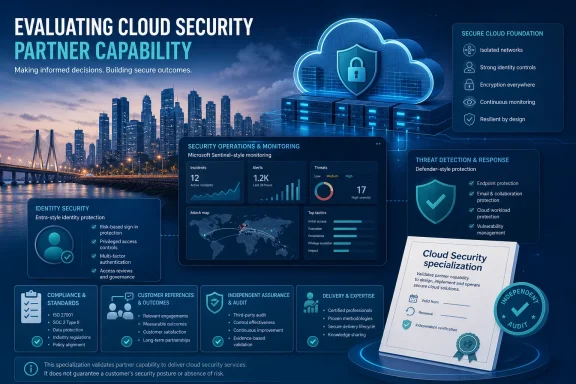 The credential’s official name is Cloud Security
Microsoft’s partner site lists Cloud Security as one of its Security specializations. It is aligned with the Solutions Partner for Security designation and is intended to indicate demonstrated capability across Azure, hybrid, and multicloud security engagements. The designation is not called “Microsoft Azure Cloud Security specialization,” even though Azure security workloads form a material part of the qualification criteria.IFI’s April 7 blog post used the official “Microsoft Cloud Security Specialization” wording. Its August 6 PRNewswire release, published by ANI with an explicit advertorial disclaimer, switches to “Microsoft Azure Cloud Security specialization” and presents the accomplishment as a fresh event.
The two descriptions may be marketing shorthand for the same designation, rather than two separate credentials. Microsoft’s program materials do not identify a separate, currently named “Azure Cloud Security” specialization alongside Cloud Security. The company has not said whether the August announcement reflects a renewal, a revalidation, a change in program requirements, or merely a renewed public-relations push.
That missing detail matters because specializations are status-based partner designations, not permanent product certifications. They have qualification and renewal rules. A customer looking to use IFI for a Microsoft Sentinel SOC, Entra identity design, Defender for Cloud rollout, or Azure landing-zone review should ask for the specialization’s current Partner Center status and validity dates—not rely only on a press release.
Microsoft’s bar is higher than a standard partner badge
IFI’s release is correct that the credential carries more requirements than simply joining the Microsoft AI Cloud Partner Program. Microsoft says partners must first hold an active Solutions Partner for Security designation, satisfy a performance threshold, meet skilling requirements, and submit customer references.The current public program documentation describes a $200,000 trailing-12-month Azure consumed-revenue threshold tied to relevant security workloads. It also specifies that at least six people in the organization must hold the AZ-500 Azure Security Technologies certification and at least four must hold the SC-200 Security Operations Analyst certification. Microsoft allows the same people to count toward both totals where they hold both qualifications.
The customer evidence requirement is equally important. Microsoft says Cloud Security candidates must submit three references representing separate customer engagements. Its Partner Center documentation says those references exist to validate real customer success and depth of delivery, rather than simply a reseller’s licensing volume or staff certification count.
In other words, IFI’s achievement signals that Microsoft accepted evidence of organizational capacity, qualifying security-related Azure consumption, relevant skills, and customer engagements. It does not mean Microsoft has independently audited every customer environment named in the release, nor does it turn the provider into an insurer against breach, outage, misconfiguration, or regulatory failure.
IFI cites two examples: recovery of a real-estate customer’s digital platform following a security incident, and a centralized Microsoft Sentinel security-operations framework for a financial-services customer. The company has not named either customer, disclosed the incident type, stated which Sentinel data sources or automation workflows were deployed, or provided measurable results such as mean time to detect, mean time to respond, alert volume reduction, or containment time. Those omissions make the examples useful as indicators of service scope, but insufficient for independently assessing delivery outcomes.
Microsoft is changing how Security specializations are checked
The timing of the August release comes amid a change in Microsoft’s partner-verification process. In a July 2026 Partner Center announcement, Microsoft said it was moving its four Security specializations—Cloud Security, Data Security, Identity and Access Management, and Threat Protection—to an audit-based model at the end of July.Under the announced approach, an independent third-party auditor will assess whether partners can deliver Microsoft Security solutions in customer environments. Microsoft said the audit is partner-funded, performed every two years, and results in a Pass or No Pass outcome. Partners were to receive a six-month extension to their anniversary date to prepare for the new obligation.
The public requirements pages still emphasize the established combination of security designation, performance, skilling, and customer-reference gates. Microsoft’s July notice adds a further operational consequence: holding the status will increasingly depend on passing an external delivery audit, rather than exclusively on Partner Center’s reference and metrics workflow.
That puts IFI’s announcement in a different light. A Cloud Security specialization is becoming more expensive and more operationally demanding to retain. For a managed services firm selling continuous monitoring, Zero Trust identity controls, Defender, Sentinel, and Azure governance, the audit change will put more attention on whether documented practices match day-to-day service delivery.
IFI has not said whether it has completed an audit, scheduled one, or is operating under the transition extension Microsoft announced. It also has not stated the specialization’s expiration or renewal anniversary. Those are the relevant facts for customers considering a multi-year Azure security engagement.
What customers should verify before treating the badge as a buying signal
The designation is a useful shortlisting signal, especially for organizations that want a Microsoft-aligned provider rather than a generalist MSP. IFI already describes itself as a Microsoft Solutions Partner and Azure Expert Managed Service Provider, and its April post said it could deliver identity, threat-protection, information-protection, and governance services across the Microsoft cloud.Still, the specialization does not answer the operational questions that decide whether an engagement succeeds. A buyer should look for evidence tied to its own estate:
- Ask whether IFI will provide named AZ-500- and SC-200-qualified staff for the engagement, rather than relying on organization-wide certification totals.
- Request an architecture that identifies Microsoft Sentinel ingestion sources, retention periods, analytic rules, automation playbooks, escalation paths, and any third-party SIEM or SOAR dependencies.
- Establish which security controls will be actively managed, including Microsoft Defender for Cloud, Defender XDR components, Entra Conditional Access, privileged access, Azure Policy, Key Vault, Firewall, WAF, and backup or recovery tooling.
- Require service-level commitments for critical alert acknowledgement, investigation, containment recommendations, and customer approvals, particularly where automated Sentinel responses could affect production workloads.
- Confirm the partner’s current specialization status and how its planned audit or renewal will affect service continuity.
The announcement is a validation claim, not a product launch
Nothing in the ANI release changes Windows, Microsoft 365, Azure, Defender, Entra, or Sentinel licensing and no new security capability is being delivered to IFI’s existing customers by virtue of the announcement alone. There is also no disclosed price, packaged service tier, geographic rollout, support model, or migration offer attached to it.The announcement’s value is therefore commercial rather than technical: it gives IFI a Microsoft-recognized credential it can use when competing for security consulting and managed-services work. Microsoft says specialized partners can receive a customer-facing label on their business profile and may be prioritized in Microsoft Marketplace customer searches, making the badge relevant to procurement discovery.
The more consequential date is not August 6, 2026, but IFI’s next specialization anniversary under Microsoft’s new audit regime. Until the company identifies what, if anything, changed between its April Cloud Security announcement and this week’s Azure-branded release, customers should treat this as confirmation of an already public partner credential—not evidence of a new Azure security product or a newly disclosed customer-security capability.
References
- Primary source: ANI News
Published: Thu, 06 Aug 2026 05:05:00 GMT
IFI Techsolutions achieves Microsoft Azure Cloud Security Specialization
Mumbai (Maharashtra) [India], August 6: IFI Techsolutions Limited ("IFI Techsolutions"), a global cloud solutions and managed services provider, today announced that it has achieved the Microsoft Azure Cloud Security specialization, demonstrating its expertise in helping organizations secure...www.aninews.in - Related coverage: partner.microsoft.com
Cloud Security specialization
Validate your organization's capabilities implementing comprehensive security solutions across your customers' Microsoft Azure, hybrid, and multicloud environments.partner.microsoft.com
- Related coverage: learn.microsoft.com
Apply for specializations - Partner Center | Microsoft Learn
Strengthen your business profile in the Microsoft partner directory. Learn how to use Partner Center to apply for and earn advanced specializations.learn.microsoft.com - Related coverage: learn.microsoft.com
Specializations Overview - Partner Center | Microsoft Learn
Learn about advanced specializations you can attain, along with existing Solutions Partner designations, to strengthen your business profile.learn.microsoft.com - Related coverage: ifi.tech
IFI Techsolutions Strengthens Cloud Security Expertise with Microsoft Specialization - IFI Techsolutions
IFI Techsolutions has earned the Microsoft Cloud Security Specialization. This recognition reflects our ability to design, implement, and manage security solutions across the Microsoft cloud environment. What This Means This specialization confirms our strength in three key areas. First...ifi.tech - Related coverage: microsoft.github.io
- Related coverage: ifi.tech
Microsoft Cloud Security Solutions | Azure Cloud Security
Protect your business with Microsoft cloud security solutions from IFI Techsolutions. Get advanced threat protection, compliance & secure cloud management.ifi.tech - Related coverage: partner.microsoft.com
Digital Sovereignty Specialization
Earn the Digital Sovereignty specialization to deliver secure, compliant, locally governed cloud solutions with Microsoft Azure and Microsoft 365. - Related coverage: microsoft.com
Microsoft – AI, Cloud, Productivity, Computing, Gaming & Apps
Explore Microsoft products and services and support for your home or business. Shop Microsoft 365, Copilot, Teams, Xbox, Windows, Azure, Surface and more.www.microsoft.com
- Related coverage: techcommunity.microsoft.com
- Related coverage: sc102-prod-cd.azurewebsites.net
- Related coverage: info.microsoft.com
- Related coverage: slideserve.com
PPT - Microsoft Gold Certified Partner/Microsoft Cloud Solution Partners PowerPoint Presentation - ID:12842386
IFI Techsolutions is a leading cloud solutions and managed services provider that was recognized as a 2020 Microsoft Partner of the Year Finalist. Founded by former Microsoft executives, IFI Techsolutions has earned Microsoft Solution Partner designations for Infrastructure, Data & AI, and...www.slideserve.com
- Related coverage: windowsforum.com
- Related coverage: windowsforum.com
ai and cloud partnership | Windows Forum
Explore ai and cloud partnership discussions on WindowsForum.com, covering Microsoft's AI Cloud Partner Program, Solutions Partner designations, and partner.windowsforum.com
