
The consolidation, reported independently by Windows Central, ZDNET, and Thurrott, resolves a product split Microsoft itself created as Copilot expanded from a consumer chatbot into a work assistant tied to Microsoft 365 files, apps, and organizational data. But it arrives with an immediate cost: Copilot Groups, Podcasts, and consumer Deep Research are being retired on August 18, 2026—before the broad desktop rollout of the unified app even begins.
That timing makes this more than a branding cleanup. Existing users have five days to preserve whatever can be preserved, and administrators need to distinguish the new shared shell from the separate security and licensing boundaries that must continue to govern work data.
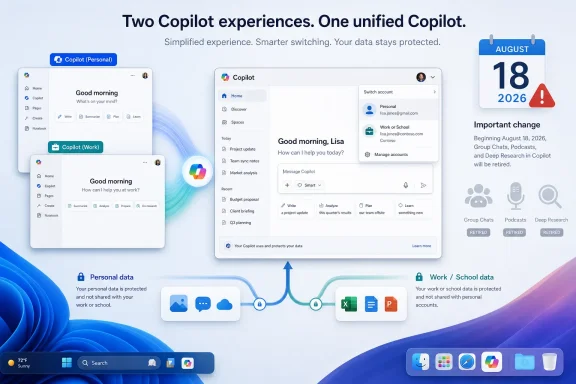 One App, Multiple Identities
The current arrangement has been needlessly hard to explain. The consumer Microsoft Copilot app has handled general chat, image generation, file uploads, voice features, and personal conversation history. The Microsoft 365 Copilot app has been the entry point for Microsoft 365 content, organizational search, agents, and licensed work features. Both apps can appear on Windows, macOS, iOS, Android, and the web, often leaving users to work out which icon contains which conversation or capability.
Microsoft’s stated answer is a unified app that changes according to the signed-in account. Windows Central reports that users will be able to sign in with a personal, work, or school account; Thurrott says the revised Microsoft 365 Copilot app is being renamed the Microsoft Copilot app and will become the vehicle for the combined experience. The latter point is important for support desks: this is not necessarily a clean replacement in which one old app simply disappears and another arrives. In at least part of the transition, Microsoft 365 Copilot is being updated in place, with a new identity and navigation, while consumer users are moved into the same destination.
Microsoft says the account switcher keeps personal and work environments separate, with no data flowing between them. That is the desired design, but it is also a vendor assurance rather than a newly documented administrative control. Organizations should not interpret a shared icon, a shared client, or a switcher as permission for users to move content between personal and corporate contexts. Existing Microsoft 365 licensing, tenant policies, sensitivity labels, data-loss prevention rules, and Entra account controls remain the mechanisms that determine what a work account can see and do.
The benefits are clearest for users who routinely change roles during a day: an employee using a personal account at home and an Entra account at work will no longer need to mentally map two apps to two sets of chat histories. The downside is that a familiar visual divide is being removed. Support documentation and internal training should teach users to inspect the active account before submitting a prompt, uploading a file, or acting on an answer grounded in corporate content.
The Rollout Is Staggered, Not a Single Cutover
The reporting points to a multi-stage migration rather than a single launch date. Thurrott says the transition starts this week with a subset of Windows Insiders. ZDNET reports that Microsoft intends to begin the unified-app rollout in mid-September, while Thurrott specifies that the broader Windows and macOS desktop rollout is scheduled for then.
Consumer mobile users are on a different path. According to Windows Central and Thurrott, people using the existing consumer Copilot mobile app will need to download the new unified app later in August, though Microsoft says their chats and most existing content will move with them. Web users should be redirected. Existing Microsoft 365 Copilot mobile users may receive an automatic update or need to update manually, depending on platform distribution.
This creates a short period in which an organization may encounter multiple outcomes at once: Insiders on the new experience, Windows users seeing an updated taskbar icon, mobile users with an app-store update pending, and other users still on the prior software. The submitted reports do not identify Windows build requirements, supported macOS versions, geographic sequencing, or a date by which every client will complete the transition. Microsoft also has not publicly detailed whether the same update path applies to specialized government, education, or regulated-cloud tenants.
Those omissions do not make the rollout suspect; they define the limits of what IT can promise today. A help desk should avoid telling users that “Copilot has been replaced” until the unified client is actually available in that user’s channel and account type. In this case, rollout status—not an app icon alone—will determine the user experience.
Microsoft Is Preserving Licensing Differences
A single front end does not mean Microsoft is flattening its paid AI tiers. ZDNET reports that Microsoft 365 subscribers will retain higher usage limits and the ability to reach Word, Excel, Outlook, other Microsoft 365 apps, files, and content from Copilot. Free users retain the standard Copilot functions such as chat, voice, image creation, prompts, and file uploads, but the experience will still be shaped by the account and license attached to it.
For work and school accounts, the central distinction remains grounding in organizational data. A user with an eligible Microsoft 365 Copilot license can work with the content and services made available by the tenant. A personal user does not gain access to corporate mail, OneDrive, SharePoint, or Microsoft Graph data merely because a personal identity and an Entra identity are now selectable in the same application.
There is also a consumer-facing feature change embedded in the merger. Thurrott reports that personal-account users coming through the Microsoft 365 Copilot app will receive Copilot Chat at no additional cost. That expands access to the chat experience, but Microsoft has not announced a blanket entitlement to premium Microsoft 365 capabilities. Administrators should expect feature questions to become more frequent precisely because the interface will look more unified while the underlying rights remain conditional.
The migration is therefore best understood as interface consolidation, not account consolidation. It reduces app sprawl, but it does not reduce the need for clear identity hygiene, licensing assignments, and user education.
The Three Retirements Have Unequal Consequences
Microsoft is retiring Group chats, Podcasts, and Deep Research from consumer Copilot on August 18. The official support pages for Podcasts and Deep Research confirm the date and clarify that the two features have very different preservation rules.
For Podcasts, the situation is blunt: Microsoft says users will no longer be able to create or access previously generated podcasts after August 18. More significantly, Microsoft’s support guidance says Podcasts had no export option. That conflicts with ZDNET’s report that users could download individual podcasts from the library before retirement. Microsoft’s own support record is the stronger evidence here, and it says there is no way to save a Copilot Podcast outside the service.
Users who depend on a generated podcast should therefore not rely on an assumed download button or a published link continuing to work. Microsoft says previously shared podcast links will also stop functioning after retirement. If the material matters, the practical fallback is to preserve the underlying source material, prompt, script, notes, or a separate recording made through an approved process—not to assume the Copilot library provides an archive.
Deep Research has a less destructive exit. Microsoft says existing saved reports will remain available after August 18, 2026, although users will no longer be able to create new reports in consumer Copilot. Microsoft 365 Premium subscribers can continue creating detailed reports through the separate Researcher capability, while Personal and Family subscribers can find past Deep Research work in chat history. Microsoft also says existing reports can be opened in Word and saved.
That distinction should influence what users do now. There is no urgent preservation action mandated for Deep Research, but anyone who needs a durable copy should export important reports to Word before relying on chat history as a records system. The feature that disappears is the consumer Deep Research creation mode; the enterprise-oriented Researcher experience continues for qualifying Microsoft 365 licensing.
Group chats are the least documented of the three in Microsoft’s public support materials so far. ZDNET reports that messages, conversations, and images created in group chats will become inaccessible after August 18 and recommends copying what matters into a separate document or file. Until Microsoft publishes equivalent detailed retention guidance, users should treat that warning as operationally real and export text, images, and any decisions or project context before the deadline.
What Windows Users and IT Teams Should Do Now
The immediate work is mostly communication and preservation, not a complex deployment project. Microsoft has not announced a new tenant-side migration wizard, required policy change, or a revised Microsoft 365 Copilot licensing model as part of this app unification. That leaves organizations with a manageable but time-sensitive checklist:
- Users who created Copilot Group chats should copy important conversations, images, and decisions out before August 18, 2026.
- Users should assume Copilot Podcasts cannot be downloaded or recovered after retirement, despite conflicting third-party reporting, because Microsoft’s support documentation says the feature offered no export path.
- Users with valuable Deep Research reports should save copies to Word, even though Microsoft says existing reports will remain accessible.
- Help desks should update screenshots, app names, and instructions that refer specifically to “Microsoft 365 Copilot app,” especially where the documented workflow starts with opening that app.
- Administrators should remind staff that switching to a personal account inside the same app does not make corporate data available there and does not change acceptable-use rules.
Microsoft has finally chosen a model that users have been asking for: one client that recognizes that a person can have both a personal and professional identity. The merger should make Copilot easier to find and less confusing to launch. But the company has paired that simplification with a hard August 18 retirement deadline and, in the case of Podcasts, no credible recovery path once the service turns off.
Update: Microsoft ties app merger to a broader Copilot “super app” plan (August 13, 2026)
The Verge reports that the unified Copilot client is also groundwork for a broader “super app” Microsoft plans to launch later in 2026. That detail gives the current consolidation a longer-term purpose beyond removing duplicate consumer and work Copilot icons.
The Verge also says users who already use both apps will have their existing chats and content brought into the updated Copilot app, while remaining separated by account type. Microsoft 365 Copilot users should see only minor navigation changes alongside the new icon and access to Copilot Chat.
One temporary disruption may affect consumer workflows during rollout: Shopping and Copilot Health may be unavailable for a period, according to The Verge. Microsoft has also reiterated that enterprise security, compliance, and government controls are not changing as part of the client merger.
Update: New Copilot app may require Recall exclusions to be reapplied (August 13, 2026)
GeekWire reports that organizations which excluded the old Copilot app from Windows Recall screenshots will need to create that exclusion again for the renamed Microsoft Copilot app. Microsoft says the prior app-level exclusion will not transfer automatically, making this a concrete post-migration task for endpoint administrators concerned about Recall’s captured activity.
The report also says the consumer voice companion Mico is being removed as part of the transition, although Microsoft expects to retain it in some education-oriented Copilot experiences. GeekWire further reports that consumer content shared with or generated by Copilot will move to OneDrive, where storage above the included allowance may require a paid plan.
Microsoft’s free Copilot chat tier will remain available but may impose tighter capacity limits for some users, according to GeekWire. Users who encounter those limits will be directed toward paid Microsoft 365 plans with higher usage allowances.
Update: Petri reports phased redirects and new Copilot web address (August 13, 2026)
According to Petri, Microsoft’s transition will add the copilot.cloud.microsoft address for enterprise testing later this month, followed by automatic URL redirects beginning in late August. Organizations on Microsoft’s deferred release schedule are reportedly due to receive those redirects by late September.
Petri also reports that the redesigned Windows and macOS clients move to general availability in mid-September, while web and mobile changes begin rolling out worldwide later in August. This provides more concrete staging for IT communications than the earlier broad rollout window.
For administrators, the practical additions are testing the new URL in controlled environments, checking bookmarks and internal documentation before redirects begin, and validating any Recall filtering policy that names the former Microsoft Copilot app.