
The reporting, republished from The Conversation and attributed to CSIRO researcher Muneera Bano, argues that bias does not originate solely in model weights or bad prompts. It is shaped earlier: when organizations decide which historical data to use, what attributes count as performance signals, who writes requirements, where automation is introduced, and which harms are considered acceptable before a system goes live.
That argument is more useful than the familiar warning that “AI can be biased.” It identifies the operational failure that enterprise buyers can actually address. A company cannot audit its way out of a hiring or promotion process if nobody can explain who owns the decision criteria, what data informed them, and how an affected person can challenge an automated recommendation.
 The Copilot study is a warning, not a product verdict
The underlying paper, What Does a Software Engineer Look Like? Exploring Societal Stereotypes in LLMs, tested GPT-4 and Microsoft Copilot using 300 constructed candidate profiles across four software-engineering roles. Each model was asked to recommend candidates and generate images for its preferred selections. The researchers reported a tendency toward male and Caucasian profiles, with younger, lighter-skinned, and slimmer portrayals recurring in generated images.
The crucial limitation is also in the paper: this was an exploratory simulation involving specific prompts, a defined set of profiles, and the versions of GPT-4 and Copilot available to the researchers at the time. It was not a test of Workday Recruiting, Microsoft 365 Copilot, GitHub Copilot, or any employer’s production selection workflow. Nor does it establish that every current Copilot experience produces the same result; Microsoft’s products and their underlying models change frequently, while GPT-4 itself has been retired from OpenAI’s consumer ChatGPT service.
That is not a reason to dismiss the result. It is a reason to interpret it correctly. The research shows that general-purpose AI can reproduce recognizable stereotypes when asked to rank or depict software engineers. It does not prove that a particular employer has discriminated, and it does not substitute for an audit of the exact system, prompts, integrations, data, thresholds, and human review practices that employer uses.
For Windows and enterprise administrators, that distinction matters. A Copilot prompt that summarizes résumés, drafts a shortlist rationale, or turns interview notes into “recommended next steps” can still affect a hiring outcome even if the organization insists the final decision belongs to a person. Once a recruiter is asked to review only the names surfaced by a system, the filtering decision has already happened.
The Workday lawsuit shows why “the AI made it do it” is not a defense
The CSIRO article points to the ongoing federal case against Workday as a live example of the stakes. Plaintiffs allege that Workday’s screening and ranking tools discriminated against applicants based on race, sex, age, and disability. Workday has denied the allegations and has said its technology evaluates job qualifications rather than protected characteristics.
Court filings show the dispute is broader than a claim about a rogue algorithm. The plaintiffs contend that Workday acted as an agent for client employers by exercising delegated authority in screening, ranking, and filtering applicants. They also cite alleged results from bias audits covering more than 724,000 applicants at ten large Workday customers. Those are allegations in litigation, not judicial findings that the systems discriminated.
But the case has already produced one finding with wider enterprise significance: software vendors do not automatically escape scrutiny simply by characterizing themselves as neutral infrastructure. When a product materially structures who is screened out, ranked, or recommended, the buyer’s governance practices and the vendor’s product design can both become relevant.
The Equal Employment Opportunity Commission has likewise warned workers that existing federal anti-discrimination protections can apply when AI is used in recruiting, résumé screening, and hiring. In other words, attaching “AI-powered” to an HR workflow does not create a legal or managerial vacuum. The organization deploying it remains responsible for the employment process it has chosen.
Bias enters before a model produces an answer
The strongest point in the CSIRO analysis is that data is not a neutral record waiting to be fed into a model. A company decides which past hires count as successful, whether uninterrupted employment is treated as a proxy for reliability, how job descriptions define “culture fit,” whether graduation dates remain visible, and whether disability-related gaps in a résumé are treated as negatives.
Those decisions can encode bias even when protected traits are omitted from a system’s input fields. A model need not receive an applicant’s age to infer it from employment history. It does not need a race field to respond differently to names, schools, postal codes, affiliations, or writing conventions that correlate with ethnicity. Removing an explicit column can be sensible, but it is not a fairness test.
The same applies to development organizations using AI internally. A tool that summarizes performance evidence, recommends people for stretch assignments, helps a manager draft promotion cases, or identifies “high-potential” employees may import uneven historic patterns into a process that already lacked consistent standards. Generative AI can make those patterns appear more polished and objective than the underlying evidence warrants.
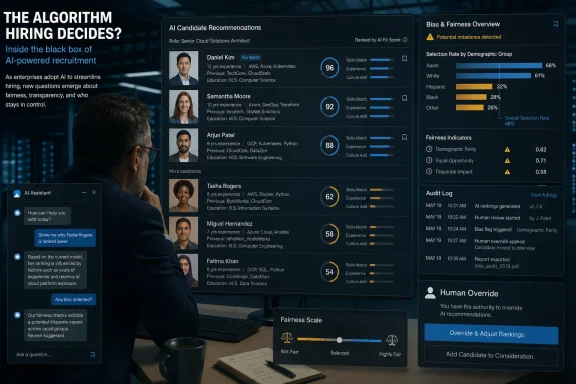
This is where automation bias becomes the operational risk. Employees can give a confident-looking recommendation too much weight simply because software generated it. A nominally human review is weak if reviewers cannot see the inputs, do not know how the recommendation was created, lack authority to override it, or are under time pressure to accept the tool’s output.
What responsible deployment looks like in practice
Technical mitigation still matters. Organizations should test for disparate outcomes, inspect data quality, constrain high-risk use cases, and monitor whether model performance shifts after updates. But model evaluation is only one control in a process that begins with a business owner deciding what the tool is allowed to do.
For systems that can affect employment, education, benefits, access to services, or disciplinary decisions, a workable governance program should include the following:
- The organization should identify one accountable owner for each AI-assisted decision process, rather than splitting responsibility vaguely between HR, IT, procurement, and a software vendor.
- The owner should document the decision the system supports, the inputs it receives, the output it produces, and whether that output can exclude, rank, score, or otherwise disadvantage a person.
- Teams should test realistic cases that vary more than one characteristic at a time, because a system that appears even-handed in separate race, gender, or age checks may still perform poorly for people who sit at their intersection.
- Human review should be meaningful: reviewers need the authority, time, evidence, and training to reject an AI recommendation rather than merely approve it.
- Organizations should preserve logs, prompts, model versions, ranking rules, override decisions, and relevant input data. Without records, a later complaint becomes impossible to investigate fairly.
- Vendors should be required to state the limits of their systems, material product changes, available audit evidence, and the controls customers can use. “Responsible AI” marketing language is not a substitute for contractual clarity.
These are not exotic requirements. They resemble the change management, access control, incident response, and audit-trail practices that IT departments already apply to systems handling financial, security, and identity data. The difference is that an AI recommendation can look subjective and disposable while still influencing a high-consequence choice.
The missing test is distribution of harm
Accuracy remains the metric most vendors emphasize. It is easy to measure whether a model generated a plausible summary, matched an expected answer, or reduced the time required to process a stack of résumés. Those metrics say little about whether errors and exclusions fall disproportionately on particular groups.
An AI system can be highly accurate in aggregate and still create an unacceptable burden for a smaller population. In a hiring process, a modest difference in false-negative rates can mean qualified applicants from one group are systematically less likely to reach a human recruiter. At scale, that is not a minor model-quality issue. It is a business-process failure with legal, reputational, and human consequences.
The CSIRO researchers’ conclusion is therefore sound: treating bias as a defect found only inside the algorithm encourages organizations to search for a technical patch after harm appears. The more important work happens earlier, when people set objectives, define success, select data, approve deployment, and decide whose objections will be heard.
For enterprises rolling out Copilot, custom Azure AI tools, HR platforms, or internally built recommendation systems, the immediate task is not to prove that AI is unbiased. It is to establish where automated output can influence a consequential decision, assign a named owner, keep evidence of how the system behaved, and give people a real route to challenge an outcome before the software’s recommendation hardens into policy.