
Microsoft’s August 4 profile of Muhammad Yusuf Fadhel Marwiji and Emejleano Rusmin Nggepo makes a credible case for hands-on AI and cloud training in Indonesia, but it does not establish the larger claim implied by its headline: that access has already translated into digital careers. What the company documents is earlier in the pipeline—two students gaining practical exposure to Microsoft Fabric, Azure and GitHub Copilot through the Microsoft Elevate Training Center, operated with Indonesian learning-platform partner Dicoding.
That distinction is more than semantic. Yusuf, a forestry researcher in Makassar, is applying machine learning concepts to flood-risk analysis. Lano, an Informatics student in Tangerang Regency, says cloud tools reduced the practical limits imposed by his aging, GPU-less laptop and helped him move faster on projects, including a camera- and voice-based object-identification app intended to assist blind users. Those are meaningful outcomes from training. But Microsoft provides no independent evaluation, job-placement figure, certification-completion rate, project repository, or employer validation for either participant.
The value in these accounts is therefore not a promised career result. It is a clearer illustration of where cloud services and AI assistants can lower the entry barrier—and where they decidedly do not.
Yusuf’s route into AI began with forestry, environmental studies and Geographic Information Systems. His graduate flood-risk research combines variables including elevation, slope and rainfall to identify locations that may be vulnerable to flooding. Microsoft says he sees machine learning as a way to process larger spatial datasets faster and uncover patterns that would be difficult to identify through manual analysis.
That is a conventional and sensible use of machine learning in geospatial work. A model can rank locations, estimate risk or detect relationships across multiple layers of data far more efficiently than a person inspecting variables one by one. In a practical GIS workflow, that could mean moving from ad hoc spreadsheet analysis to repeatable feature preparation, model experimentation and batch scoring.
But the company’s profile contains an important qualification that should not be lost amid the AI messaging: Yusuf says the analytical output must still be checked in the field. Flood-risk models are only as useful as their inputs, labels and geographic assumptions. Elevation and slope may be stable enough for broad screening, but rainfall measurements, drainage conditions, land-use changes, soil conditions and localized infrastructure can quickly complicate a model trained on incomplete or outdated data.
For Windows and IT professionals, the story is familiar. Automation shifts the bottleneck; it does not erase it. A cloud-hosted workflow can remove a local workstation’s compute constraint, but it cannot fix weak source data, inconsistent coordinate systems, poorly documented datasets or an untested model. Yusuf’s approach is strongest where it treats AI as a tool for prioritizing field investigation rather than a replacement for it.
Microsoft’s May description of the Elevate Training Center confirms that its workshops cover cloud, machine learning and generative AI through hands-on exercises. Its earlier announcement said Dicoding’s part of the program includes Microsoft Fabric, Azure, Python and generative AI. That explains the platform connection in Yusuf’s account, but Microsoft does not say which specific Azure services he used, whether he deployed a production workflow, or whether his flood-risk work has been externally evaluated.
The missing details matter because “GeoAI” can describe anything from a notebook experiment to a service used by a local government or environmental agency. Microsoft’s profile supports the former. It does not document the latter.
Microsoft Fabric is positioned for that kind of workflow: ingesting data, transforming it through pipelines or notebooks, organizing it in OneLake and making it available for analytics and data-science tasks. An extract, transform and load project—the ETL work Lano describes—is a better introduction to real-world AI development than jumping immediately to a model. Models do not compensate for missing, inconsistent, poorly structured or irrelevant data.
Yet the practical implication needs sharpening. Cloud computing does not make an older Windows laptop irrelevant; it changes its role. The machine becomes a client for a browser, code editor, shell, local testing tools, authentication prompts and remote development session. That is a major improvement when the workload is remote, but stable connectivity, a supported browser, enough memory for daily tools and sufficient disk space still determine whether the experience is usable.
The World Bank’s December 2025 Indonesia Economic Prospects report gives the broader context Microsoft’s profile leaves unstated. It found that internet access has expanded rapidly in Indonesia, while quality and usage remain uneven; it specifically noted that many people in rural areas, schools and health clinics still lack high-speed connections, and that average internet speeds trail regional peers. A program that moves compute to the cloud can sidestep a missing GPU, but it cannot sidestep unreliable broadband.
The same constraint applies to the “access” framing around a modest laptop. The cloud helps with compute, but the user must still have an account, identity verification where required, network access, time to learn, and a path from a trial environment to sustained use. Those are not small conditions for a student balancing family obligations or work.
Microsoft’s own Fabric documentation shows why that deserves attention. Fabric offers a 60-day trial capacity that can run data engineering, data science, Data Factory, real-time analytics and Power BI workloads. It is genuinely useful for learning: it permits notebooks, pipelines and up to 1 TB of OneLake storage.
But it is not a permanent development environment. Microsoft says that when the trial expires, access to the trial capacity is revoked. Non-Power BI Fabric items, such as notebooks and pipelines, become inactive unless the workspace is reassigned to paid Fabric or Power BI Premium capacity. Content remains available in OneLake for only seven days before a user must move it to a valid paid capacity to reactivate it.
The trial also excludes some of the very AI features often used in marketing material. Microsoft’s documentation says Fabric trials do not support Copilot, Trusted Workspace Access, Data Agent, AI functions or AI services. A learner can gain valuable skills in data engineering and analytics without those tools, but a training story should distinguish between learning the platform’s core workflow and having continuing access to the product’s full AI feature set.
There is also a capacity reality. Trial capacity may be configured at F4 or F64, does not support autoscale, and has limits on what can be created and run. That is appropriate for a lab. It becomes a constraint when a student wants to preserve a portfolio project, collaborate on a sustained prototype or serve a real user base.
Microsoft Elevate may well provide a managed environment or course-specific access beyond the standard public trial. The company’s published profile does not say. Until it does, readers should not assume that completing the training comes with a durable Azure or Fabric tenancy.
Microsoft’s profile does not identify the application’s technology stack, source availability, object-detection model, test method, supported languages, privacy design or accessibility testing. No independent outlet appears to have published technical documentation or user testing for the app. It should therefore be treated as a student project claim, not a verified assistive-technology product.
That standard is especially important for software intended for blind users. A camera-based recognition system can be helpful, but incorrect identification, weak lighting performance, delayed speech output, ambiguous instructions and unhandled privacy concerns can turn a promising demonstration into a risky real-world tool. Accessibility features require feedback from the people expected to rely on them, not merely an AI-generated codebase.
GitHub’s own documentation also complicates the idea that Copilot is simply free access to an always-on coding partner. The free plan has limited features and usage. Verified students can receive unlimited code completions plus a defined allowance of AI credits, while paid individual plans start at $10 per month for Copilot Pro. Lano may qualify for the student offering, but Microsoft’s article does not say which plan he uses or whether program participation covers it.
The better reading is that Copilot helped Lano iterate faster, not that it removed the hard work of software engineering. The developer still owns requirements, security, dependency hygiene, testing, code review, model behavior and the consequences of a bad output.
Those are vendor-reported participation and target figures, not independently audited employment outcomes. Microsoft’s English announcement is also dated January 7, 2026 while describing a launch tied to Indonesia’s National Heroes Day; the Indonesian-language version of the same announcement carries a November 17, 2025 publication date. That record does not invalidate the program, but it is a reminder that campaign pages should not be treated as clean statistical reporting without supporting methodology.
The two accounts do support a narrower, more defensible conclusion. Training can connect nontraditional backgrounds to modern tools: a forestry researcher can learn the foundations of geospatial machine learning, and a student with limited local hardware can use remote compute and coding assistance to build more ambitious prototypes. Those are valuable openings.
Whether they become durable digital careers will depend on the parts Microsoft leaves unmeasured: reliable connectivity, continuing cloud access, credible portfolios, mentoring, paid work opportunities and the ability to maintain projects after the workshop credits or trial capacity expire.
The value in these accounts is therefore not a promised career result. It is a clearer illustration of where cloud services and AI assistants can lower the entry barrier—and where they decidedly do not.
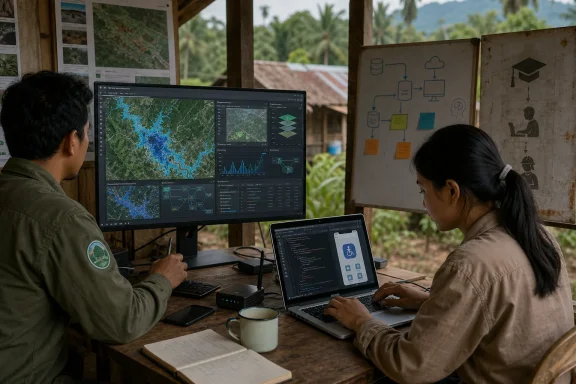 Yusuf’s GeoAI work still depends on field validation
Yusuf’s route into AI began with forestry, environmental studies and Geographic Information Systems. His graduate flood-risk research combines variables including elevation, slope and rainfall to identify locations that may be vulnerable to flooding. Microsoft says he sees machine learning as a way to process larger spatial datasets faster and uncover patterns that would be difficult to identify through manual analysis.That is a conventional and sensible use of machine learning in geospatial work. A model can rank locations, estimate risk or detect relationships across multiple layers of data far more efficiently than a person inspecting variables one by one. In a practical GIS workflow, that could mean moving from ad hoc spreadsheet analysis to repeatable feature preparation, model experimentation and batch scoring.
But the company’s profile contains an important qualification that should not be lost amid the AI messaging: Yusuf says the analytical output must still be checked in the field. Flood-risk models are only as useful as their inputs, labels and geographic assumptions. Elevation and slope may be stable enough for broad screening, but rainfall measurements, drainage conditions, land-use changes, soil conditions and localized infrastructure can quickly complicate a model trained on incomplete or outdated data.
For Windows and IT professionals, the story is familiar. Automation shifts the bottleneck; it does not erase it. A cloud-hosted workflow can remove a local workstation’s compute constraint, but it cannot fix weak source data, inconsistent coordinate systems, poorly documented datasets or an untested model. Yusuf’s approach is strongest where it treats AI as a tool for prioritizing field investigation rather than a replacement for it.
Microsoft’s May description of the Elevate Training Center confirms that its workshops cover cloud, machine learning and generative AI through hands-on exercises. Its earlier announcement said Dicoding’s part of the program includes Microsoft Fabric, Azure, Python and generative AI. That explains the platform connection in Yusuf’s account, but Microsoft does not say which specific Azure services he used, whether he deployed a production workflow, or whether his flood-risk work has been externally evaluated.
The missing details matter because “GeoAI” can describe anything from a notebook experiment to a service used by a local government or environmental agency. Microsoft’s profile supports the former. It does not document the latter.
Lano’s laptop problem has a real cloud answer, with real limits
Lano’s experience is the more concrete cloud-computing case. He describes attempting back-end development and machine-learning work on a laptop that slows, overheats and restarts. For training workloads, particularly model fitting and data transformation, offloading compute to managed cloud infrastructure can be the difference between being able to practice and being unable to complete an exercise.Microsoft Fabric is positioned for that kind of workflow: ingesting data, transforming it through pipelines or notebooks, organizing it in OneLake and making it available for analytics and data-science tasks. An extract, transform and load project—the ETL work Lano describes—is a better introduction to real-world AI development than jumping immediately to a model. Models do not compensate for missing, inconsistent, poorly structured or irrelevant data.
Yet the practical implication needs sharpening. Cloud computing does not make an older Windows laptop irrelevant; it changes its role. The machine becomes a client for a browser, code editor, shell, local testing tools, authentication prompts and remote development session. That is a major improvement when the workload is remote, but stable connectivity, a supported browser, enough memory for daily tools and sufficient disk space still determine whether the experience is usable.
The World Bank’s December 2025 Indonesia Economic Prospects report gives the broader context Microsoft’s profile leaves unstated. It found that internet access has expanded rapidly in Indonesia, while quality and usage remain uneven; it specifically noted that many people in rural areas, schools and health clinics still lack high-speed connections, and that average internet speeds trail regional peers. A program that moves compute to the cloud can sidestep a missing GPU, but it cannot sidestep unreliable broadband.
The same constraint applies to the “access” framing around a modest laptop. The cloud helps with compute, but the user must still have an account, identity verification where required, network access, time to learn, and a path from a trial environment to sustained use. Those are not small conditions for a student balancing family obligations or work.
Fabric training is not the same as durable Fabric access
This is the central omission in Microsoft’s account. The company describes exposure to Microsoft Fabric and Azure, but does not disclose what access participants receive after training, whether the program covers service consumption charges, whether learners get Azure credits, or what becomes of their projects when training access ends.Microsoft’s own Fabric documentation shows why that deserves attention. Fabric offers a 60-day trial capacity that can run data engineering, data science, Data Factory, real-time analytics and Power BI workloads. It is genuinely useful for learning: it permits notebooks, pipelines and up to 1 TB of OneLake storage.
But it is not a permanent development environment. Microsoft says that when the trial expires, access to the trial capacity is revoked. Non-Power BI Fabric items, such as notebooks and pipelines, become inactive unless the workspace is reassigned to paid Fabric or Power BI Premium capacity. Content remains available in OneLake for only seven days before a user must move it to a valid paid capacity to reactivate it.
The trial also excludes some of the very AI features often used in marketing material. Microsoft’s documentation says Fabric trials do not support Copilot, Trusted Workspace Access, Data Agent, AI functions or AI services. A learner can gain valuable skills in data engineering and analytics without those tools, but a training story should distinguish between learning the platform’s core workflow and having continuing access to the product’s full AI feature set.
There is also a capacity reality. Trial capacity may be configured at F4 or F64, does not support autoscale, and has limits on what can be created and run. That is appropriate for a lab. It becomes a constraint when a student wants to preserve a portfolio project, collaborate on a sustained prototype or serve a real user base.
Microsoft Elevate may well provide a managed environment or course-specific access beyond the standard public trial. The company’s published profile does not say. Until it does, readers should not assume that completing the training comes with a durable Azure or Fabric tenancy.
GitHub Copilot can accelerate a project; it cannot certify its quality
Lano’s description of GitHub Copilot is also plausible: contextual suggestions can reduce the amount of boilerplate code a developer writes and shorten the gap between a design idea and a working prototype. He says Copilot supported development of an application using camera and voice interaction to help blind people identify nearby objects.Microsoft’s profile does not identify the application’s technology stack, source availability, object-detection model, test method, supported languages, privacy design or accessibility testing. No independent outlet appears to have published technical documentation or user testing for the app. It should therefore be treated as a student project claim, not a verified assistive-technology product.
That standard is especially important for software intended for blind users. A camera-based recognition system can be helpful, but incorrect identification, weak lighting performance, delayed speech output, ambiguous instructions and unhandled privacy concerns can turn a promising demonstration into a risky real-world tool. Accessibility features require feedback from the people expected to rely on them, not merely an AI-generated codebase.
GitHub’s own documentation also complicates the idea that Copilot is simply free access to an always-on coding partner. The free plan has limited features and usage. Verified students can receive unlimited code completions plus a defined allowance of AI credits, while paid individual plans start at $10 per month for Copilot Pro. Lano may qualify for the student offering, but Microsoft’s article does not say which plan he uses or whether program participation covers it.
The better reading is that Copilot helped Lano iterate faster, not that it removed the hard work of software engineering. The developer still owns requirements, security, dependency hygiene, testing, code review, model behavior and the consequences of a bad output.
Microsoft’s evidence stops before employment
Microsoft has a substantial national skilling ambition behind these individual stories. The company said its Elevate initiative, previously branded elevAIte Indonesia, had equipped more than 1.2 million participants with AI skills since launching in December 2024 and was targeting 500,000 certified AI talents in 2026. Its documentation also describes collaborations intended to reach educators, nonprofits, community leaders, developers and students.Those are vendor-reported participation and target figures, not independently audited employment outcomes. Microsoft’s English announcement is also dated January 7, 2026 while describing a launch tied to Indonesia’s National Heroes Day; the Indonesian-language version of the same announcement carries a November 17, 2025 publication date. That record does not invalidate the program, but it is a reminder that campaign pages should not be treated as clean statistical reporting without supporting methodology.
The two accounts do support a narrower, more defensible conclusion. Training can connect nontraditional backgrounds to modern tools: a forestry researcher can learn the foundations of geospatial machine learning, and a student with limited local hardware can use remote compute and coding assistance to build more ambitious prototypes. Those are valuable openings.
Whether they become durable digital careers will depend on the parts Microsoft leaves unmeasured: reliable connectivity, continuing cloud access, credible portfolios, mentoring, paid work opportunities and the ability to maintain projects after the workshop credits or trial capacity expire.
References
- Primary source: Microsoft Source
Published: 2026-08-04T04:26:42+00:00
Loading…
news.microsoft.com - Related coverage: news.microsoft.com
Loading…
news.microsoft.com - Related coverage: learn.microsoft.com
Loading…
learn.microsoft.com - Related coverage: techcommunity.microsoft.com
Loading…
techcommunity.microsoft.com - Related coverage: techcommunity.microsoft.com
Loading…
techcommunity.microsoft.com - Related coverage: learn.microsoft.com
Loading…
learn.microsoft.com - Related coverage: genderdata.worldbank.org
Loading…
genderdata.worldbank.org - Related coverage: ppp.worldbank.org
Loading…
ppp.worldbank.org - Related coverage: thedocs.worldbank.org
Loading…
thedocs.worldbank.org - Related coverage: time.com
Loading…
time.com