
Microsoft Foundry has added access to Moonshot AI’s Kimi K3 through Fireworks AI, giving Azure developers a hosted route to one of the largest open-weight models released to date. As reported by TechGenyz, the July 31 availability expands Foundry’s third-party model catalog with a system built for very large context windows, coding, reasoning, visual input, and multistep agent workloads.
The important qualification is the delivery path: Kimi K3 is served by Fireworks AI within Microsoft Foundry, rather than presented as a Microsoft-hosted first-party Azure model endpoint. That distinction matters for organizations reviewing data handling, compliance terms, regional availability, support boundaries, and pricing before they move a production workload.
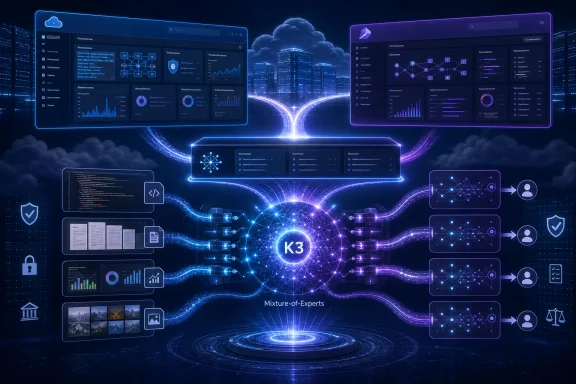
Moonshot AI’s Kimi K3 is a mixture-of-experts, or MoE, model with 2.8 trillion total parameters. Its architecture activates about 104 billion parameters per token, selecting 16 routed experts from a pool of 896 rather than running the entire network for every inference step.
That sparse design does not make K3 lightweight. It remains a demanding model best suited to a managed inference provider or unusually well-equipped self-hosting environment. But it helps explain why Fireworks can offer K3 as a production service while preserving the capacity advantages associated with an enormous model.
Fireworks describes K3 as its flagship Kimi offering and lists support for serverless inference, on-demand deployments, function calling, image input, and a context limit just above one million tokens. For Foundry users, that puts a major open-weight option beside proprietary and smaller open models already available through Microsoft’s platform.
Long context does not eliminate the need for retrieval-augmented generation, prompt design, or evaluation. Passing an entire repository or document archive into a model can be expensive and can still produce poor results if the relevant facts are not structured well. It does, however, broaden the ceiling for code-review agents, enterprise search tools, document analysis, and long-running automation.
Moonshot’s Kimi K3 technical report also describes native visual understanding, Kimi Delta Attention, Attention Residuals, and reinforcement-learning-based post-training for general, coding, and agentic tasks. Those are vendor claims and should be tested against an organization’s own workload rather than treated as a blanket replacement for existing models.
The open-weight label also deserves a careful reading. It gives customers more flexibility to inspect, adapt, and potentially deploy the model elsewhere, but it does not mean inference is free, simple, or automatically private. With Fireworks in the path, customers need to assess Fireworks-specific data-sharing and compliance terms alongside Microsoft Foundry’s controls.
For Windows developers and enterprise IT teams already standardizing on Microsoft Foundry, Kimi K3 is primarily another model-selection option: one aimed at workloads where long context and open-weight flexibility may matter more than using a single preferred model provider. The next test is less about its 2.8-trillion-parameter headline and more about whether it delivers reliable results, acceptable latency, and predictable costs on real Azure applications.
 A 2.8T Model Without a 2.8T Inference Bill
Moonshot AI’s Kimi K3 is a mixture-of-experts, or MoE, model with 2.8 trillion total parameters. Its architecture activates about 104 billion parameters per token, selecting 16 routed experts from a pool of 896 rather than running the entire network for every inference step.That sparse design does not make K3 lightweight. It remains a demanding model best suited to a managed inference provider or unusually well-equipped self-hosting environment. But it helps explain why Fireworks can offer K3 as a production service while preserving the capacity advantages associated with an enormous model.
Fireworks describes K3 as its flagship Kimi offering and lists support for serverless inference, on-demand deployments, function calling, image input, and a context limit just above one million tokens. For Foundry users, that puts a major open-weight option beside proprietary and smaller open models already available through Microsoft’s platform.
The Million-Token Use Case Is More Than a Marketing Number
Kimi K3’s advertised one-million-token context window is the practical headline for developers. In principle, that gives an application room to work across large source repositories, long technical and legal document collections, extended research corpora, or a lengthy chain of tool calls without aggressively splitting material into small retrieval chunks.Long context does not eliminate the need for retrieval-augmented generation, prompt design, or evaluation. Passing an entire repository or document archive into a model can be expensive and can still produce poor results if the relevant facts are not structured well. It does, however, broaden the ceiling for code-review agents, enterprise search tools, document analysis, and long-running automation.
Moonshot’s Kimi K3 technical report also describes native visual understanding, Kimi Delta Attention, Attention Residuals, and reinforcement-learning-based post-training for general, coding, and agentic tasks. Those are vendor claims and should be tested against an organization’s own workload rather than treated as a blanket replacement for existing models.
Fireworks Changes the Enterprise Calculation
Microsoft’s existing Fireworks AI integration is designed to let developers enable eligible third-party models, deploy them through Foundry, and call them from Azure-hosted applications. That can be considerably more practical than attempting to operate K3’s open weights internally, especially for teams that want Azure identity, project controls, application integration, and a managed deployment workflow.The open-weight label also deserves a careful reading. It gives customers more flexibility to inspect, adapt, and potentially deploy the model elsewhere, but it does not mean inference is free, simple, or automatically private. With Fireworks in the path, customers need to assess Fireworks-specific data-sharing and compliance terms alongside Microsoft Foundry’s controls.
For Windows developers and enterprise IT teams already standardizing on Microsoft Foundry, Kimi K3 is primarily another model-selection option: one aimed at workloads where long context and open-weight flexibility may matter more than using a single preferred model provider. The next test is less about its 2.8-trillion-parameter headline and more about whether it delivers reliable results, acceptable latency, and predictable costs on real Azure applications.
References
- Primary source: Techgenyz
Published: 2026-07-31T18:02:10+00:00
Microsoft Foundry Kimi K3 Adds New AI Model - Techgenyz
Microsoft Foundry Kimi K3 integration launches via Fireworks AI, bringing Moonshot AI 2.8T open model with a 1M token context to Azure.techgenyz.com - Related coverage: tomshardware.com
Moonshot AI releases weights for Kimi-K3, firing a shot across the bow of OpenAI and Anthropic — open-weight model performs almost as well as frontier models while being 2-3x easier to run | Tom's Hardware
Cached prompts can reach a 10x inference cost gain versus Anthropic and OpenAI's offeringswww.tomshardware.com - Related coverage: learn.microsoft.com
Fireworks models on Microsoft Foundry - Microsoft Foundry | Microsoft Learn
Learn how to enable, deploy, and use Fireworks models in Microsoft Foundry, including catalog models, custom model import (BYOM), data privacy, and frequently asked questions.learn.microsoft.com - Related coverage: contextstudios.ai
Kimi K3 Puts a 2.8T Open Model on Your Shortlist | Context Studios Blog
Moonshot's Kimi K3 is a 2.8-trillion-parameter open-weight model at $3/$15 per million tokens. Why the July 27 weights date matters more than the benchmarks.www.contextstudios.ai - Related coverage: azure.microsoft.com
Introducing Fireworks AI on Microsoft Foundry: Bringing high performance, low latency open model inference to Azure | Microsoft Azure Blog
Learn how you can access low latency, high throughput inferencing for open models and performance-optimized deployment of custom models with Fireworks AI on Microsoft Foundry. azure.microsoft.com
- Related coverage: aiweekly.co
Moonshot open-sources Kimi K3, a 2.8T-parameter MoE model | AI Weekly
Moonshot AI just dropped Kimi K3 on Hugging Face, a 2.8-trillion-parameter mixture-of-experts model with a million-token context window and native… aiweekly.co