
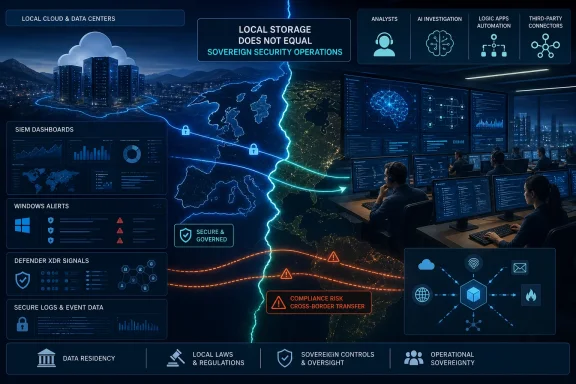
NTT DATA’s new Sovereign Security Operations in an Increasingly Digital but Regulated Economy asks whether a security operations center is compliant because its logs, alerts, behavioral signals, and investigation data cross borders. The useful warning is real: SOC telemetry can contain personal, operational, and regulated data, and where it is processed, who can access it, and which jurisdiction controls the service are now architecture decisions. But the report’s strongest practical lesson is narrower than its marketing: putting security data in a local region does not, by itself, make a SOC sovereign or compliant.
The April 2026 IDC Spotlight, sponsored by NTT DATA and now being promoted through NTT DATA’s regional sites, argues that security sovereignty has expanded beyond storage to cover SIEM platforms, XDR, monitoring infrastructure, analyst operations, and AI-assisted investigations. That is a reasonable expansion of the problem. It is also a potentially expensive one for organizations that treat a regional cloud selection as the end of their compliance review.
For Windows and Microsoft security teams, the immediate implication is to map the whole detection and response path—not simply the Log Analytics workspace. Microsoft Sentinel, Microsoft Defender XDR, Microsoft 365 audit data, Security Copilot, automation playbooks, managed SOC analysts, and third-party enrichment services can each introduce distinct storage, processing, access, and transfer conditions.
The NTT DATA page says that SOC data “doesn’t stop at borders” but increasingly “the rules say it should.” That framing is too broad to use as compliance guidance. European Commission guidance says GDPR protections continue to apply when personal data leaves the EU; transfers can be permitted through an adequacy decision, appropriate safeguards such as standard contractual clauses, binding corporate rules, or limited derogations. GDPR is not a blanket instruction to keep all security logs inside a country—or even necessarily inside the EU.
The same distinction matters for non-personal security data. EU rules generally permit the storage and processing of non-personal data anywhere within the EU, with localized restrictions reserved for exceptional, public-security-based cases under national law. The complication for a SOC is that logs are rarely cleanly “non-personal”: usernames, device names, IP addresses, employee identifiers, mailbox activity, location signals, command lines, and correlated identity data often create a mixed dataset. In those cases, the stricter personal-data rules can apply to the dataset as a whole.
That does not make NTT DATA’s underlying warning wrong. It means a CISO cannot answer “is our SOC compliant?” from a data center map alone. The answer turns on the data categories, the relevant country and sector rules, the provider and subcontractor chain, the lawful transfer mechanism where one is required, privileged access arrangements, retention settings, and whether incident response itself can be conducted under the required jurisdiction.
The European Commission’s own Cloud Sovereignty Framework illustrates the gap between residency and sovereignty. Its security-and-compliance criteria include SOCs and response teams operating exclusively under EU jurisdiction, customer or authority oversight of logging and monitoring, independent audit capability, patching autonomy, supplier-chain visibility, and legal and jurisdictional control. A workload physically hosted in Frankfurt, Dublin, or Paris can still fail a stricter sovereign-cloud test if operational control or support access sits elsewhere.
NTT DATA’s UK promotional page goes further, saying most organizations have not yet built the architecture to support those controls. The underlying IDC PDF does not provide a statistic or methodology supporting that specific readiness claim. It reports the 67% importance figure and describes emerging federated SOC designs, but it does not quantify an architecture gap. That is a meaningful difference: concern about sovereignty is not evidence that most enterprises are technically unprepared.
The report also cites a 2024 IDC Global Security Services Survey to say 46% of organizations require human review before cybersecurity investigations are closed. The underlying breakdown is 21% requiring internal security staff review and 25% requiring MDR or MSSP analyst validation. Those may be complementary categories, but the report does not disclose whether respondents could select both, nor does it explain the survey methodology. The broader point—that organizations retain human accountability for investigations and response—is sound. The percentage should be treated as sponsored research context, not a compliance benchmark.
NTT DATA does disclose the commercial relationship: the document is an IDC Spotlight sponsored by NTT DATA, and its final pages profile NTT DATA’s Unified Detection and Response portfolio, its claimed network of 21 SOC facilities, more than 800 security specialists, and more than 500 customers. The paper is therefore best read as an informed vendor-sponsored market brief, not an independent regulatory checklist or an assurance that NTT DATA’s services satisfy every sovereign-SOC requirement.
That gives Sentinel administrators a substantial design control: workspace location, retention, and deletion policies can be selected as part of deployment. It does not resolve every compliance question. Microsoft states that Sentinel can share customer data with Microsoft Defender XDR, Azure Log Analytics, and Security Copilot. A compliance review therefore needs to trace those service connections and any additional data flows created by connectors, export rules, data-lake configurations, managed services, and incident-response processes.
Microsoft Defender XDR adds another consideration. Its documentation says consolidated data is stored and processed in a selected data-center location, normally aligned with Microsoft Defender for Endpoint; the selected location is visible in the portal. Microsoft also warns that an existing Defender tenant cannot be moved to another geographical region. A team that enables Defender XDR first and asks jurisdictional questions later may discover that its desired regional design requires a support-led discussion or a more disruptive tenant strategy.
Microsoft’s EU Data Boundary commitments are relevant but should not be overstated. The company says the boundary covers specified enterprise online services for customer data and personal data, with limited circumstances in which transfers outside the boundary can continue. It also says system-generated logs containing personal data are pseudonymized, not absent. Pseudonymization is a valuable privacy control; it is not equivalent to proving that every operational process, support interaction, AI service, or responder is subject only to the jurisdiction demanded by a particular regulator or customer contract.
Microsoft Sentinel playbooks deserve special attention because they are built on Azure Logic Apps and can run automatically when alerts or incidents are created or updated. Microsoft documents that automation rules can pass incident details—including alerts and entities—to playbooks, while playbooks can integrate with internal and external systems. The operational benefit is obvious; the sovereignty consequence is that every action connector, API destination, managed identity, and tenant boundary becomes part of the evidence trail an organization may need to defend.
A defensible sovereign-SOC review should therefore begin with an inventory that includes more than storage locations:
For Microsoft-heavy environments, the concrete next step is to review the Sentinel workspace region, Defender XDR data location, Security Copilot and Purview integrations, Logic Apps connectors, and outsourced analyst access as one system. Organizations that complete only the workspace-location check will have evidence of residency. They will not necessarily have evidence of sovereign security operations.
For Windows and Microsoft security teams, the immediate implication is to map the whole detection and response path—not simply the Log Analytics workspace. Microsoft Sentinel, Microsoft Defender XDR, Microsoft 365 audit data, Security Copilot, automation playbooks, managed SOC analysts, and third-party enrichment services can each introduce distinct storage, processing, access, and transfer conditions.
 The report describes a security-design problem, not a universal legal requirement
The NTT DATA page says that SOC data “doesn’t stop at borders” but increasingly “the rules say it should.” That framing is too broad to use as compliance guidance. European Commission guidance says GDPR protections continue to apply when personal data leaves the EU; transfers can be permitted through an adequacy decision, appropriate safeguards such as standard contractual clauses, binding corporate rules, or limited derogations. GDPR is not a blanket instruction to keep all security logs inside a country—or even necessarily inside the EU.The same distinction matters for non-personal security data. EU rules generally permit the storage and processing of non-personal data anywhere within the EU, with localized restrictions reserved for exceptional, public-security-based cases under national law. The complication for a SOC is that logs are rarely cleanly “non-personal”: usernames, device names, IP addresses, employee identifiers, mailbox activity, location signals, command lines, and correlated identity data often create a mixed dataset. In those cases, the stricter personal-data rules can apply to the dataset as a whole.
That does not make NTT DATA’s underlying warning wrong. It means a CISO cannot answer “is our SOC compliant?” from a data center map alone. The answer turns on the data categories, the relevant country and sector rules, the provider and subcontractor chain, the lawful transfer mechanism where one is required, privileged access arrangements, retention settings, and whether incident response itself can be conducted under the required jurisdiction.
The European Commission’s own Cloud Sovereignty Framework illustrates the gap between residency and sovereignty. Its security-and-compliance criteria include SOCs and response teams operating exclusively under EU jurisdiction, customer or authority oversight of logging and monitoring, independent audit capability, patching autonomy, supplier-chain visibility, and legal and jurisdictional control. A workload physically hosted in Frankfurt, Dublin, or Paris can still fail a stricter sovereign-cloud test if operational control or support access sits elsewhere.
IDC’s numbers show concern, but not readiness
IDC’s sponsored report says 67% of surveyed organizations consider sovereign controls over security analytics software very or extremely important to operational sovereignty, while 63% report increased interest in sovereign digital infrastructure. Those figures indicate that the issue has moved onto procurement and board-level agendas. They do not establish how many organizations have implemented compliant architectures, how the survey population was selected, what jurisdictions respondents operate in, or what IDC counted as a “sovereign control.”NTT DATA’s UK promotional page goes further, saying most organizations have not yet built the architecture to support those controls. The underlying IDC PDF does not provide a statistic or methodology supporting that specific readiness claim. It reports the 67% importance figure and describes emerging federated SOC designs, but it does not quantify an architecture gap. That is a meaningful difference: concern about sovereignty is not evidence that most enterprises are technically unprepared.
The report also cites a 2024 IDC Global Security Services Survey to say 46% of organizations require human review before cybersecurity investigations are closed. The underlying breakdown is 21% requiring internal security staff review and 25% requiring MDR or MSSP analyst validation. Those may be complementary categories, but the report does not disclose whether respondents could select both, nor does it explain the survey methodology. The broader point—that organizations retain human accountability for investigations and response—is sound. The percentage should be treated as sponsored research context, not a compliance benchmark.
NTT DATA does disclose the commercial relationship: the document is an IDC Spotlight sponsored by NTT DATA, and its final pages profile NTT DATA’s Unified Detection and Response portfolio, its claimed network of 21 SOC facilities, more than 800 security specialists, and more than 500 customers. The paper is therefore best read as an informed vendor-sponsored market brief, not an independent regulatory checklist or an assurance that NTT DATA’s services satisfy every sovereign-SOC requirement.
Microsoft Sentinel makes location selectable—but the workflow still matters
Microsoft Sentinel is a concrete example of why SOC sovereignty cannot be reduced to the location of a primary SIEM workspace. Microsoft’s current documentation says Sentinel stores customer data in the same Azure region as its associated Log Analytics workspace. It also says Sentinel processes customer data in Europe when the associated workspace is in Europe, in Israel for Israeli workspaces, and in China 21Vianet for Chinese workspaces; for workspaces elsewhere, processing occurs in a US region.That gives Sentinel administrators a substantial design control: workspace location, retention, and deletion policies can be selected as part of deployment. It does not resolve every compliance question. Microsoft states that Sentinel can share customer data with Microsoft Defender XDR, Azure Log Analytics, and Security Copilot. A compliance review therefore needs to trace those service connections and any additional data flows created by connectors, export rules, data-lake configurations, managed services, and incident-response processes.
Microsoft Defender XDR adds another consideration. Its documentation says consolidated data is stored and processed in a selected data-center location, normally aligned with Microsoft Defender for Endpoint; the selected location is visible in the portal. Microsoft also warns that an existing Defender tenant cannot be moved to another geographical region. A team that enables Defender XDR first and asks jurisdictional questions later may discover that its desired regional design requires a support-led discussion or a more disruptive tenant strategy.
Microsoft’s EU Data Boundary commitments are relevant but should not be overstated. The company says the boundary covers specified enterprise online services for customer data and personal data, with limited circumstances in which transfers outside the boundary can continue. It also says system-generated logs containing personal data are pseudonymized, not absent. Pseudonymization is a valuable privacy control; it is not equivalent to proving that every operational process, support interaction, AI service, or responder is subject only to the jurisdiction demanded by a particular regulator or customer contract.
Automation can be the hidden cross-border export path
NTT DATA’s report correctly identifies AI-assisted investigation and automation as a sovereignty issue, though it does not provide a detailed implementation model. Once a SOC sends an incident to an AI assistant, case-management system, threat-intelligence provider, sandbox, ticketing tool, chat platform, or external enrichment API, the organization has created a new data flow. If the incident contains usernames, endpoints, URLs, file hashes tied to a user, mailbox metadata, or behavioral evidence, the playbook may export regulated data even though the central SIEM is locally hosted.Microsoft Sentinel playbooks deserve special attention because they are built on Azure Logic Apps and can run automatically when alerts or incidents are created or updated. Microsoft documents that automation rules can pass incident details—including alerts and entities—to playbooks, while playbooks can integrate with internal and external systems. The operational benefit is obvious; the sovereignty consequence is that every action connector, API destination, managed identity, and tenant boundary becomes part of the evidence trail an organization may need to defend.
A defensible sovereign-SOC review should therefore begin with an inventory that includes more than storage locations:
- Map raw telemetry, normalized events, alerts, incidents, hunting queries, evidence attachments, and AI prompts separately, because they may have different destinations and retention policies.
- Record the geographic processing region, legal entity, administrator access model, subcontractors, and support path for every SIEM, XDR, SOAR, case-management, and AI service.
- Test Sentinel automation rules and Logic Apps with representative incidents to determine exactly which alert fields and entities leave the primary security environment.
- Determine whether local analysts, a regional managed service, or a global follow-the-sun team can view raw records, correlated incidents, and exported evidence.
- Document what threat intelligence can be shared as indicators, detection logic, anonymized patterns, or aggregated statistics when raw telemetry must remain in-region.
The compliance question belongs in the architecture review
The NTT DATA paper is right to move logs and SOC operations into the data-sovereignty conversation. It is wrong, or at least incomplete, if read as saying that data residency is the core test. A sovereign SOC is a chain of controls covering collection, processing, analyst access, provider jurisdiction, automation, AI use, cross-border escalation, auditability, and deletion—not a cloud-region checkbox.For Microsoft-heavy environments, the concrete next step is to review the Sentinel workspace region, Defender XDR data location, Security Copilot and Purview integrations, Logic Apps connectors, and outsourced analyst access as one system. Organizations that complete only the workspace-location check will have evidence of residency. They will not necessarily have evidence of sovereign security operations.
References
- Primary source: NTT Data
Published: Tue, 04 Aug 2026 06:04:16 GMT
Loading…
www.nttdata.com - Related coverage: commission.europa.eu
Loading…
commission.europa.eu - Related coverage: uk.nttdata.com
Loading…
uk.nttdata.com - Related coverage: commission.europa.eu
Loading…
commission.europa.eu - Related coverage: europa.eu
Loading…
europa.eu - Related coverage: europa.eu
Loading…
europa.eu - Related coverage: home-affairs.ec.europa.eu
Loading…
home-affairs.ec.europa.eu - Related coverage: home-affairs.ec.europa.eu
Loading…
home-affairs.ec.europa.eu - Related coverage: learn.microsoft.com
Loading…
learn.microsoft.com - Related coverage: learn.microsoft.com
Loading…
learn.microsoft.com