
Neowin first highlighted the deleted Groove language and heavily reduced Cortana section. Microsoft’s own published change summary confirms both edits: Groove is removed from the Digital Goods terms because it is “no longer available,” while Cortana’s terms now say Microsoft has not supported Cortana Services since 2024 and delete provisions covering capabilities that no longer work.
For Windows users, the immediate practical effect is small. Cortana has been retired in stages for years, and the Groove music-streaming service was shut down in 2017. Yet the agreement matters because it governs the consumer-facing Microsoft account services around Windows—Microsoft Store, OneDrive, Outlook.com, Rewards, Copilot, Xbox, and more—and this year’s rewrite also expands the contract language around forced app updates and changes the arbitration provider for U.S. disputes.
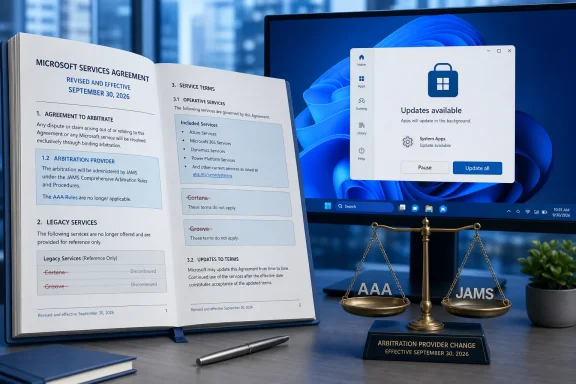 Cortana and Groove are gone from the operative terms, not the master list
The old Services Agreement treated Cortana as a live personal-assistant service. It included clauses about personalized features, third-party integrations, Cortana-enabled hardware, purchases made through connected services, and automatic updates to Cortana software. The incoming version keeps a single short declaration: Cortana was a personal assistant service for noncommercial use, and Microsoft no longer supports Cortana Services as of 2024.
That is a legal cleanup rather than a new product retirement. Microsoft’s support documentation says the standalone Cortana app for Windows was retired in spring 2023; Cortana integrations across Teams mobile, Teams Rooms, Outlook mobile, and Microsoft 365 mobile followed in fall 2023; and Outlook mobile’s voice search and Play My Emails features were retired in June 2024. The September 2026 agreement is therefore two years behind the last listed service retirement.
Groove is similar, though the wording is more decisive. The prior Digital Goods clause said Microsoft could provide digital music, video, books, games, and other media through “Microsoft Groove,” Microsoft Movies & TV, Store, Xbox services, and future related services. The revised clause removes Groove from that sentence. Microsoft’s change log explicitly says Groove is no longer available.
The oddity is that neither service disappears from the document’s final list of covered products. “Cortana,” “Cortana skills by Microsoft,” “Groove,” and “Groove Music Pass” remain listed there, alongside other long-dead Microsoft names such as Mixer, Windows Movie Maker, Windows Live Mail, and Xbox Music.
This is not evidence that Groove or Cortana are returning. It shows the difference between the agreement’s operative terms and its sprawling catch-all inventory of products that have at some point fallen under the consumer agreement. Microsoft has removed the clauses that imply it still operates these services while leaving the catalog untouched. For customers, that means the contract is less misleading; for Microsoft, it avoids a more labor-intensive cleanout of legacy names across the whole legal document.
Microsoft Store updates now have a clearer consequence
The more relevant Windows change is in the Microsoft Store section. Microsoft already reserved the right to check for and download app updates even when a user was not signed in to the relevant Store. The revised language says customers may change Store or system settings to pause automatic updates, rather than simply state a preference not to receive them.
The important addition is what follows: certain apps cannot be used until an update is accepted, and choosing not to download or install updates can mean an app is no longer available, supported, or retains its earlier functionality. That is the practical rule users need to understand.
It does not mean Microsoft has suddenly acquired a new power to update every Windows application. The agreement distinguishes Microsoft Store apps from Office Store applications that are partly or wholly online. Developers of those hosted Office applications may update them without requiring user permission, as they could under prior language. Microsoft’s existing Windows support guidance also makes clear that publishers can manage updates through their own apps, outside the Store’s update toggle.
The new wording instead closes a gap between an apparent user control and the support reality. You can pause Store app updates, but that setting is not a promise that an old build will remain usable. Developers can make backend changes, revoke compatibility, require a new service endpoint, or set a minimum version before the application will connect. In managed environments, that is familiar behavior; in the consumer agreement, Microsoft is now spelling it out.
Windows enthusiasts who deliberately defer Store updates to avoid interface changes or regressions should treat the language as a warning, not an alarm. Keep a working rollback and packaging strategy where possible, especially for Store-delivered utilities that are important to your workflow. But do not confuse a paused update with a supported frozen version.
The agreement applies to consumer services, not volume-licensed Microsoft 365, Azure, Microsoft 365 for enterprise, education, or government customers. Administrators managing those products remain governed by their organizations’ applicable commercial agreements and service-specific documentation. A personal Microsoft account used on a work PC can still bring the consumer agreement into play for its own consumer services.
The unadvertised material change is arbitration
Microsoft’s own summary places its biggest legal change after the product housekeeping: U.S. arbitrations initiated after the September 30 effective date will move from the American Arbitration Association to JAMS. The agreement also updates the rules and procedures incorporated into the contract, confirms that the Federal Arbitration Act governs the arbitration section, and creates a post-batch mediation requirement for unresolved “Related Cases,” with Microsoft paying the mediation fee.
That is not a Windows feature change, but it is more consequential than deleting a Groove reference. The Services Agreement contains a binding arbitration clause and class-action waiver for U.S. residents and businesses. In plain terms, disputes covered by the agreement are generally directed away from court and into individual arbitration, subject to the contract’s exceptions and procedures.
Microsoft’s public change summary does not explain why it selected JAMS or quantify how the revised batch and mediation process will work in practice. It also does not identify whether the change was driven by cost, caseload, procedural preferences, or the providers’ differing rules. The company is transparent that the provider changes; it offers no consumer-facing rationale for the switch.
Anyone who uses Microsoft’s consumer services only casually is unlikely to notice. People with substantial Microsoft account balances, Xbox purchases, OneDrive data, Rewards points, or a potential account-enforcement dispute should at least recognize that the dispute-resolution machinery changes on the same date as the rest of the agreement.
Copilot, Microsoft 365, and Rewards receive naming repairs
Microsoft is also consolidating its Copilot terms. The heading “Copilot AI Experiences” becomes simply “Copilot,” and the new clause says use of Copilot is governed by the relevant supplemental terms together with the Services Agreement. The prior version separately carved out Copilot with commercial data protection; the new wording instead says it clarifies which Copilot versions sit within this consumer agreement.
Microsoft 365 language has been updated to reflect current consumer suite names, including Microsoft 365 Personal, Microsoft 365 Family, and Microsoft 365 Premium. The rewritten clause focuses on the software license terms for Word, Excel, PowerPoint, Outlook, OneDrive, Access, Publisher, and other consumer Microsoft 365 services. This is primarily nomenclature and contract maintenance, not a licensing expansion announced through the agreement.
The Microsoft Rewards edit is less transparent. Microsoft says it has updated annual redemption limits to reflect two tiers of limits, but the agreement itself continues to direct users to Rewards support pages for the limits that currently apply. It does not publish the two thresholds in the contract. That leaves users unable to determine from the change notice alone whether their redemption behavior is affected, which accounts qualify for which tier, or whether the tiers vary by region.
That omission is especially notable because Rewards points are explicitly not a customer’s property under the agreement, have no cash value, and can be limited by Microsoft. If Microsoft is changing an annual redemption ceiling, the operative number should be easy to find before users hit it—not only after a redemption is denied.
What changes on September 30
The incoming agreement was published on July 30, 2026, and Microsoft says continued use of covered consumer products and services on or after September 30 constitutes acceptance. Users who do not agree must stop using the services and close their Microsoft account before that date.
For most Windows users, the productive reading is straightforward:
- Cortana and Groove are being removed from the parts of the contract that still pretended they operated, though their names remain in the covered-services appendix.
- Microsoft Store app updates can be paused, but an outdated app may lose support, functionality, or access until it is updated.
- U.S. disputes under the consumer agreement will move from AAA arbitration to JAMS arbitration.
- Microsoft has changed Rewards redemption-limit language without publishing the tier thresholds in the agreement itself.
The contract revision does not revive or newly kill Cortana or Groove. It records their long-completed retirements while tightening the legal position around app updates and dispute handling—the parts of this annual legal refresh that can still affect a Windows user after September 30.
References
- Primary source: Neowin
Published: August 8, 2026 at 9:30 PM UTC
Loading…
www.neowin.net - Related coverage: support.microsoft.com
Loading…
support.microsoft.com - Related coverage: support.microsoft.com
Loading…
support.microsoft.com - Related coverage: microsoft.com
Loading…
www.microsoft.com - Related coverage: blogs.microsoft.com
The next phase of the Microsoft-OpenAI partnership - The Official Microsoft Blog
Amended Agreement Provides Long-Term Clarity The rapid pace of innovation requires us to continue to evolve our partnership to benefit our customers and both companies. Today, we are announcing an amended agreement to simplify our partnership and the way we work together, grounded in...blogs.microsoft.com - Related coverage: microsoft.com
Loading…
www.microsoft.com - Related coverage: neowin.net
Loading…
www.neowin.net - Related coverage: techcommunity.microsoft.com
- Related coverage: learn.microsoft.com
Loading…
learn.microsoft.com - Related coverage: sdpc.a4l.org
Loading…
sdpc.a4l.org - Related coverage: download.microsoft.com
Loading…
download.microsoft.com