That is a meaningful distinction. A 3 GW lease would rank among the largest single AI infrastructure commitments disclosed anywhere, roughly 50% larger than Microsoft’s already substantial 2 GW Pecos, Texas campus announcement in June. A deal of that size would also be difficult to reconcile with the public record without at least some disclosure from Microsoft, SpaceX, a developer, a power supplier, or a major financial filing.
The evidence available as of August 9 supports a more modest conclusion: Microsoft is aggressively buying and building AI capacity; SpaceX has said it intends to sell excess terrestrial AI compute to selected third parties; and a future commercial relationship is plausible. The reported 3+ GW Microsoft lease, however, remains unverified speculation rather than established news.
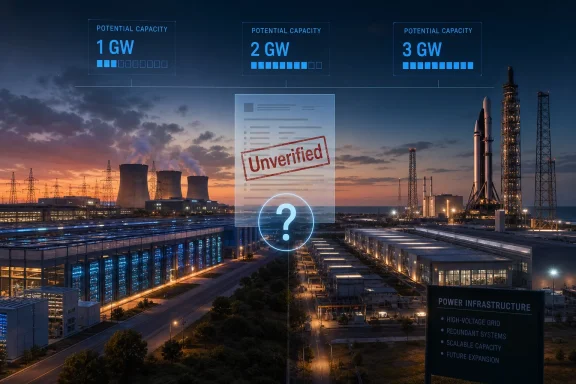 The headline overstates what the article establishes
NextBigFuture presents the claim as settled in its headline: Microsoft “Will Lease 3+ Gigawatts” from SpaceX in 2027. But its article offers no contract documents, no attributable company statement, and no reporting that identifies where the capacity would be located or what Microsoft would pay.
Instead, the post makes a chain of projections: SemiAnalysis’s assumptions about AI token revenue per gigawatt, an assertion that SpaceX could complete 10 GW of AI data-center capacity, and a calculation that Microsoft could reach more than $300 billion in annualized Azure AI revenue if it leased capacity from SpaceX. Those projections may be interesting to investors, but they do not establish that a lease exists.
The lack of basic deal terms is especially conspicuous for a claim at this scale. A genuine 3 GW capacity commitment would need answers to several operational questions:
- Is the figure IT load, total facility power, or contracted power generation capacity?
- Is the capacity in one campus or several locations, and is it terrestrial or orbital?
- Is Microsoft leasing powered shells, GPU-equipped compute, or a managed inference service?
- What is the delivery schedule during 2027, and what hardware generation is included?
- Is there a minimum-spend obligation, a take-or-pay structure, or a termination right?
None is supplied. The post also provides no indication that Microsoft, SpaceX, xAI, regulators, lenders, utilities, or construction partners have confirmed the supposed transaction.
That is not a minor reporting gap. The difference between “SpaceX may someday offer capacity to Microsoft” and “Microsoft has signed for 3 GW in 2027” is the entire story.
SpaceX’s own prospectus describes a 1 GW installed base, not a disclosed Microsoft commitment
SpaceX’s June 2026 prospectus offers the strongest primary record on the company’s terrestrial AI operations. It says the combined nameplate compute draw of COLOSSUS and COLOSSUS II reached approximately 1.0 GW as of March 31, 2026. The prospectus explicitly defines that metric as GPU power draw and says it excludes cooling, power-distribution losses, lighting, security, and other facility overhead.
That definition matters because the gigawatt numbers now circulating in AI infrastructure coverage are often not comparable. A site can be described in terms of grid interconnection, generation capacity, facility load, or accelerator draw. Each measure can produce very different numbers for what appears to be the same data center.
SpaceX also says in the prospectus that it intends to sell excess AI capacity to a limited number of third parties and explore becoming a supplier alongside firms such as CoreWeave and Nebius. Microsoft is mentioned in the document as a competitor in AI models and cloud services, not as a named customer or counterparty to a capacity contract.
The prospectus does describe future expansion at COLOSSUS II, including more than 400 MW of additional compute capacity once a next phase is operational. But that still does not amount to a disclosed 3 GW Microsoft lease. Nor does it establish that three gigawatts will be available to outside customers in 2027 rather than used for Grok training, inference, other customers, redundancy, or future expansion.
SpaceX has commercial ambitions in AI infrastructure. It has not publicly tied Microsoft to a 3 GW capacity purchase.
Orbital AI cannot be the 2027 explanation
The SpaceX filing is also clear on timing for its space-based ambitions: it expects to begin deploying orbital AI-compute satellites as early as 2028. It describes early satellites generating about 100 kilowatts of compute power and acknowledges that meaningful scale would require enormous satellite manufacturing and launch cadence.
That makes an orbital interpretation of the NextBigFuture headline untenable for 2027. A 3 GW orbital service would equal 30,000 units of 100 kW compute capacity before accounting for redundancy, networking, ground links, maintenance, and the realities of launching and operating hardware at scale. SpaceX’s long-term target of deploying 10 GW or even 100 GW annually is presented as an ambition based on future manufacturing and launch capabilities, not a capacity commitment available next year.
If Microsoft were to buy from SpaceX in 2027, the available public evidence points to terrestrial capacity, likely associated with SpaceX/xAI’s fast-build data-center model and behind-the-meter power generation. But even that interpretation remains a hypothesis. The companies have not identified a site, utility arrangement, construction program, or product offering connected to Microsoft.
For IT buyers, the distinction is practical. Terrestrial hosted GPU capacity can be contracted, provisioned, connected to Azure services, and governed through conventional data-residency and compliance arrangements. An orbital compute service would introduce radically different architecture, latency, data-transfer, support, fault-tolerance, and regulatory questions. Treating the two as interchangeable “gigawatts” obscures the actual delivery risk.
Microsoft’s confirmed capacity plans show why the rumor sounds plausible
Microsoft is not standing still. The company announced in June that it will build an approximately 2 GW data-center campus in Pecos, Texas, over the next five to seven years. Microsoft said the campus will use dedicated, on-site energy infrastructure initially and that it is funding the generation and supporting equipment needed for its own operations.
Microsoft also has a documented lease at the Crusoe-developed Abilene, Texas campus. The Information reported that Microsoft had leased a 900 MW site after Oracle and OpenAI walked away from the planned expansion, while Data Center Dynamics earlier reported an approximately 700 MW arrangement based on sources familiar with the matter. The later confirmed figure is 900 MW, illustrating another important point: early megawatt reports can change materially as deals close and scope becomes public.
Those transactions show that Microsoft has both the financial capacity and the immediate need to secure enormous blocks of AI power. They do not validate the SpaceX claim. Pecos is Microsoft-built capacity; Abilene is a Crusoe lease. Neither is SpaceX capacity, and neither adds evidence of a separate 3 GW agreement.
Microsoft’s April 27 restructuring of its OpenAI relationship does strengthen its incentive to acquire more compute for Azure and its own AI services. OpenAI said Microsoft will no longer pay OpenAI a share of Microsoft revenue earned by offering OpenAI models on Azure. But the same announcement says OpenAI’s revenue-share payments to Microsoft continue through 2030, subject to a cap. The NextBigFuture post gets the first half of that change right while omitting the continuing revenue stream in the other direction.
More capacity does give Microsoft additional choices: serve OpenAI, run Microsoft’s own models and Copilot services, or sell AI infrastructure and model access to Azure customers. Yet the leap from that incentive to a forecast of Azure growth exceeding 100% next year is unsupported. Microsoft’s recently reported Azure growth has been in the low-40% range; capacity availability is important, but revenue depends on customer demand, pricing, utilization, model costs, and the timing of hardware deployment.
The consequence: do not plan around a deal that has not been disclosed
The most useful reading of this report is not that Microsoft has secured a vast new supply of SpaceX compute. It is that the AI infrastructure market has reached a point where a 3 GW bilateral lease sounds credible enough to spread quickly—even when the underlying evidence does not show that it happened.
Windows and Azure administrators should treat it accordingly. There is no announced Azure region, no new GPU SKU, no private-preview program, no published service-level agreement, and no customer migration path tied to SpaceX capacity. Enterprise procurement teams should not infer future Azure availability, pricing, or OpenAI-model access from the claim.
A confirmed agreement would leave a substantial paper trail: a named capacity site, a construction or power partner, a SpaceX disclosure, Microsoft commentary, or an Azure product and region roadmap. Until one of those appears, the 3+ GW figure belongs in the category of market speculation—not Microsoft’s capacity plan for 2027.
References
- Primary source: nextbigfuture.com
Published: August 8, 2026 at 6:29 PM UTC
- Related coverage: blogs.microsoft.com
Powering the next wave of AI: Expanding capacity with our new datacenter in Pecos - The Official Microsoft Blog
Today, Microsoft is announcing one of the largest single capacity additions in our history. In Pecos, Texas, we will build a new datacenter campus, expanding our global datacenter capacity by approximately 2 gigawatts (GW) to meet strong and sustained customer demand for AI and cloud services...blogs.microsoft.com - Related coverage: techinvestment.com
- Related coverage: sciencesprings.wordpress.com
From WIRED: “Data Center Operators Are Trying to Fix Their Water Use Problems” – sciencesprings
From WIRED Jun 3, 2026 Molly Taft Google, Microsoft, and other hyperscalers have come under scrutiny for their impact on water quality and availability. Data Center in Newark, Calif. Credit: Jason …sciencesprings.wordpress.com - Related coverage: explainx.ai
SpaceX AI1 Orbital Solar Datacenter: Technical Breakdown and Feasibility (2026) | explainx.ai Blog | explainx.ai
SpaceX filed for 1 million solar-powered orbital AI data centers, unveiled the AI1 satellite with 150kW peak compute, and merged with xAI. Full technical breakdown and honest feasibility analysis inside.explainx.ai - Related coverage: inc.com
- Related coverage: content.spacex.com
Project Apex Australian Wrap and S 1 Final (Lodgement 4 June 2026) Compressed vF
PDF documentcontent.spacex.com
- Related coverage: content.spacex.com
- Related coverage: local.microsoft.com
- Related coverage: theinformation.com
Microsoft Leases Texas Data Center Site After Oracle and OpenAI Walked Away — The Information
Microsoft will lease a 900-megawatt data center site in Abilene, Texas, the company confirmed on Friday. The site, developed by data center startup Crusoe, was originally intended for Oracle, which occupies other data centers on the site, which Crusoe developed for the cloud provider. But Oracle...www.theinformation.com - Related coverage: tbpndigest.com

SemiAnalysis's Doug O'Laughlin: Amazon's execution edge is why OpenAI chose AWS, space data centers are hype | TBPN Digest
OpenAI chose AWS over competitors because Amazon can deliver 5 to 6 gigawatts of data center capacity in 2026 while Oracle, Coreweave, and Flexential face construction and power delays.
www.tbpndigest.com
- Related coverage: news.microsoft.com
Microsoft Unveils Regional Express Bus Service, Expands Seattle Presence With New Offices - Source
New employee shuttle service to help ease the commute, take 240,000 cars off roads per year.news.microsoft.com - Related coverage: datacenterdynamics.com
Microsoft agrees to lease 700MW at Crusoe's data center in Abilene, Texas - report - DCD
Talks conclude: Microsoft gets the gigwww.datacenterdynamics.com - Related coverage: siliconreport.com
The biggest AI data centers in the US, ranked by power capacity — Silicon Report
Blackstone's QTS platform leads the field at 3 gigawatts of commissioned capacity, trailed by a cluster of 2-to-2.2GW campuses from AWS, OpenAI's Starga...www.siliconreport.com - Related coverage: nextbigfuture.com
- Related coverage: news.bloomberglaw.com
Duke to Power Microsoft Data Center in North Carolina (Correct)
Duke Energy has signed deals with Microsoft and Compassto power expansive data center complexes under construction in North Carolina as the artificial intelligence boom supercharges the demand for electricity.news.bloomberglaw.com
- Related coverage: seekingalpha.com
Crusoe confirms Microsoft as new 900MW capacity customer at Abilene data center site | Seeking Alpha
Crusoe says Microsoft will lease 900MW at its Abilene, Texas AI data center, boosting capacity to 2.1GW—get the latest hyperscaler infrastructure update.seekingalpha.com - Related coverage: windowscentral.com
Microsoft filings suggest "around 70%" of its AI revenue is concentrated entirely on OpenAI — which seems rather unhealthy | Windows Central
Recent analysis showed that Microsoft's AI business, while seemingly booming, still carries a somewhat enormous Sam Altman-shaped risk.www.windowscentral.com - Related coverage: openai.com
The next phase of the Microsoft OpenAI partnership | OpenAI
OpenAI and Microsoft announce an amended agreement that simplifies the partnership, adds long-term clarity, and supports continued AI innovation at scale.openai.com - Related coverage: openai.com
Joint Statement from OpenAI and Microsoft | OpenAI
Microsoft and OpenAI continue to work closely across research, engineering, and product development, building on years of deep collaboration and shared success.openai.com - Related coverage: theinformation.com
Microsoft Gives Up Exclusive Rights to Sell OpenAI Models — The Information
Microsoft and OpenAI amended the terms of their arrangement, allowing OpenAI to sell its models on competing cloud providers, the companies said on Monday. The companies also scrapped a controversial clause in their deal that would have granted Microsoft a share of OpenAI’s revenue and certain...www.theinformation.com - Related coverage: arstechnica.com
OpenAI ends its exclusive partnership with Microsoft - Ars Technica
Amended agreement clears the way for OpenAI models to run on Amazon Bedrock.arstechnica.com - Related coverage: microsoft.com
Microsoft Fiscal Year 2026 Second Quarter Earnings Conference Call
www.microsoft.com
- Related coverage: investing.com
Microsoft, OpenAI change terms of deal so startup can court Amazon and others By Reuters
Microsoft, OpenAI change terms of deal so startup can court Amazon and otherswww.investing.com - Related coverage: sec.gov
Document
www.sec.gov - Related coverage: microsoft.com
Microsoft Fiscal Year 2026 Third Quarter Earnings Conference Call
- Related coverage: washingtonpost.com
Microsoft cuts OpenAI revenue share in a fresh step to loosen their AI alliance - The Washington Post
Microsoft said Monday it will no longer pay a share of its revenue to ChatGPT maker OpenAI, the latest move to untether a close partnership that helped unleash an artificial intelligence boom www.washingtonpost.com
- Related coverage: finance.yahoo.com
Microsoft Corp (MSFT) (Q4 2026) Earnings Call Highlights: Record Revenue Surpasses $331 ...
Microsoft Corp (MSFT) delivered a record fiscal year with Azure revenue surpassing $100 billion, while AI-driven demand continues to outpace capacity.finance.yahoo.com