
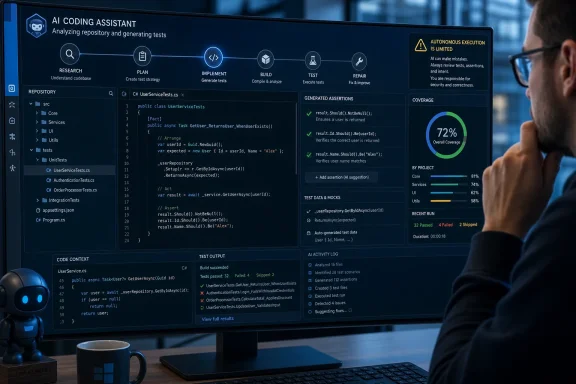
Microsoft has added a code-testing-agent skill to its open-source TestFX repository that can direct an AI coding assistant to research a codebase, plan unit tests, write them, build them, run them, and attempt repairs when they fail. The practical catch is in the implementation: this is not a new standalone Microsoft testing product or a general-purpose test engine that developers can simply install and run unattended. It is a set of Markdown instructions and role definitions intended for an agent-capable development environment, with Microsoft’s own documentation listing Visual Studio Code and the GitHub Copilot extension as requirements.
InfoWorld first reported the July 31 addition as “code-testing-generator,” the name of the orchestration agent invoked by the skill. Microsoft’s GitHub record uses a more precise distinction: code-testing-agent is the installable skill, while
What Microsoft has published is useful, but its real value lies in standardizing a workflow that many teams are already prompting coding agents to perform inconsistently. The new material packages repository inspection, test authoring, compilation, execution, error correction, and linting into a repeatable sequence. It could make generated tests less disposable. It does not remove the need to judge whether those tests prove anything important.
The code arrived inside Microsoft’s public TestFX project, home to MSTest and Microsoft.Testing.Platform. TestFX is an obvious place for Microsoft to publish it: the repository already carries testing guidance, framework migration material, coverage-analysis tools, and build diagnostics. But that location also reveals the limits of the announcement.
The artifact is a skill definition under the repository’s
That is different from shipping a model, a compiler-integrated code-analysis engine, or a test-generation service with a defined support lifecycle. Microsoft has supplied the playbook that a compatible agent should follow. The actual output will still depend on the model selected by the user, the agent host, its tool permissions, the repository’s build environment, and whether the project can be built and tested locally.
Microsoft’s documentation calls for a project with a build and test system already configured, plus an installed or installable test framework. In other words, this does not bootstrap a broken or undocumented codebase into a reliably tested one. It works best after a team has already done the unglamorous work: a reproducible build, a functioning test runner, dependencies available to the developer or CI worker, and conventions worth copying.
The claim that it supports “any programming language” should be read as an aspirational interface claim, not a compatibility certification. The published guidance contains dedicated examples for .NET, Python, TypeScript, Go, and Java. It also names Rust, Ruby, Swift, Kotlin, C++, and PowerShell as languages where the same process can be adapted. Microsoft does not publish a supported-language matrix, compatibility tests, or success-rate data for those broader targets.
The planning phase then produces
This is a sensible response to the most common failure mode in AI-generated test code: an agent writes something that resembles the project’s test style but references the wrong APIs, assumes a dependency is mockable when it is not, or uses a test command that was valid three years ago. Reading the repository before generating code is not a breakthrough. Making it an explicit required step is more valuable than the marketing shorthand suggests.
Microsoft’s supplied test-generation instructions also tell the agent to discover existing naming, location, assertion, mocking, and harness conventions before producing tests. It asks for concise and parameterized cases, with happy paths, edge conditions, invalid inputs, exceptions, state transitions, and dependency mocking considered where appropriate. The target is 80% coverage across the requested scope.
The important word there is target. Eighty percent coverage is not a quality certificate, and Microsoft does not present it as one. Coverage measures whether a test executed code, not whether it checked the right result or defended against a meaningful regression. A generated test suite can push a coverage meter upward while merely confirming that methods return whatever the current implementation returns.
Microsoft’s own troubleshooting guidance quietly acknowledges a more basic risk. It says that many generated-test failures come from incorrect expected values in assertions rather than production defects, and directs developers to inspect the actual test output and source code before changing anything. That is the correct advice, but it puts human review back at the center of the process. A passing generated test is evidence that the test and current code agree; it is not independent evidence that the behavior is correct.
Microsoft’s documentation tells the agent to avoid environment-dependent tests involving external services, endpoints, ports, and precise timing because they fail in CI. That is sound unit-test practice. But it also exposes the gap between generated unit-test volume and actual application confidence. Mocking an HTTP client can prove that a method called the client correctly; it does not prove Microsoft Entra ID accepted a token, SQL Server applied a migration, or a Windows service had the permissions it needed in a hardened production environment.
This creates a predictable deployment problem if teams treat the new skill as a coverage accelerator rather than a test-design assistant. The easiest code to test will be tested first. Difficult seams — static dependencies, filesystem operations, registry access, native calls, authentication boundaries, background jobs, and UI code — will either be heavily mocked or skipped. The resulting coverage reports can look healthier while the highest operational risks remain outside the generated suite.
For .NET teams, the strongest use case is probably narrower: ask the agent to work on a specific project or class, require it to follow the repository’s existing MSTest, xUnit, NUnit, or TUnit conventions, and review the generated diff as if it came from a junior contributor. The tool is positioned to find the test command and framework rather than force a migration to MSTest. That is a welcome constraint for repositories where the test framework is a settled architectural choice.
Those omissions are material for organizations using GitHub Copilot or another compatible coding agent against proprietary code. The skill may be open source, but the environment it guides can still access source files, restore packages, run scripts, modify test projects, and execute arbitrary test setup code. Test suites are code. A repository’s build and test scripts may reach package feeds, local tooling, service emulators, containers, or network resources.
Microsoft’s broader guidance for agentic code execution recommends sandboxing or containerization to avoid unintended system changes. That should be the baseline here, particularly for developer workstations with production credentials, access to internal feeds, or checked-out source from multiple customers. An agent that is allowed to “fix” compilation failures needs a constrained write scope and a clear rule that it cannot alter production behavior merely to make a test pass.
A practical first deployment should therefore be limited:
But a test that compiles and passes can still be wrong, especially when the same agent inferred both the behavior and the expected result. Microsoft’s own material effectively concedes this by instructing developers to inspect assertions against the source when tests fail. The same discipline should apply when they pass.
For Windows and .NET teams, the immediate opportunity is not to hand an entire solution to the agent and demand an 80% coverage number. It is to use the skill on small, reviewable units of logic where a human already understands the expected behavior, then compare its generated tests against the team’s own regression history and failure modes. If it finds overlooked null handling, boundary conditions, or error cases while respecting the project’s existing framework, it has earned a place in the workflow.
Microsoft has released a reusable unit-test generation procedure, not an automated substitute for test engineering. Its first practical test will be whether teams preserve that distinction when the coverage dashboard starts moving.
code-testing-generator is the coordinator it tells an AI assistant to call. That naming detail matters for administrators and developers looking for a package, service, or new Visual Studio feature under the reported name: there is no separate code-testing-generator repository or product release to deploy.What Microsoft has published is useful, but its real value lies in standardizing a workflow that many teams are already prompting coding agents to perform inconsistently. The new material packages repository inspection, test authoring, compilation, execution, error correction, and linting into a repeatable sequence. It could make generated tests less disposable. It does not remove the need to judge whether those tests prove anything important.
 A skill embedded in Microsoft’s TestFX repository
The code arrived inside Microsoft’s public TestFX project, home to MSTest and Microsoft.Testing.Platform. TestFX is an obvious place for Microsoft to publish it: the repository already carries testing guidance, framework migration material, coverage-analysis tools, and build diagnostics. But that location also reveals the limits of the announcement.The artifact is a skill definition under the repository’s
.agents/skills directory. Its central file, SKILL.md, is documentation that tells an AI coding agent how to behave. It defines the cases where it should be used, the files it should create, the specialist roles it should invoke, and the conditions it should check before claiming success. The skill is licensed under MIT, so teams can inspect, modify, and redistribute the instructions.That is different from shipping a model, a compiler-integrated code-analysis engine, or a test-generation service with a defined support lifecycle. Microsoft has supplied the playbook that a compatible agent should follow. The actual output will still depend on the model selected by the user, the agent host, its tool permissions, the repository’s build environment, and whether the project can be built and tested locally.
Microsoft’s documentation calls for a project with a build and test system already configured, plus an installed or installable test framework. In other words, this does not bootstrap a broken or undocumented codebase into a reliably tested one. It works best after a team has already done the unglamorous work: a reproducible build, a functioning test runner, dependencies available to the developer or CI worker, and conventions worth copying.
The claim that it supports “any programming language” should be read as an aspirational interface claim, not a compatibility certification. The published guidance contains dedicated examples for .NET, Python, TypeScript, Go, and Java. It also names Rust, Ruby, Swift, Kotlin, C++, and PowerShell as languages where the same process can be adapted. Microsoft does not publish a supported-language matrix, compatibility tests, or success-rate data for those broader targets.
Research, plan, implement — then build and run
The significant design choice is Microsoft’s use of a research-plan-implement pipeline rather than a one-shot “write tests for this file” prompt. The first phase surveys the repository to identify the language, test framework, project structure, dependencies, existing tests, and the commands needed to build and run the result. It saves that assessment to.testagent/research.md.The planning phase then produces
.testagent/plan.md, grouping work into phases, ranking files by complexity and dependencies, identifying test cases, and setting success criteria. Only after those steps does the implementation agent begin writing test files. The implementation phase can call separate builder, tester, fixer, and linter roles to compile the project, execute generated tests, repair errors, and format code.This is a sensible response to the most common failure mode in AI-generated test code: an agent writes something that resembles the project’s test style but references the wrong APIs, assumes a dependency is mockable when it is not, or uses a test command that was valid three years ago. Reading the repository before generating code is not a breakthrough. Making it an explicit required step is more valuable than the marketing shorthand suggests.
Microsoft’s supplied test-generation instructions also tell the agent to discover existing naming, location, assertion, mocking, and harness conventions before producing tests. It asks for concise and parameterized cases, with happy paths, edge conditions, invalid inputs, exceptions, state transitions, and dependency mocking considered where appropriate. The target is 80% coverage across the requested scope.
The important word there is target. Eighty percent coverage is not a quality certificate, and Microsoft does not present it as one. Coverage measures whether a test executed code, not whether it checked the right result or defended against a meaningful regression. A generated test suite can push a coverage meter upward while merely confirming that methods return whatever the current implementation returns.
Microsoft’s own troubleshooting guidance quietly acknowledges a more basic risk. It says that many generated-test failures come from incorrect expected values in assertions rather than production defects, and directs developers to inspect the actual test output and source code before changing anything. That is the correct advice, but it puts human review back at the center of the process. A passing generated test is evidence that the test and current code agree; it is not independent evidence that the behavior is correct.
Unit tests are the boundary, not the beginning
The agent’s scope is strictly unit tests. Microsoft expressly excludes integration, end-to-end, browser, and performance testing from this skill. That makes it a reasonable fit for pure business logic, validation code, parser behavior, data transformations, and isolated service classes. It is a weak fit for the problems that consume much of an enterprise Windows shop’s debugging time: identity failures, policy interactions, deployment drift, network access, database semantics, browser behavior, desktop UI automation, and production-only configuration differences.Microsoft’s documentation tells the agent to avoid environment-dependent tests involving external services, endpoints, ports, and precise timing because they fail in CI. That is sound unit-test practice. But it also exposes the gap between generated unit-test volume and actual application confidence. Mocking an HTTP client can prove that a method called the client correctly; it does not prove Microsoft Entra ID accepted a token, SQL Server applied a migration, or a Windows service had the permissions it needed in a hardened production environment.
This creates a predictable deployment problem if teams treat the new skill as a coverage accelerator rather than a test-design assistant. The easiest code to test will be tested first. Difficult seams — static dependencies, filesystem operations, registry access, native calls, authentication boundaries, background jobs, and UI code — will either be heavily mocked or skipped. The resulting coverage reports can look healthier while the highest operational risks remain outside the generated suite.
For .NET teams, the strongest use case is probably narrower: ask the agent to work on a specific project or class, require it to follow the repository’s existing MSTest, xUnit, NUnit, or TUnit conventions, and review the generated diff as if it came from a junior contributor. The tool is positioned to find the test command and framework rather than force a migration to MSTest. That is a welcome constraint for repositories where the test framework is a settled architectural choice.
The security and governance work stays with the operator
The workflow reads source code, writes new files, invokes build commands, runs tests, and potentially repeats those actions after failures. That makes it more powerful than autocomplete, and it demands a correspondingly tighter execution boundary. The TestFX documentation does not specify a sandbox model, a permissions policy, an approval mechanism for command execution, or a data-handling model for repositories used with the skill.Those omissions are material for organizations using GitHub Copilot or another compatible coding agent against proprietary code. The skill may be open source, but the environment it guides can still access source files, restore packages, run scripts, modify test projects, and execute arbitrary test setup code. Test suites are code. A repository’s build and test scripts may reach package feeds, local tooling, service emulators, containers, or network resources.
Microsoft’s broader guidance for agentic code execution recommends sandboxing or containerization to avoid unintended system changes. That should be the baseline here, particularly for developer workstations with production credentials, access to internal feeds, or checked-out source from multiple customers. An agent that is allowed to “fix” compilation failures needs a constrained write scope and a clear rule that it cannot alter production behavior merely to make a test pass.
A practical first deployment should therefore be limited:
- Run the skill in a disposable branch or isolated working tree, never directly against a release branch.
- Give the agent access to a non-production test environment and remove secrets from the process environment before it runs builds or tests.
- Require code review for every generated assertion, mock, expected value, and test project change.
- Treat
.testagentresearch and planning files as review artifacts, because they show what the agent believed the repository’s conventions and commands were. - Run the repository’s full test suite and static analysis independently after the agent’s scoped work completes.
A better prompt recipe, not autonomous quality assurance
The strongest conclusion from Microsoft’s code-testing-agent is that the company is trying to move agentic coding from improvisation toward durable, inspectable workflow artifacts. The research and plan files make an agent’s assumptions visible. The build-test-fix loop forces at least a mechanical check that generated tests compile and pass. Those are improvements over pasting a class into chat and accepting whatever test fixture returns.But a test that compiles and passes can still be wrong, especially when the same agent inferred both the behavior and the expected result. Microsoft’s own material effectively concedes this by instructing developers to inspect assertions against the source when tests fail. The same discipline should apply when they pass.
For Windows and .NET teams, the immediate opportunity is not to hand an entire solution to the agent and demand an 80% coverage number. It is to use the skill on small, reviewable units of logic where a human already understands the expected behavior, then compare its generated tests against the team’s own regression history and failure modes. If it finds overlooked null handling, boundary conditions, or error cases while respecting the project’s existing framework, it has earned a place in the workflow.
Microsoft has released a reusable unit-test generation procedure, not an automated substitute for test engineering. Its first practical test will be whether teams preserve that distinction when the coverage dashboard starts moving.
References
- Primary source: InfoWorld
Published: 2026-08-07T05:16:59+00:00
Loading…
www.infoworld.com - Related coverage: microsoft.github.io
Loading…
microsoft.github.io - Related coverage: github.com
Loading…
github.com - Related coverage: microsoft.github.io
Loading…
microsoft.github.io - Related coverage: github.com
Loading…
github.com - Related coverage: mcpservers.org
Loading…
mcpservers.org - Related coverage: skills.managed-code.com
Loading…
skills.managed-code.com