
Microsoft’s latest Thailand findings from its 2026 Work Trend Index put the country near the top of its AI-readiness measure: 32% of Thai AI users are classified as “Frontier Professionals,” twice the 16% benchmark Microsoft uses for the report’s global survey. But the more consequential figure is the one Microsoft says happens after an employee discovers a useful prompt, agent, or redesigned process: only two in ten Thai teams systematically document those wins into repeatable workflows.
That gap is the substance behind Microsoft Thailand’s new “Owned Intelligence” pitch. The company is arguing that AI value does not reside in a Copilot chat, an individual employee’s prompt library, or a successful pilot. It resides in the ability to turn a local practice into governed organizational knowledge: an approved workflow, a defined owner, access controls, quality checks, an escalation path, and a record of what the system is allowed to do.
Microsoft’s August 4 Thailand announcement follows its global Work Trend Index release in May and a Thailand-focused regional release in June. The company’s own reporting makes the central problem unusually clear: Thai workers appear eager to use AI, but the surrounding management systems are still built for conventional productivity work. That leaves organizations with high individual experimentation and low institutional retention of what those experiments teach them.
For Windows and Microsoft 365 administrators, that is a warning against treating Copilot or AI agents as another end-user productivity rollout. The hard work begins when a useful AI-assisted process needs to become dependable enough for the next employee, the next department, and the next audit.
Microsoft says 89% of Thai workers treat AI-generated material as a starting point to refine rather than a final answer, while 86% of the report’s Frontier Professionals say AI lets them produce work they could not have done a year earlier. Those figures suggest substantial willingness to work with AI rather than simply use it for search or first-draft writing.
Yet the skills data complicates the celebratory headline. Only 53% of Thai respondents identify quality control of AI output as an increasingly important skill, according to Microsoft’s August announcement. Only 45% point to critical thinking when working with AI, placing Thailand last in Microsoft’s six-country Southeast Asia comparison on that measure.
This is not a minor training deficit. The value of an agentic workflow depends on a person or team being able to judge whether an output is correct, appropriate, complete, and safe to act on. An AI assistant that summarizes tickets, drafts customer replies, reconciles information, or recommends operational next steps may save time even when it is occasionally wrong. An agent that can take actions in systems of record changes the risk profile entirely.
Microsoft’s global report acknowledges this directly. It says agents introduce risks including unintended system actions, unauthorized access, and data exfiltration, and it argues that IT needs to manage them as entities with identities, permissions, policy enforcement, and lifecycle management. The Thailand release promotes “human agency,” but the operational translation is more specific: human supervision has to include defined accountability and the technical ability to stop, review, and correct an automated process.
An organization cannot claim it has retained “Owned Intelligence” if its best AI workflow exists as a few undocumented chat histories, a personal Power Automate flow, or a cloud agent connected to data the owner should never have accessed.
Both can be true. Workers may feel pressure to demonstrate AI fluency, while their performance objectives, compliance obligations, workload, and manager expectations still reward shipping today’s work through the old process. The result is predictable: staff use AI quietly to accelerate individual tasks, but avoid proposing changes that could disrupt a measured workflow, expose a flawed process, or create a new approval burden.
The leadership figures underline the contradiction. Microsoft says 51% of Thai employees believe leadership communicates a clear AI direction, compared with 26% in the global survey. Yet only roughly one-third say leaders reward experimentation when results are not immediate. A strategy statement without time, budget, adjusted goals, and tolerance for failed experiments is not a transformation program. It is an instruction to adopt a tool without changing the operating model around it.
Microsoft’s broader study associates organizational conditions — culture, manager support, and talent practices — with more than twice the self-reported AI impact attributed to individual mindset and behavior. Importantly, that is an association in survey data, not proof that a particular management intervention will produce a specific productivity gain. But it does reinforce the practical conclusion: buying more AI licenses will not solve a process-design and governance problem.
Thai organizations already have a version of the standard enterprise AI pattern: executives see fast adoption, workers see personal gains, and IT inherits an expanding collection of pilots, connectors, permissions, data sources, and informal processes. Without a mechanism to choose the workflows worth standardizing, success becomes hard to reproduce and risk becomes hard to see.
The key distinction is whether an AI-enhanced practice is merely known or actually operationalized. A team that has learned how to triage procurement exceptions with Copilot has useful knowledge. It becomes organizational capability only when the inputs, authority limits, data sources, evaluation rules, ownership, and exception handling are documented and maintained.
Microsoft’s global Work Trend Index reports that only 26% of Frontier Professionals say workflows, human handoffs, and quality standards are documented and repeatable at the team level. The figures are even lower at function and organization levels. That makes Thailand’s reported two-in-ten documentation figure less of a local anomaly than a recurring weakness in the vendor’s own research.
For IT and security teams, the minimum viable version of “Owned Intelligence” should include:
The omission in the Thailand announcement is equally important: Microsoft does not identify which agent-management, identity, data-governance, or compliance products Thai organizations should deploy to achieve this model, nor does it provide rollout scope, customer results, cost figures, or a specific implementation timeline. The company presents Kasikornbank and Central Pattana as examples of organizations pursuing AI transformation, but the announcement does not provide independent performance metrics or technical details that would let outsiders assess those deployments.
That matters because the Thailand-specific percentages should not be read as direct results from the original 20,000-person global sample. Microsoft has not disclosed the Thai respondent count, confidence intervals, sector mix, employer-size distribution, or breakdown between Microsoft 365 Copilot users and people using other workplace AI tools in the August announcement. The data is useful as a directional indicator of reported AI behavior among workers who already use AI at work; it is not a census of Thailand’s entire workforce.
There is also a definitional wrinkle worth watching. Microsoft’s global narrative repeatedly describes Frontier Professionals as 16% of surveyed AI users, while another section of its online report identifies 19% as being in the broader “Frontier” zone where personal capability and organizational readiness reinforce each other. Those are related but not identical measures. The Thailand headline uses the 32% “Frontier Professionals” figure, so organizations should avoid comparing it casually with the 19% organizational-readiness measure.
No independent outlet appears to have published a separate verification of the Thai survey figures or the claimed rate of workflow documentation as of August 4. Microsoft’s release is authoritative for what Microsoft surveyed and announced; it is not independent evidence that Thai companies have already converted individual AI usage into durable operational advantage.
The first useful AI workflow in a department should trigger a repeatable operating process: identify the business owner, map the data and permissions, define what requires human approval, establish output-quality criteria, and decide whether the workflow belongs in an approved platform or remains an experiment. If those steps are skipped, the organization accumulates isolated user ingenuity while its security and operations teams accumulate invisible dependencies.
Microsoft is right that a company’s retained process knowledge can become difficult for competitors to replicate. But that only happens after the company does the unglamorous work of documenting it, governing it, and making it safe for someone other than its original creator to run.
Microsoft’s August 4 Thailand announcement follows its global Work Trend Index release in May and a Thailand-focused regional release in June. The company’s own reporting makes the central problem unusually clear: Thai workers appear eager to use AI, but the surrounding management systems are still built for conventional productivity work. That leaves organizations with high individual experimentation and low institutional retention of what those experiments teach them.
For Windows and Microsoft 365 administrators, that is a warning against treating Copilot or AI agents as another end-user productivity rollout. The hard work begins when a useful AI-assisted process needs to become dependable enough for the next employee, the next department, and the next audit.
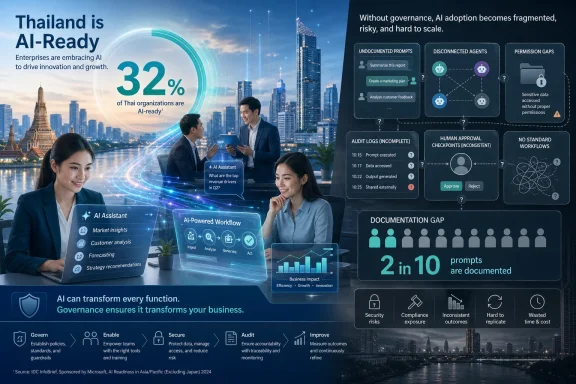 Thailand’s AI adoption is ahead of its governance habits
Microsoft says 89% of Thai workers treat AI-generated material as a starting point to refine rather than a final answer, while 86% of the report’s Frontier Professionals say AI lets them produce work they could not have done a year earlier. Those figures suggest substantial willingness to work with AI rather than simply use it for search or first-draft writing.Yet the skills data complicates the celebratory headline. Only 53% of Thai respondents identify quality control of AI output as an increasingly important skill, according to Microsoft’s August announcement. Only 45% point to critical thinking when working with AI, placing Thailand last in Microsoft’s six-country Southeast Asia comparison on that measure.
This is not a minor training deficit. The value of an agentic workflow depends on a person or team being able to judge whether an output is correct, appropriate, complete, and safe to act on. An AI assistant that summarizes tickets, drafts customer replies, reconciles information, or recommends operational next steps may save time even when it is occasionally wrong. An agent that can take actions in systems of record changes the risk profile entirely.
Microsoft’s global report acknowledges this directly. It says agents introduce risks including unintended system actions, unauthorized access, and data exfiltration, and it argues that IT needs to manage them as entities with identities, permissions, policy enforcement, and lifecycle management. The Thailand release promotes “human agency,” but the operational translation is more specific: human supervision has to include defined accountability and the technical ability to stop, review, and correct an automated process.
An organization cannot claim it has retained “Owned Intelligence” if its best AI workflow exists as a few undocumented chat histories, a personal Power Automate flow, or a cloud agent connected to data the owner should never have accessed.
Microsoft’s “Transformation Paradox” describes an incentive problem
Microsoft calls the mismatch between employee willingness and organizational change the Transformation Paradox. In Thailand, 85% of AI users reportedly fear falling behind if they do not adapt quickly, while 60% say it feels safer to pursue current goals than to redesign their workflows around AI.Both can be true. Workers may feel pressure to demonstrate AI fluency, while their performance objectives, compliance obligations, workload, and manager expectations still reward shipping today’s work through the old process. The result is predictable: staff use AI quietly to accelerate individual tasks, but avoid proposing changes that could disrupt a measured workflow, expose a flawed process, or create a new approval burden.
The leadership figures underline the contradiction. Microsoft says 51% of Thai employees believe leadership communicates a clear AI direction, compared with 26% in the global survey. Yet only roughly one-third say leaders reward experimentation when results are not immediate. A strategy statement without time, budget, adjusted goals, and tolerance for failed experiments is not a transformation program. It is an instruction to adopt a tool without changing the operating model around it.
Microsoft’s broader study associates organizational conditions — culture, manager support, and talent practices — with more than twice the self-reported AI impact attributed to individual mindset and behavior. Importantly, that is an association in survey data, not proof that a particular management intervention will produce a specific productivity gain. But it does reinforce the practical conclusion: buying more AI licenses will not solve a process-design and governance problem.
Thai organizations already have a version of the standard enterprise AI pattern: executives see fast adoption, workers see personal gains, and IT inherits an expanding collection of pilots, connectors, permissions, data sources, and informal processes. Without a mechanism to choose the workflows worth standardizing, success becomes hard to reproduce and risk becomes hard to see.
“Owned Intelligence” needs a system of record, not a slogan
Microsoft uses “Owned Intelligence” to describe institutional know-how captured from human-and-AI work and embedded into how a company operates. Strip away the branding, and it resembles a more disciplined form of knowledge management joined to workflow automation and AI governance.The key distinction is whether an AI-enhanced practice is merely known or actually operationalized. A team that has learned how to triage procurement exceptions with Copilot has useful knowledge. It becomes organizational capability only when the inputs, authority limits, data sources, evaluation rules, ownership, and exception handling are documented and maintained.
Microsoft’s global Work Trend Index reports that only 26% of Frontier Professionals say workflows, human handoffs, and quality standards are documented and repeatable at the team level. The figures are even lower at function and organization levels. That makes Thailand’s reported two-in-ten documentation figure less of a local anomaly than a recurring weakness in the vendor’s own research.
For IT and security teams, the minimum viable version of “Owned Intelligence” should include:
- A named business owner who is accountable for the output and for deciding when the workflow must be changed or withdrawn.
- A documented inventory of each agent’s identity, connected systems, permissions, data classifications, and delegated actions.
- Evaluation criteria that test factual accuracy, policy compliance, edge cases, and failure behavior before a workflow is promoted from a pilot.
- Logging and audit trails that show what data was retrieved, what action was proposed or taken, and where human approval occurred.
- A review cycle that removes obsolete instructions, revokes unneeded access, and re-tests workflows after model, connector, or business-process changes.
The omission in the Thailand announcement is equally important: Microsoft does not identify which agent-management, identity, data-governance, or compliance products Thai organizations should deploy to achieve this model, nor does it provide rollout scope, customer results, cost figures, or a specific implementation timeline. The company presents Kasikornbank and Central Pattana as examples of organizations pursuing AI transformation, but the announcement does not provide independent performance metrics or technical details that would let outsiders assess those deployments.
The report’s Thai numbers need careful reading
Microsoft describes the Work Trend Index 2026 as combining productivity-signal analysis with a survey of 20,000 AI users in 10 core markets. Thailand is not one of those ten markets: Microsoft’s June regional material says Thailand was included in an additional regional wave using the same methodology.That matters because the Thailand-specific percentages should not be read as direct results from the original 20,000-person global sample. Microsoft has not disclosed the Thai respondent count, confidence intervals, sector mix, employer-size distribution, or breakdown between Microsoft 365 Copilot users and people using other workplace AI tools in the August announcement. The data is useful as a directional indicator of reported AI behavior among workers who already use AI at work; it is not a census of Thailand’s entire workforce.
There is also a definitional wrinkle worth watching. Microsoft’s global narrative repeatedly describes Frontier Professionals as 16% of surveyed AI users, while another section of its online report identifies 19% as being in the broader “Frontier” zone where personal capability and organizational readiness reinforce each other. Those are related but not identical measures. The Thailand headline uses the 32% “Frontier Professionals” figure, so organizations should avoid comparing it casually with the 19% organizational-readiness measure.
No independent outlet appears to have published a separate verification of the Thai survey figures or the claimed rate of workflow documentation as of August 4. Microsoft’s release is authoritative for what Microsoft surveyed and announced; it is not independent evidence that Thai companies have already converted individual AI usage into durable operational advantage.
The next project is workflow control
The actionable takeaway for Microsoft 365 shops in Thailand is not to slow AI use merely because the organization lacks a finished AI strategy. It is to stop measuring success only in terms of usage, prompts, or hours saved.The first useful AI workflow in a department should trigger a repeatable operating process: identify the business owner, map the data and permissions, define what requires human approval, establish output-quality criteria, and decide whether the workflow belongs in an approved platform or remains an experiment. If those steps are skipped, the organization accumulates isolated user ingenuity while its security and operations teams accumulate invisible dependencies.
Microsoft is right that a company’s retained process knowledge can become difficult for competitors to replicate. But that only happens after the company does the unglamorous work of documenting it, governing it, and making it safe for someone other than its original creator to run.
References
- Primary source: Microsoft Source
Published: 2026-08-04T04:14:15+00:00
Loading…
news.microsoft.com - Related coverage: news.microsoft.com
- Related coverage: microsoft.com
2026 Work Trend Index report: Agents, human agency, and opportunity
As AI and agents take on execution, our own agency expands. The question is whether organizations are built to capture it.www.microsoft.com - Related coverage: blogs.microsoft.com
How Frontier Firms are rebuilding the operating model for the age of AI - The Official Microsoft Blog
Updated May 11, 2026: The post was updated to reflect that third-party plugins will be available starting May 12, 2026. Spend time with any software engineering team right now and you’ll see something worth paying attention to. Over the last few years, the way software gets built has moved...blogs.microsoft.com - Related coverage: assets-c4akfrf5b4d3f4b7.z01.azurefd.net
Microsoft 2026 Work Trend Index Annual Report
Agents, human agency, and the opportunity for every organizationassets-c4akfrf5b4d3f4b7.z01.azurefd.net
- Related coverage: techradar.com
'Every business leader knows the world is changing, but far fewer have a clear picture of what to do about it': Microsoft flags the changing world of AI at work, and why "Frontier Firms" are leading the way | TechRadar
Microsoft digs deep into how businesses are using AIwww.techradar.com - Related coverage: assets-c4akfrf5b4d3f4b7.z01.azurefd.net
Loading…
assets-c4akfrf5b4d3f4b7.z01.azurefd.net - Related coverage: pcgamer.com
Using 'trillions of anonymised productivity signals', Microsoft thinks nearly half of people like AI in their work | PC Gamer
There's dozens of us who don't!www.pcgamer.com - Related coverage: techradar.com
Microsoft Build 2026 — all the news and updates as it happened | TechRadar
Everything we saw at Microsoft Build 2026www.techradar.com
