
XDA Developers reached that conclusion after two weeks comparing MSI’s new Intel-powered machine with Asus’ AMD-based ROG Xbox Ally X, citing substantially higher frame rates in demanding games alongside a larger 8-inch display and improved ergonomics. Independent lab testing from Tom’s Hardware and Windows Central supports the central finding: Intel’s Arc G3 Extreme platform is materially faster than AMD’s Ryzen AI Z2 Extreme in today’s handheld benchmarks.
The important qualification is that MSI has not delivered a universally better handheld experience. It has delivered the fastest current Windows handheld, packed into a device that costs roughly 80% more than Asus’ flagship and still relies on an unfinished layer of launcher and power-management software. For buyers deciding between the two, the Claw is a performance-first luxury device; the Xbox Ally X remains the practical default.
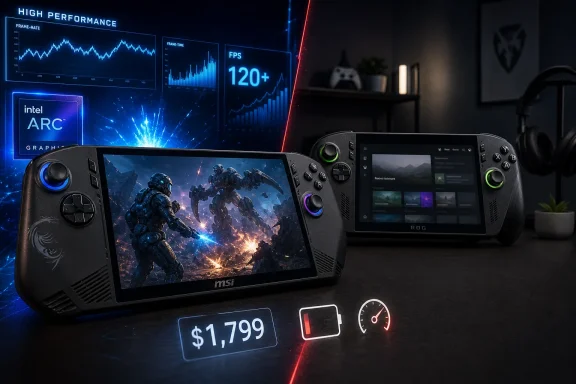 Arc G3 Extreme changes the performance hierarchy
MSI’s Claw 8 EX AI+ is built around Intel’s Arc G3 Extreme, a handheld-specific processor derived from Intel’s Panther Lake generation. The submitted report describes it as a “12-core Xe3-based architecture,” but MSI’s own specification sheet draws an important distinction: the chip has 14 CPU cores—two performance cores, eight efficiency cores, and four low-power efficiency cores—alongside an Arc B390 integrated GPU with 12 Xe3 graphics cores.
That distinction is more than pedantry. Handheld performance is constrained by how CPU, GPU, memory bandwidth, thermals, and power limits interact in a small chassis. Intel appears to have aimed Arc G3 Extreme at the part that most changes portable PC gaming: the integrated graphics budget. The result, based on more than one test lab, is a real break from the close AMD-versus-AMD competition that has characterized recent Windows handhelds.
Tom’s Hardware found the Claw 8 EX AI+ running Shadow of the Tomb Raider at 98 frames per second at 800p on battery and 112 fps when plugged in, a margin of more than 30 fps over the ROG Xbox Ally X in its test. Its Cyberpunk 2077 benchmark reached 48 fps at the Claw’s native 1920×1200 resolution on battery using the Steam Deck preset, and 52 fps while plugged in. Those results do not make every current AAA game a 1200p showcase, but they do provide extra room to choose sharper image quality, smoother frame pacing, or lower reliance on aggressive upscaling.
Windows Central’s synthetic results point in the same direction. It recorded a 3DMark Time Spy score of 6,726 for the Claw versus 4,029 for the ROG Xbox Ally X. Synthetic scores never substitute for game testing, particularly when comparing different driver stacks and display resolutions, but the gap is consistent with the in-game evidence: Arc G3 Extreme is not trading punches with the Z2 Extreme. It is ahead.
XDA’s experience in Assassin’s Creed IV: Black Flag Resynced, Cyberpunk 2077, and Forza Horizon 6 fits that broader pattern. The outlet reported roughly 20 to 30 fps gains in several scenarios, depending on settings. Its cited 50–65 fps result in Black Flag Resynced used XeSS 3 on the Claw, while the Ally X used AMD FSR, so it should not be read as a clean chip-for-chip comparison. Upscaling quality, game implementation, power profiles, and the chosen resolutions can all move the final result.
Still, readers should not dismiss all of those results as an upscaler trick. Tom’s Hardware used its own benchmark suite and also found a large lead. The sound conclusion is straightforward: Intel now has the strongest integrated graphics platform in a mainstream Windows handheld, at least in the Claw 8 EX AI+ configuration available today.
The extra performance does not produce a battery breakthrough
The Claw’s performance lead is impressive partly because both it and the ROG Xbox Ally X carry 80Wh batteries. Asus advertises the same capacity in the Ally X, while MSI lists 80Wh for the Claw. On paper, that makes the comparison useful: MSI is not merely winning by shipping a vastly larger battery.
But buyers looking for a dramatic endurance advantage should moderate expectations. XDA reported only about 15 to 20 minutes more battery life than the ROG Xbox Ally X in its own use. That is plausible given the Claw’s larger 8-inch, 1920×1200 display and its ability to push substantially higher frame rates. Faster hardware invites higher settings and higher sustained power draw.
MSI’s AI Engine profile generally targets around 25W in games, with the system dynamically varying its behavior. Manual mode permits a 35W long-duration limit and 45W short-duration limit. Those modes matter. A handheld that is configured to chase the Claw’s maximum advantage will trade away much of the battery-life benefit that Intel’s efficiency claims might imply.
Tom’s Hardware found that its review unit lost 48% battery capacity after one hour of Lego Batman: Legacy of the Dark Knight at 800p, medium settings, XeSS Balanced, AI Engine mode, and 50% brightness. Its more restrictive Endurance mode, which locks performance to a 30 fps target, left 66% after an hour in the same title. Windows Central measured about three and a half hours in PCMark 10’s gaming workload under its Endurance settings.
The Claw therefore has a useful efficiency mode, but no evidence yet supports treating it as a category-defining battery-life leap over the Ally X. Its advantage is performance headroom. Use that headroom to raise resolution and frame rate, and the battery comparison becomes much closer.
MSI’s 8-inch screen and controls make a better case than its software
The Claw 8 EX AI+ has a native-landscape 8-inch, 1920×1200 IPS touch display with variable refresh rate up to 120Hz. The ROG Xbox Ally X uses a 7-inch, 1920×1080, 120Hz display. The one-inch diagonal difference sounds modest in a spec table but is immediately meaningful on a device designed to be held at arm’s length.
The MSI panel also uses a 16:10 aspect ratio, which gives Windows desktop apps and game launchers additional vertical room. That is useful on a Windows handheld, where settings windows, installers, and desktop troubleshooting remain part of ownership. The 1200p resolution gives games a sharper target when the Arc G3 Extreme has enough headroom, although it also demands more GPU work than the Ally X’s 1080p screen.
There is a tradeoff: at $1,800, the Claw’s IPS panel looks conservative. Tom’s Hardware and Windows Central both singled out the absence of OLED as a weakness when Lenovo already offers OLED options in this class. MSI’s display is large, sharp, and fast; it is not the premium-screen statement its price implies.
MSI has made more progress with ergonomics. The Claw uses redesigned flared grips, Hall-effect sticks, Hall-effect triggers, HD haptics, and an 8-inch panel that creates its unusual lower “chin.” XDA found it close to the Ally X in comfort, though it preferred Asus’ Xbox-style grip design. HotHardware also found the revised chassis more refined than the previous Claw, while noting the unusual concave D-pad and the device’s weight.
The practical result is that MSI no longer has to ask enthusiasts to accept awkward controls in exchange for Intel silicon. The Claw is a legitimate high-end handheld physically as well as electrically.
MSI Center M is still the weak link
The Claw supports Microsoft’s Xbox Full Screen Experience, the controller-oriented Windows mode that can reduce desktop overhead and provide an Xbox-first boot experience. But unlike the ROG Xbox Ally X, it does not have an Xbox button wired to a dedicated Asus-and-Microsoft product identity. On MSI’s device, users enter the full-screen interface through the Xbox app and can configure the system to boot into it.
MSI’s own software layer remains the clearest reason to wait rather than buy on launch momentum. XDA reported Center M failing to open, crashes associated with the overlay, instability when switching between Xbox Mode and the Windows desktop, and wake-from-sleep failures requiring a restart. Those are serious observations because handheld software is not optional polish: it controls power profiles, input modes, library access, and the route back from a game to Windows.
No other reviewed outlet reported that exact cluster of failures. Windows Central said MSI Center M has improved but remains awkward, and it encountered an early bug where Xbox games did not appear in the launcher. Tom’s Hardware was more positive about its basic function, describing a serviceable controller-navigable interface that aggregates libraries from Xbox, Steam, Epic Games Store, GOG Galaxy, and other storefronts—though it also found at least one poor game-art entry.
That is enough evidence to separate two conclusions. Center M is functional and offers the features buyers need, including power profiles and desktop/gamepad control modes. It is also not yet as trustworthy or seamless as the device’s price requires. MSI can improve that through updates, but prospective owners should evaluate the machine based on the present software, not promises of a future fix.
The price is the decisive comparison
The Claw 8 EX AI+ comes in one 32GB RAM and 1TB SSD configuration at $1,799.99. Asus lists the ROG Xbox Ally X at $999.99 with 24GB of LPDDR5X memory and a 1TB SSD. MSI’s extra 8GB of memory, larger display, dual Thunderbolt 4 ports, Wi-Fi 7 support, and substantially faster Arc G3 Extreme graphics are meaningful upgrades. They do not make an $800 premium disappear.
For that difference, an Ally X owner could buy a large microSD Express card, a dock, a protective case, a high-capacity power bank, and several major games—and still spend less. The Claw’s price also crosses into gaming-laptop territory, where users can obtain a discrete GPU, a larger display, and significantly more flexibility if portability is not the first requirement.
The MSI Claw 8 EX AI+ has earned the “real rival” label because it establishes a genuine alternative to the ROG Xbox Ally X rather than another device that matches it on paper and loses on execution. Intel’s Arc G3 Extreme has changed the benchmark conversation, and MSI’s redesigned controls and screen make that speed enjoyable to use.
But the buying guidance has not changed as much as the benchmark charts have. The ROG Xbox Ally X remains the sensible Windows handheld at $999.99. The Claw 8 EX AI+ is for buyers who can justify paying $800 more for the fastest portable Windows gaming hardware available now—and who are prepared to tolerate MSI working out the software that should have been finished before it asked for that price.
