
The new configuration was first reported by Chinese outlet ITHome, which says the system combines the 10-core, 16-thread Core i5-14400F with 32GB of DDR4 memory, a 1TB SSD, an H610M motherboard, Wi‑Fi 6, Bluetooth 5.2, and an RTX 5060 Ti. The reported chassis dimensions are 290 × 168 × 360 mm, with a front USB-A port, USB-C port, and separate 3.5 mm microphone and headphone jacks.
For someone looking at the listing from outside China, the more useful takeaway is not the headline GPU upgrade. It is the number of unanswered configuration details that materially affect whether a prebuilt with an RTX 5060 Ti is a good buy: MSI and the retailer reporting do not identify the graphics card’s VRAM capacity, the power-supply rating, the SSD model, the memory speed, the Windows edition, or the upgrade terms.
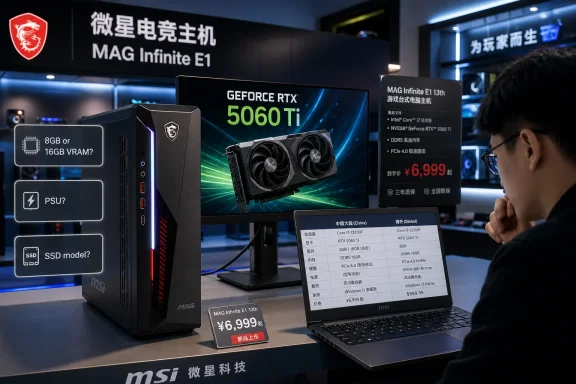 The RTX 5060 Ti name leaves out the specification that matters
Nvidia’s RTX 5060 Ti is sold in both 8GB and 16GB GDDR7 variants. MSI’s global MAG Infinite E1 specifications list both capacities among supported RTX 5060 Ti options, which means “RTX 5060 Ti” alone does not settle which card is inside the 9,599-yuan machine.
That omission is not cosmetic. The two versions share the same GPU designation but differ in available graphics memory, which affects how much headroom a system has for newer games, high-resolution texture settings, creative workloads, local AI experiments, and multi-year ownership. A prebuilt buyer should not assume the 16GB model simply because it is the more attractive configuration on paper.
ITHome did not report the card memory capacity, and no second outlet located reporting this specific i5-14400F/32GB/1TB configuration supplied it either. Until MSI’s China store page or a retail listing identifies the exact card model, the system should be treated as an RTX 5060 Ti desktop with unconfirmed 8GB-versus-16GB graphics memory.
The same caution applies to board-partner card design. MSI’s own product specifications show several RTX 5060 Ti models, including Shadow and Ventus variants. Those can differ in cooler design, clock settings, physical size, and noise behavior. A buyer comparing this desktop with a self-built PC needs the full GPU model name before making a meaningful parts-and-price comparison.
MSI’s own E1 specifications show why regional listings must be read carefully
The reported Chinese configuration differs from MSI’s global MAG Infinite E1 specifications in several important ways. MSI’s global page lists DDR5 memory support, an 18-liter chassis measuring 168 × 323 × 369 mm, and a 500W 80 Plus Bronze power supply. The China-market report describes DDR4 memory and a 290 × 168 × 360 mm chassis instead.
Those differences do not establish that either source is wrong. They demonstrate that MAG Infinite E1 is a product family rather than one fixed worldwide bill of materials. MSI explicitly notes that specifications and availability can vary by model and country, a warning that is especially relevant here.
The H610M motherboard in the reported China configuration also suggests MSI is positioning the machine around a cost-controlled platform rather than long-term expansion. Intel’s H610 chipset is functional for a locked Core i5 such as the 14400F, but it is the entry-level option in Intel’s 600-series desktop range. It can be entirely adequate for a turnkey gaming PC, yet buyers should not infer the kind of memory tuning, I/O expansion, or CPU-upgrade flexibility associated with higher-tier B760 or Z790 systems.
The Core i5-14400F itself remains a sensible pairing for a midrange graphics card. Its six performance cores and four efficiency cores provide 10 total cores and 16 threads, and the “F” suffix means it has no integrated graphics. That makes the discrete GPU mandatory for video output and removes a convenient fallback if the graphics card needs troubleshooting.
The price is meaningful only inside the Chinese retail market
At 9,599 yuan, the E1 is being sold as a complete gaming desktop rather than a barebones chassis or parts bundle. That price includes the assembly, compact case, memory, storage, wireless hardware, and the GPU, but it should not be converted directly into a U.S. street-price verdict.
China’s pricing can be shaped by local promotions, taxes, regional component availability, retailer subsidies, and system-builder margins that do not map cleanly to U.S. or European retail. The reported listing also has no confirmed international release plan. MSI has not announced that this exact i5-14400F, 32GB DDR4, 1TB, RTX 5060 Ti package will be sold through its U.S. store or other markets.
There is another reason to avoid treating the listed number as a universal baseline: the specification does not disclose the power supply. MSI’s global E1 documentation lists a 500W 80 Plus Bronze unit for certain models, but that does not confirm the PSU in this Chinese configuration. Power-supply capacity, connector provision, manufacturer, and warranty matter more in a compact prebuilt than they do in a spec-sheet comparison, particularly if an owner expects to upgrade the graphics card later.
Storage and memory are similarly vague. “1TB SSD” does not tell buyers whether the drive is PCIe Gen 3 or Gen 4, whether it has DRAM cache, or whether it is a retail-grade drive or a lower-cost OEM part. “32GB DDR4” does not reveal the module configuration or speed. Those details rarely make a system unusable, but they determine whether the advertised capacity translates into the responsiveness and expansion options a buyer expects.
A compact prebuilt with a clear purchase checklist
The front I/O arrangement is practical for a desktop that may sit on or below a desk: one USB-A port, one USB-C port, and dedicated audio connectors are more convenient than reaching behind the case. The compact footprint is also a legitimate selling point for players who do not want a full tower.
But compact prebuilts impose trade-offs. Cooler clearance, GPU replacement space, airflow paths, and proprietary cabling are all more consequential than they are in an ordinary ATX case. MSI’s global E1 documentation describes an air-cooled design and a compact system volume, while the China report gives different external dimensions for this version. Neither source provides enough detail to determine the exact cooler, fan layout, or internal clearance of the 9,599-yuan model.
Anyone considering the machine should obtain the retail SKU and confirm these items before ordering:
- The listing should state whether the installed RTX 5060 Ti has 8GB or 16GB of GDDR7 memory.
- The retailer should identify the exact graphics-card model and the power supply’s wattage, efficiency rating, and available PCIe power connectors.
- The listing should confirm the installed Windows edition and whether the machine includes a valid regional warranty for the buyer’s location.
- The seller should specify the SSD interface and memory speed, along with the number of free M.2, SATA, and DIMM slots.
- The buyer should confirm whether the case and motherboard use standard replaceable parts before planning a future GPU or cooling upgrade.
MSI’s new Wujin E1 option is therefore a credible addition to the company’s China desktop catalog, but it is not yet a fully transparent RTX 5060 Ti prebuilt offering. The 9,599-yuan price and 32GB/1TB headline look competitive only after the card’s VRAM capacity, PSU, storage model, and regional warranty are established—and MSI has not publicly provided those details for this specific configuration.