
Niron Magnetics and Japanese precision-motor manufacturer ASPINA have signed a supply agreement aimed at moving rare-earth-free electric motors toward high-volume applications, including automotive systems, industrial equipment, consumer devices and emerging space hardware.
The agreement, announced July 13 by Niron and ASPINA, pairs ASPINA’s motor-design and application-engineering work with Niron’s Iron Nitride permanent magnets. The immediate significance is not that mass-market motors have arrived, but that the companies have established a commercial route for qualifying and producing them in applications where magnet sourcing, reliability and performance are all design constraints.
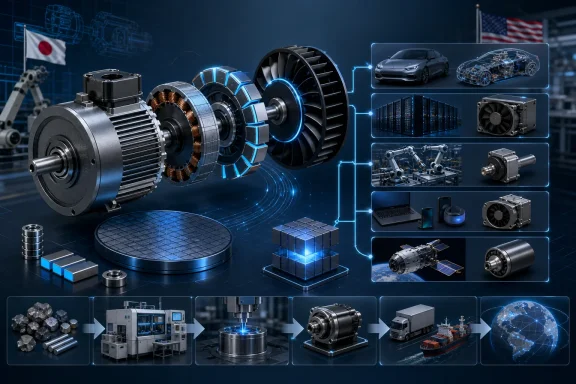
ASPINA’s own July 14 release says the companies will develop next-generation motors using Niron’s rare-earth-free iron-nitride magnets. The partners identify brushless DC motors, hybrid stepper motors, and centrifugal fan and blower products as initial high-volume targets.
That matters because these are not speculative laboratory categories. Brushless DC motors are commonplace in cooling systems, storage devices, automation equipment, appliances and vehicle subsystems; hybrid steppers are widely used in positioning and motion-control applications. For PC and enterprise hardware builders, the fan-and-blower focus is particularly relevant: cooling remains a volume market where supply continuity and component qualification can matter as much as a modest performance gain.
Niron said the arrangement covers space, automotive, consumer electronics and automation markets. ASPINA brings a global production and engineering footprint built around motors, actuators and system solutions, while Niron supplies the magnetic material platform.
That promise still has to survive the less glamorous parts of commercialization: magnet consistency, motor redesign, thermal performance, tooling, certification, supplier qualification and cost at production scale. A supply agreement is more consequential than a research collaboration because it creates a path to these steps, but neither company has announced shipment volumes, pricing, customer products or a production timetable.
Manufacturing Dive, which reported on the announcement, characterized the deal as an effort to develop and manufacture rare-earth-free motor products rather than a declaration of broad commercial availability. That distinction is important for IT buyers and OEMs: this is a supply-chain and product-development milestone, not a signal that rare-earth-free cooling fans or drives are about to displace existing components overnight.
Niron is also pursuing a larger U.S. manufacturing buildout for its magnet technology. The ASPINA deal gives that effort a defined downstream use case: not simply producing alternative magnets, but integrating them into established motor families that can be tested and scaled.
The next proof point will be named programs, qualified designs and production-volume commitments. Until then, Niron and ASPINA have made a credible commercial move—but the real test is whether Iron Nitride motors can meet familiar OEM requirements without forcing customers to accept unfamiliar trade-offs.
 A magnet deal with a motor-production target
ASPINA’s own July 14 release says the companies will develop next-generation motors using Niron’s rare-earth-free iron-nitride magnets. The partners identify brushless DC motors, hybrid stepper motors, and centrifugal fan and blower products as initial high-volume targets.That matters because these are not speculative laboratory categories. Brushless DC motors are commonplace in cooling systems, storage devices, automation equipment, appliances and vehicle subsystems; hybrid steppers are widely used in positioning and motion-control applications. For PC and enterprise hardware builders, the fan-and-blower focus is particularly relevant: cooling remains a volume market where supply continuity and component qualification can matter as much as a modest performance gain.
Niron said the arrangement covers space, automotive, consumer electronics and automation markets. ASPINA brings a global production and engineering footprint built around motors, actuators and system solutions, while Niron supplies the magnetic material platform.
Iron Nitride is the central technical bet
Niron’s magnets use iron and nitrogen rather than the neodymium, dysprosium and other rare-earth materials normally associated with high-performance permanent-magnet motors. The company positions Iron Nitride as a way to reduce material-sourcing exposure without reverting to lower-performance magnet designs.That promise still has to survive the less glamorous parts of commercialization: magnet consistency, motor redesign, thermal performance, tooling, certification, supplier qualification and cost at production scale. A supply agreement is more consequential than a research collaboration because it creates a path to these steps, but neither company has announced shipment volumes, pricing, customer products or a production timetable.
Manufacturing Dive, which reported on the announcement, characterized the deal as an effort to develop and manufacture rare-earth-free motor products rather than a declaration of broad commercial availability. That distinction is important for IT buyers and OEMs: this is a supply-chain and product-development milestone, not a signal that rare-earth-free cooling fans or drives are about to displace existing components overnight.
The Windows hardware angle is indirect but real
Windows itself is not part of the announcement, yet the hardware ecosystem around PCs, workstations, servers, industrial Windows devices and edge systems depends heavily on compact motors. Fans, pumps, robotic mechanisms, factory automation equipment and peripheral devices all consume motor components whose availability can constrain finished-product deliveries.Niron is also pursuing a larger U.S. manufacturing buildout for its magnet technology. The ASPINA deal gives that effort a defined downstream use case: not simply producing alternative magnets, but integrating them into established motor families that can be tested and scaled.
The next proof point will be named programs, qualified designs and production-volume commitments. Until then, Niron and ASPINA have made a credible commercial move—but the real test is whether Iron Nitride motors can meet familiar OEM requirements without forcing customers to accept unfamiliar trade-offs.