
For Windows users, enterprise IT leaders, and the expanding ecosystem that relies on Nvidia-powered AI infrastructure, this is not merely a dispute about a single chip shipment or one model release. It is a test of whether Washington can design controls that slow illicit access to the most powerful compute platforms without weakening American manufacturing, cloud capacity, developer adoption, or the open AI ecosystem that increasingly shapes how software is built and deployed.
 A Washington Visit at the Center of the AI Hardware Race
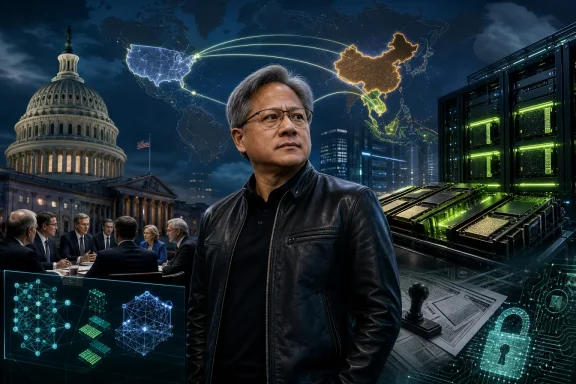
Huang’s reported meeting with Lutnick is notable because it lands at the intersection of three policy tracks that are normally discussed separately: semiconductor supply chains, export enforcement, and AI-model governance. Axios said the Nvidia leader was also scheduled to meet Sen. Mark Warner and other members of Congress from both parties, although neither Nvidia nor the Commerce Department publicly confirmed the specific Lutnick meeting or disclosed its agenda.
Nvidia did confirm the broader purpose of Huang’s trip through a spokesperson. The company said he was in Washington to discuss Nvidia’s role in strengthening the U.S. supply chain, a plan to produce $500 billion in American technology over four years, and U.S. leadership in AI, including leadership in open source. That framing, reported by both Axios and the South China Morning Post, is carefully calibrated.
It presents Nvidia as more than a supplier of high-margin accelerators. The company is positioning itself as a builder of domestic AI capacity: chips, systems, server racks, advanced manufacturing, data-center infrastructure, developer tools, and the CUDA-centered software ecosystem that connects it all. That message is designed to resonate in Washington because AI leadership depends on far more than the raw performance of a GPU.
The strategic complication is that the very scale which makes Nvidia central to U.S. AI ambitions also makes the company central to the enforcement challenge. Every advanced accelerator is a valuable commercial product, a potentially sensitive export, and a component in a globally distributed infrastructure stack. The policy question is not simply whether a particular processor is restricted. It is whether the United States can reliably track who gains access to the compute capability that processor enables.
Why Huang’s presence matters
Nvidia’s CEO is entering this debate with a public argument that differs sharply from the more restrictive instincts evident elsewhere in Washington. In an interview published last week, Huang argued that American firms should be allowed to use high-quality Chinese open models and warned against treating broad access to open-weight AI as a national-security threat in itself. Axios reported that Huang described Chinese models as “excellent” and argued that open models enlarge the AI market rather than automatically undermining U.S. firms.
That view matters because Nvidia benefits when AI becomes cheaper, more deployable, and more widely used. Lower-cost models may place pressure on API pricing and closed-model subscriptions, but they can also expand the total number of organizations building AI applications. More deployments eventually mean more inference, more data-center capacity, and potentially more demand for the high-performance compute systems Nvidia sells.
Washington, however, is considering a different risk equation. If open models from Chinese labs become widely used in American companies, policymakers worry about intellectual-property issues, security exposure, strategic dependence, and the possibility that rapid model progress was assisted by access to U.S.-origin hardware or proprietary model outputs. Huang’s meetings arrive as those two interpretations of AI competition collide.
The Moonshot AI Allegations Raise the Stakes
The immediate backdrop is the controversy around Moonshot AI and its Kimi K3 model. The South China Morning Post reported that senior Trump administration officials accused the Beijing-based startup of using export-controlled Nvidia chips in Thailand to train its latest models, including Kimi K3.
Those allegations are consequential even before any enforcement outcome is announced. They focus attention on a difficult reality of modern compute governance: advanced chips do not have to be physically sold into mainland China for Chinese organizations to potentially benefit from them. Infrastructure can be operated through overseas subsidiaries, cloud environments, colocated systems, leased capacity, and third-country data centers.
The allegation specifically involving Thailand illustrates why country-of-destination rules alone are insufficient. A chip may be legally or illegally transported to one jurisdiction, yet the key policy concern is often who operates it, who has administrative control, what workloads are run on it, and whether restricted entities are the ultimate beneficiaries. Those distinctions are much harder to monitor than a conventional export transaction.
Reporting on Kimi K3 has amplified the political attention because the model is being portrayed as a major technical and commercial event. The Associated Press reported that Moonshot temporarily paused new Kimi K3 subscriptions after demand overwhelmed its available capacity, underscoring both the model’s market interest and the compute strain associated with serving advanced AI systems at scale.
AP also described K3 as a 2.8-trillion-parameter model and reported that it was considered the world’s largest open-source AI model. That number should be read carefully: parameter counts are a useful indicator of model scale, but they do not independently establish quality, safety, efficiency, cost, or real-world value. They are particularly imperfect when comparing mixture-of-experts architectures, where only a portion of the total model is activated for a given token.
A model that is large, open, and demanding to serve
Technical reporting illustrates why Kimi K3 has captured attention. Tom’s Hardware reported that Moonshot described K3 as an open 3T-class system with a one-million-token context window, native vision capabilities, and a mixture-of-experts design activating 16 of 896 experts per token. The same report said Moonshot’s published materials referenced Nvidia hardware in some testing and recommended serving K3 on supernodes containing 64 or more accelerators.
That is important context for the Nvidia export-control debate. Cutting-edge AI is not a story about one GPU placed in one server. Training and serving frontier-scale models depends on dense clusters, fast interconnects, memory capacity, storage, networking, cooling, power delivery, orchestration software, and an experienced operational team. The controls that matter therefore need to account for systems and services, not merely individual components.
At the same time, the availability of a sophisticated open-weight model changes the competitive landscape in ways that are relevant to Windows-centric organizations. A business does not need to subscribe exclusively to a U.S.-hosted chatbot to experiment with frontier-adjacent capabilities. It can potentially obtain weights, evaluate them in a sandbox, host models privately, customize workflows, and integrate inference into internal Windows Server, Azure, or hybrid environments—subject to licensing, security, infrastructure, and legal constraints.
That flexibility is also the source of the policy anxiety. Once model weights circulate, controls built around hosted access become less effective. Policymakers may seek to constrain compute, access to model outputs, distribution channels, or specific entities—but each approach carries trade-offs for researchers, developers, cloud providers, and businesses that use open AI responsibly.
Export Controls Are Becoming More Granular
The latest dispute does not mean the United States has imposed a total ban on all Nvidia products going to China. Instead, the rules have become more granular, product-specific, and compliance-heavy. In January, the Commerce Department’s Bureau of Industry and Security announced a revised license-review policy under which applications for Nvidia’s H200, AMD’s MI325X, and similar chips could be reviewed case by case if specified security requirements were met. BIS stated that applicants must demonstrate that exports would not reduce semiconductor capacity available to U.S. customers, that the Chinese purchaser has adopted export-compliance procedures including customer screening, and that the product has undergone independent third-party testing in the United States.
That policy is revealing. It recognizes that a complete technological separation between the U.S. and Chinese AI ecosystems is neither simple nor necessarily desirable for American industry. But it also raises the compliance standard. The more powerful the product, the more the sale depends on knowing the buyer, the end use, the deployment environment, and the safeguards around the product after delivery.
For Nvidia, such a framework provides both opportunity and risk. It creates a pathway for some sales under controlled conditions, preserving part of an enormous market. Yet it also puts greater scrutiny on distributors, OEMs, cloud partners, systems integrators, resellers, and the documentation that ties a processor to its approved end user.
The weak point is often not the chip itself
AI accelerators are highly visible products, but enforcement failures often emerge in the less glamorous parts of the supply chain. Those can include:
- Incomplete end-user screening, where the named buyer is not the real beneficiary.
- Third-country routing, where restricted entities obtain access through overseas infrastructure.
- Cloud and remote-compute arrangements, where hardware remains outside a restricted jurisdiction but workloads are managed from it.
- Resale or repurposing, where equipment moves after a compliant initial transaction.
- Poor telemetry and audit trails, making it difficult to establish where systems are operating and who controls them.
- Service-provider opacity, particularly where multiple intermediaries lease capacity across borders.
The alleged Thailand access route highlights why these risks cannot be treated as theoretical. Even an enforcement regime with strong rules on paper can be undermined if beneficial ownership, workload access, and post-sale system control are not adequately verified.
For U.S. technology companies, the lesson is broader than Nvidia. AI export compliance increasingly needs to be part of product architecture, customer onboarding, cloud governance, procurement, and incident response. It can no longer sit only in a legal department’s export-control checklist.
Open Models and “Distillation” Are Now Part of the Same Policy Fight
The hardware allegations surrounding Kimi K3 are being discussed alongside a separate controversy over AI distillation. In machine learning, distillation commonly refers to a smaller “student” model learning behavior from a larger “teacher” model, often to make inference cheaper or faster. Axios explained that the administration is drawing a distinction between legitimate distillation used to produce efficient models and “industrial-scale” activity conducted through fraudulent accounts, evasive techniques, or violations of providers’ terms.
That distinction is sensible in principle. AI development has always involved learning from publicly available knowledge, benchmarks, model outputs, academic techniques, and prior work. Treating all resemblance or all model-to-model learning as theft would threaten normal research and product development.
But a framework that permits ordinary distillation while prohibiting covert extraction is difficult to enforce. It requires evidence about access methods, account behavior, output volumes, contractual restrictions, safeguards, and intent. In other words, it shifts the debate from high-level technical vocabulary to detailed records of how training data and model outputs were acquired.
The administration’s emerging position appears to be that it can support open-weight AI while taking action against entities accused of using proprietary American models or restricted hardware unlawfully. Axios reported that officials were considering measures including sanctions and Entity List designations against Chinese firms when alleged misconduct crosses into intellectual-property theft.
This approach has a practical advantage over an indiscriminate crackdown on open models. It lets U.S. policymakers defend competition and open innovation while reserving enforcement tools for specific conduct. It also avoids creating the impression that America’s answer to Chinese AI progress is to close off the wider software ecosystem.
Huang’s counterargument: openness can be a strength
Huang has made the opposite strategic case: that open models should not automatically be viewed as a vulnerability. Axios reported that he argued models can be inspected, customized, sandboxed, and hardened, and that a world dependent on a single small set of closed systems may create a different kind of systemic risk.
There is merit in that argument. Open-weight software can be audited by security researchers, adapted to specialized enterprise use cases, operated within controlled environments, and optimized for local hardware. For organizations handling sensitive information, local deployment can reduce exposure to third-party hosted services—provided the organization has the expertise to secure the model, infrastructure, data pipelines, plugins, and user access.
Yet the risks should not be minimized. Open models can lower barriers for both beneficial and malicious use. They can create software-supply-chain challenges, including poisoned weights, compromised repositories, unsafe fine-tunes, weak licensing compliance, and opaque training provenance. They also make it easier for enterprises to adopt systems faster than their governance policies can keep up.
The policy objective should therefore not be simplistic “open versus closed” thinking. It should be verifiable provenance, responsible deployment, enforceable contracts, robust access control, and concrete accountability for unlawful conduct.
What This Means for Windows and Enterprise IT
The political drama in Washington may appear distant from the daily concerns of Windows administrators, but its effects will flow directly into enterprise technology decisions. The cost and availability of Nvidia systems influence cloud pricing, on-premises AI road maps, workstation procurement, server refresh cycles, and the feasibility of running specialized models locally.
Windows remains central to the AI development workflow. Developers build, test, and manage AI applications on Windows workstations; enterprises connect AI services to Microsoft 365, Teams, Azure, Power Platform, SQL Server, and Active Directory; and administrators increasingly govern mixed fleets of Windows endpoints, Linux AI servers, cloud services, and edge devices. A disruption in advanced GPU supply or a substantial compliance burden can ripple through every layer of that stack.
The most immediate enterprise considerations
Organizations evaluating AI infrastructure should treat the current policy environment as a planning variable, not background noise.
- Build for supply flexibility.
Avoid assuming that a specific accelerator, region, cloud configuration, or model family will remain continuously available. Procurement strategies should accommodate alternative hardware, cloud capacity, and deployment models. - Maintain model provenance records.
Enterprises should document where models were obtained, the applicable license, the model version, any fine-tuning data, hosting location, and the identities of third-party service providers. This is useful for security, audits, legal review, and incident response. - Separate experimentation from production.
An open-weight model downloaded for evaluation should not automatically receive access to enterprise data, developer secrets, customer records, or production networks. Use isolated environments, least-privilege permissions, logging, and approval gates. - Examine cloud geography and administrative access.
Data residency is only part of the picture. Organizations should understand where compute is physically hosted, who can administer it, whether subcontractors are involved, and which jurisdictions may affect access or compliance obligations. - Plan for local inference realistically.
Large models can provide privacy and control benefits, but their infrastructure requirements are substantial. The Associated Press noted that Kimi K3’s demand strained available capacity, while an analyst told AP the model was highly demanding in compute terms. That is a reminder that “open” does not mean cheap or simple to operate. - Treat AI packages as software supply-chain components.
Model weights, inference engines, CUDA libraries, Python packages, orchestration tools, retrieval connectors, and plugins all need the same discipline applied to any other critical software dependency.
Nvidia’s Balancing Act Is Becoming Harder
Nvidia’s strongest position is that it can advocate simultaneously for U.S. industrial capacity, open innovation, and carefully targeted security controls. The company can credibly point to its role in American AI infrastructure and domestic manufacturing investment while arguing that overbroad restrictions may reduce U.S. influence over global AI platforms.
The weakness in that position is that it depends on enforcement being credible. If advanced export-controlled systems can be obtained or used through third countries with limited consequences, policymakers may conclude that lighter-touch controls are inadequate. The political response could be tighter restrictions not only on the highest-end chips, but on cloud access, system integration, technical support, export licensing, and the broader software ecosystem surrounding AI deployment.
That would create uncertainty for Nvidia’s customers as well as its competitors. Large cloud providers can often absorb compliance complexity, but smaller OEMs, research institutions, regional data-center operators, managed service providers, and startups may find it harder to navigate a fragmented global ruleset. The result could be less innovation at the edge of the ecosystem, even if the intended target is illicit access by restricted entities.
There is also a reputational dimension. Nvidia’s brand has become synonymous with the AI boom, and that makes every allegation involving advanced chips strategically significant whether or not it results in a formal enforcement action. The company must demonstrate not just that it follows the letter of export rules, but that its channels, partners, and compliance systems can withstand intense scrutiny.
The Larger Lesson: AI Policy Must Follow Capability, Not Headlines
The Kimi K3 controversy demonstrates that the AI race is no longer measured only by which company releases the most impressive proprietary model. Capability now spreads through a wider network of open weights, efficient architectures, cross-border cloud infrastructure, specialized accelerators, advanced packaging, software tooling, and increasingly sophisticated developer communities.
That makes a purely hardware-centric response incomplete. Chips remain essential, especially for training and high-volume inference, but they are not the sole determinant of AI progress. Algorithmic efficiency, model architecture, synthetic data, systems optimization, networking, and software engineering can all change the amount of useful capability derived from a given amount of compute.
The most durable U.S. strategy will therefore require several things at once:
- Targeted, enforceable export controls focused on genuinely sensitive capability.
- Serious anti-diversion enforcement involving intermediaries, cloud access, and third-country infrastructure.
- Investment in domestic manufacturing and power capacity so America can build and operate AI systems at scale.
- Support for open innovation, where transparency, inspection, and competition can strengthen the ecosystem.
- Clear rules for model provenance and unauthorized extraction, rather than vague prohibitions that chill legitimate research.
- Enterprise-grade security standards for the software and infrastructure used to deploy AI.
Huang’s Washington meetings matter because they sit directly on this fault line. Nvidia is asking policymakers to see open AI, domestic manufacturing, and broad compute adoption as components of American strength. The administration, meanwhile, is signaling that access to advanced AI hardware and proprietary model capabilities must be tightly governed when it involves alleged evasion or theft.
The outcome will help determine not only how Nvidia sells chips, but how enterprises build AI systems, how cloud providers allocate capacity, how developers choose models, and how open innovation evolves across the Windows ecosystem. The central challenge is no longer deciding whether AI is strategic. It is designing rules that preserve America’s ability to build, deploy, and improve AI faster than adversaries can exploit the gaps in those rules.
Update: Report details alleged Blackwell access used to train Kimi K3 (July 29, 2026)
Tom’s Hardware, citing The Information, reports that Moonshot AI allegedly trained Kimi K3 using Nvidia Blackwell hardware obtained through two Chinese firms operating Blackwell-equipped data centers. The report adds detail beyond the earlier Thailand-access allegations: Moonshot reportedly had to combine multiple eight-GPU Blackwell servers across data centers because no single provider could supply enough capacity for the training run.
The sourcing remains anonymous and neither Moonshot nor Nvidia is quoted confirming the arrangement. But if substantiated, the account would point to a more distributed compute-access model than a straightforward shipment diversion—one involving third-party infrastructure, remote operations, and clustered systems.
Tom’s Hardware also reports that Moonshot is said to be seeking further compute access for Kimi K4, while using Nvidia’s China-market H20 systems for K3 inference. For export-control enforcement, the practical concern is increasingly not only where a GPU is delivered, but whether restricted organizations can aggregate and operate advanced compute remotely across multiple facilities.
Update: Report points to Alibaba cloud arrangement behind Kimi K3 compute (August 1, 2026)
Briefs Finance reports that Moonshot AI may have used a large Alibaba cloud-computing arrangement to support Kimi K3, reportedly involving roughly 20,000 Nvidia Hopper-generation processors. Sources cited by the outlet said the deployment may include H200 chips, although Alibaba denied supplying H200-powered compute to Moonshot and did not identify the hardware involved.
This is distinct from the earlier Blackwell allegations: the reported Alibaba arrangement concerns older Hopper-class systems, while the physical location of that compute has not been disclosed. That matters because U.S. rules can permit Chinese customers to rent overseas AI capacity in some circumstances, even when direct acquisition of restricted chips would require authorization.
Briefs Finance also reports that a White House official alleged Moonshot “broke the rules,” but no public enforcement finding or account of the alleged procurement method has been released. For IT and cloud operators, the development reinforces that compliance scrutiny is moving beyond chip shipments toward remote access, cloud tenancy, administrative control, and the ability to aggregate large GPU fleets across jurisdictions.
