
As first reported by Data Center Dynamics and confirmed in Lunar Outpost’s July 23 announcement, the Colorado space-infrastructure company will use Nvidia Jetson modules and CUDA-X libraries across several upcoming lunar missions. Nvidia positions the arrangement as an edge-AI deployment for terrain mapping, autonomous navigation, scientific processing, and communications.
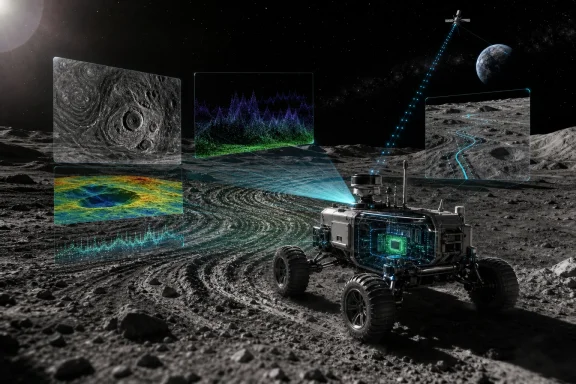 LV2 Makes the First Operational Test
Lunar Voyage 2, or LV2, is planned to travel to Reiner Gamma, a lunar swirl on the Moon’s near side associated with unusual magnetic anomalies. Lunar Outpost says its MAPP rover will use Jetson hardware to command and control its LiDAR system, then process the resulting sensor data locally before preparing larger files for downlink.
That is a narrower but more meaningful use case than simply putting an AI accelerator aboard a rover. Processing and compressing data at the edge can reduce the amount of raw material that needs to cross the Moon-Earth communications link, while enabling the vehicle to react to local terrain without waiting for every decision to be approved from Earth.
For Windows and IT professionals, the architecture will be familiar: a ruggedized endpoint runs a constrained local compute stack, processes high-volume sensor inputs near their source, and sends back the data that operators actually need. The difference is that the endpoint is operating on the lunar surface, where recovery options and bandwidth assumptions are far less forgiving.
Future Rovers Are Meant to Work Alongside People
Lunar Outpost says Lunar Voyage 3 and Lunar Voyage 5 will expand the use of Nvidia’s platform for autonomous human-robot interaction, which the company describes as a first for another planetary body. The future systems are intended to ingest sensor data in real time, generate terrain maps, plan routes, and support video streaming from the Moon.
The company’s language is aspirational, and launch schedules remain subject to the usual spaceflight risks. But the immediate technical milestone is concrete: LV2 will test whether Jetson-based processing can handle a rover’s LiDAR control, local data handling, and downlink preparation in a real lunar mission.
Nvidia’s role also fits a broader push to make edge AI useful beyond terrestrial robotics. Lunar Outpost is an Nvidia Inception member, and the company joins other space programs exploring Jetson hardware for compute workloads where sending all raw data home is impractical.
The first proof point will arrive with LV2’s Reiner Gamma mission later this year. If it works as designed, the value will not be a lunar chatbot—it will be more autonomous machines making better decisions with less dependence on an Earthbound control room.
References
- Primary source: Data Center Dynamics
Published: July 22, 2026 at 12:00 AM UTC
Nvidia works with Lunar Outpost to deploy Lunar AI for Artemis Missions - DCD
Space compute meets space robotics for new era of Moon explorationwww.datacenterdynamics.com - Related coverage: techradar.com
Nvidia signs deal to deploy edge AI on future Moon missions — laying the groundwork for a permanent human home in space | TechRadar
Edge AI for the edge of human achievementwww.techradar.com - Related coverage: lunaroutpost.com
Lunar Outpost Collaborates with NVIDIA to Deploy Edge AI Across Upcoming Moon Missions
NVIDIA’s accelerated computing platform underpins advanced autonomous navigation, lunar mapping, scientific operations, and communications across Lunar Outpost's growing mission manifest GOLDEN, CO, July 23, 2026 – Lunar Outpost, the leader in off-planet mobility and in-space infrastructure... www.lunaroutpost.com
- Related coverage: blogs.nvidia.com
Firefly Aerospace Operates NVIDIA Jetson in Lunar Orbit for the First Time | NVIDIA Blog
The NVIDIA Inception member’s Ocula moon imaging service will harness the NVIDIA Jetson platform for edge AI, running inference directly in space to significantly accelerate insights compared with downlinking all data back down to Earth.blogs.nvidia.com - Related coverage: payloadspace.com
Lunar Outpost Plans to Fly NVIDIA Chips to the Moon
The chip race and the race back to the Moon race have just crossed paths.payloadspace.com - Related coverage: science.nasa.gov
NASA’s Artemis II Moon Mission Research Continues on Earth - NASA Science
Since NASA’s Artemis II crew safely splashed down on April 10, science teams have been busy collecting data and combing through observations.science.nasa.gov