
That is not a rounding difference. It is a thousand-fold gap, and it changes whether Muse Glimmer is a responsive local assistant or a high-throughput server benchmark. Until NVIDIA corrects or explains the discrepancy, Windows users should treat 20 tokens per second, not 20,000, as the only figure in the post that resembles a plausible interactive single-GPU generation rate for a 30B dense model at BF16 or NVFP4. NVIDIA’s own figure caption adds to the confusion by referring to “over 20K tokens/gpu,” without clearly stating a time interval, batch size, concurrency level, or whether the chart measures prefill throughput rather than token-by-token generation.
Meta’s release confirms the larger development: Muse Glimmer is a return to a locally runnable model class after Meta’s recent attention shifted toward much larger systems. NVIDIA’s article positions it as a model for code agents, personal knowledge assistants, documentation workflows, and other tasks that make tool calls over long sessions rather than merely answering a one-turn chat prompt. The appeal is real. The hardware guidance, however, leaves out the information that determines whether a Windows workstation can actually run it well.
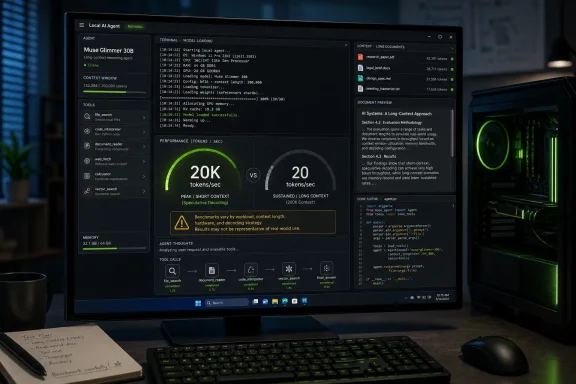 NVIDIA’s “single GPU” claim means different things on different hardware
Muse Glimmer is dense, which means all of its roughly 30 billion parameters participate in generating each token. That eliminates mixture-of-experts routing behavior, but it also means the entire model must be resident in usable memory. In ordinary BF16, 30 billion parameters alone require approximately 60 GB of storage before accounting for runtime overhead, the vision component, context cache, or an auxiliary speculative-decoding model.
That arithmetic makes NVIDIA’s platform list important. A Blackwell Ultra data-center GPU may hold the native model with room for a substantial KV cache; a GeForce RTX 5090, with 32 GB of VRAM, cannot hold a 30B model at BF16 on its own. The RTX 5090 can still be a practical Muse Glimmer machine, but only through quantization, reduced context, or a runtime configuration that trades memory use against output quality and speed. NVIDIA’s blog mentions the RTX 5090 and its 32 GB of VRAM, yet never states the precision, context length, runtime, or model variant behind that consumer-GPU scenario.
This is the practical line the announcement blurs: one GPU does not mean one unmodified model at every advertised setting. On an RTX 5090, a four-bit version of the model can make the weights fit comfortably enough for local inference. The long-context portion of the promise is harder. A 120K-plus context window is not free simply because the weights fit; the KV cache grows with sequence length and can consume the memory headroom that quantization created.
Early community testing reported that a quantized GGUF build could fit on a 24 GB RTX 3090 even with a very large context configuration, draft model, and multimodal projection enabled. That is encouraging, but it is a single user’s test rather than a reproducible vendor benchmark, and it does not establish output quality, sustained throughput, or reliable operation at that context size. It does establish that Muse Glimmer’s memory design may be friendlier than the simplistic “30B equals 60 GB” rule suggests—but local users should expect the runtime and quantization choice to matter as much as the GPU badge.
The 120K-plus context figure is also less settled than it looks
NVIDIA describes Muse Glimmer as having a “120K+” context window. Community discussion around Meta’s Hugging Face release has exposed a more specific but less tidy number: the published configuration appears to identify 131,072 tokens, while users have also encountered references to 262,144 tokens. At least one early tester who expected the larger value reported that the downloaded model would accept only 131,072.
That does not mean the model cannot be extended beyond 131K tokens. It does mean that the public release materials do not yet give deployers a clean answer on the supported maximum versus an experimental or runtime-overridden maximum. For an agent expected to ingest project trees, support tickets, indexed documents, or long chat histories, that distinction is operational—not cosmetic.
A context claim has three separate parts:
- The architecture may have a configured maximum sequence length.
- A particular inference backend may impose a lower limit or require a manual override.
- Available VRAM determines whether the requested context can be used at a practical batch size and precision.
NVIDIA presents a local, “full context length” story, but it does not publish the VRAM allocation, prompt length, concurrency, output length, or latency setup behind that statement. Those omissions prevent an IT team from turning the announcement into capacity planning. A Windows developer with an RTX 5090 and an agent that keeps 100,000 tokens of source code and tool output in memory should not infer that the model will retain NVIDIA’s advertised interactivity.
The dense architecture is still a meaningful choice. NVIDIA argues that activating all parameters for every token produces predictable latency and avoids routing overhead. That can be valuable for tool-using agents, where inconsistent behavior across multi-step runs is frustrating. Yet dense inference also places a fixed compute burden on every generated token. It is a design that favors predictability over the lower active-parameter cost promised by many MoE models, not a universal performance shortcut.
Windows support is presently a stack problem, not a model-download problem
NVIDIA lists vLLM, SGLang, NVIDIA NIM containers, NeMo AutoModel, NeMo RL, and its NemoClaw/OpenShell agent stack as deployment and customization routes. That is a substantial launch ecosystem for NVIDIA hardware, particularly for DGX Spark and enterprise systems. It is not the same thing as a ready-made Windows desktop application.
The official NVIDIA article does not identify a native Windows runtime, supported Windows versions, driver requirements, WSL configuration, or an NVIDIA App integration for Muse Glimmer. Its recommended workflows are centered on containers and developer-serving frameworks. That leaves Windows enthusiasts with a familiar local-model situation: the weights are available, but the route from download to a dependable desktop agent depends on third-party front ends and backend support arriving quickly.
That gap showed up within hours of release. Early users attempting to load Muse Glimmer GGUF variants through llama.cpp-derived tools received an “unknown model architecture” error. Community reports indicate support had to be merged into mainline llama.cpp after the model appeared. Anyone using an older packaged build of KoboldCpp, LM Studio, a llama.cpp server, or another tool that bundles an older inference engine should therefore expect a failed load rather than a transparent fallback.
This is normal for a new architecture, but it undercuts the phrase “download weights and deploy.” A GGUF file being online does not mean every Windows local-LLM tool recognizes its architecture, multimodal projection file, chat template, or draft-model path. For a production-style agent, a successful first prompt is also not enough. Tool calling, structured outputs, context rollover, file access boundaries, and recovery after a failed action need testing in the exact runtime you intend to keep deployed.
What Muse Glimmer changes for local agent builders
The most important development is not NVIDIA’s contested speed number. It is that Meta has released a 30B dense, agent-oriented model in a size class that advanced consumer GPUs can realistically host after quantization. That gives local-first developers another option between lightweight 7B-to-14B models that may struggle with more demanding coding and tool-use tasks, and much larger models that require multi-GPU hardware or remote inference.
For organizations handling source code, credentials, regulated documents, or sensitive internal records, the local route can reduce data exposure and eliminate per-token API bills. It does not remove the security work. An agent running on-device can still delete files, disclose local data through an unsafe tool chain, or follow malicious instructions embedded in a document it is asked to summarize. NVIDIA’s NemoClaw/OpenShell framing recognizes this by emphasizing a governed sandbox, but the post does not describe the sandbox’s Windows availability or its default restrictions.
NVIDIA’s article also calls Muse Glimmer “open-weight,” while its own text does not state the model license or spell out commercial redistribution terms. Early community posts describe the release as Apache 2.0, but teams that plan to fine-tune, redistribute, or embed the model in a product should verify the license in Meta’s repository rather than rely on the launch copy or a third-party quantization page.
The near-term consequence is straightforward: Muse Glimmer is worth testing on a current NVIDIA workstation, especially one with 24 GB or 32 GB of VRAM, but it is not yet a benchmark-backed reason to buy hardware or replace an existing local coding model. The first reliable Windows verdict will come from updated llama.cpp-based applications, vLLM and SGLang recipes with disclosed settings, and independent measurements that separate prompt ingestion, interactive generation, context length, quantization, and concurrency. Until then, NVIDIA’s 20K-tokens-per-second headline should be read as an unresolved documentation error, not a local performance promise.