
For Windows developers, enterprise IT departments, and AI builders, the story matters because infrastructure determines who can afford to train, fine-tune, and run large models in production. NAVER is positioning GAK Sejong not simply as another server facility, but as an AI Factory built around NVIDIA’s full-stack platform—hardware, systems, software, operations, and multi-tenant cloud services. If executed as planned, it would create a major regional source of NVIDIA-powered compute for workloads spanning model development, agentic AI, physical AI, and enterprise inference. NVIDIA’s June partnership release frames the project explicitly as a sovereign AI deployment designed to serve businesses, industries, governments, and global AI cloud customers.
 Overview: A Strategic Investment With Infrastructure Conditions
The headline figure is straightforward but the financial structure deserves careful reading. NVIDIA plans to invest $1 billion in NAVER, while Brookfield has entered a nonbinding term sheet to fund up to $9 billion; NAVER would supply the remaining funding necessary for the project. NVIDIA’s investment is also subject to normal closing conditions and to NAVER finalizing at least $9 billion in committed financing separate from NVIDIA’s own planned investment. NVIDIA’s official disclosure is therefore important for one reason: the $10 billion figure signals substantial intent, but Brookfield’s portion is not yet presented as closed, unconditional capital.
That distinction does not dilute the significance of the transaction. Equity investments by a key infrastructure supplier can align commercial incentives in ways a standard customer-vendor agreement cannot. NVIDIA has a reason to help NAVER scale demand for its accelerated-computing stack, while NAVER gains not only planned capital but closer alignment with the company whose systems remain central to large-scale AI deployment. Maeil Business Newspaper’s report characterizes the relationship as a move beyond NVIDIA simply selling GPUs to a Korean customer and toward a broader strategic partnership. (mk.co.kr)
NAVER disclosed that NVIDIA’s investment would be made through a third-party share placement. Reporting from Edaily states that NVIDIA is expected to acquire 7,241,564 NAVER common shares, representing a 4.5% stake, with the payment deadline set for October 30. That would make NVIDIA a consequential shareholder as well as a technology partner—a structure that increases the credibility of the two companies’ long-term commitment, even if it does not guarantee that the project’s aggressive capacity targets will be met on schedule. (en.edaily.co.kr)
From Portal Operator to AI Infrastructure Company
NAVER’s existing strengths are unusually relevant to this initiative. Unlike a new cloud entrant starting from scratch, the company already operates consumer internet services, cloud infrastructure, proprietary AI models, data centers, and large GPU clusters. NVIDIA has emphasized that NAVER brings full-stack capabilities across AI services, data, foundation models, supercomputing, cloud platforms, and data-center operations. NVIDIA’s June release also describes NAVER as a long-running technology company with enterprise-grade infrastructure behind its public cloud platform.
This is the business logic behind the AI Factory label. A conventional data center is commonly evaluated through available power, racks, networking, resiliency, and storage. An AI Factory adds a further economic objective: transforming power, data, and accelerated-computing capacity into model training, inference, agents, and high-volume token generation. NVIDIA’s description of its DSX platform places chips, systems, software, facilities, and partner technologies inside a single co-designed architecture intended to lower token costs and reduce the time required to reach production. NVIDIA’s explanation of the NAVER DSX deployment makes clear that the plan is for an operating platform, not merely a warehouse full of GPUs.
For NAVER, that represents a major change in corporate emphasis. Search, commerce, content, and consumer platforms can scale efficiently once software and marketplace effects take hold. High-density AI infrastructure, by contrast, requires expensive power systems, cooling, land, servers, networking, long-term supply agreements, capacity planning, debt or project finance, and customers willing to sign durable contracts. Korea JoongAng Daily’s pre-deal reporting identified this capital burden as one of the central constraints on NAVER’s ambition to compete in AI infrastructure.
The partnership is consequently as much a financing and execution story as it is a semiconductor story. Brookfield’s role could give NAVER access to an investor that specializes in physical infrastructure and has built an AI infrastructure investment platform covering data centers, compute, semiconductor manufacturing, and dedicated generation. NVIDIA’s release says Brookfield has approximately $100 billion of assets under management across the AI infrastructure value chain, underscoring why it is a strategically useful counterparty for a project whose bottlenecks extend well beyond GPU procurement.
GAK Sejong: The Capacity Road Map
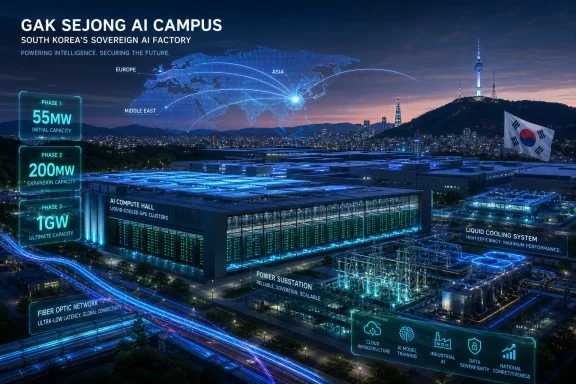
The operational timeline is ambitious. The initial DSX AI Factory deployment at GAK Sejong is planned at 55MW, with the expanded facility targeted to reach 200MW in 2028. NAVER and NVIDIA have also stated an intention to pursue 1GW of AI infrastructure over the longer term. NVIDIA’s July announcement describes the 200MW phase as more than tripling the capacity announced in June.
A 200MW AI campus is already a strategically significant industrial asset. It requires far more than purchasing accelerators in bulk: electrical interconnection, backup systems, high-voltage distribution, heat rejection, liquid-cooling capacity, networking fabric, physical security, operational automation, and a skilled workforce all become critical. Data Center Dynamics notes that NAVER’s Sejong site is planned to reach 270MW of capacity overall and to host up to 600,000 servers, while construction on additional phases continues.
The 1GW target should be read as a long-range destination rather than an imminent delivery date. A gigawatt of AI infrastructure would place NAVER in a category associated with national-scale industrial planning, where power procurement and grid readiness can be as decisive as chip availability. NVIDIA’s own language remains appropriately forward-looking: NAVER intends to extend its AI infrastructure deployment to 1GW, while the companies have presented the 200MW expansion as the nearer, defined milestone. NVIDIA’s release distinguishes between the planned 200MW expansion and the longer-term gigawatt ambition.
That hierarchy matters for investors and enterprise customers alike. The 55MW-to-200MW buildout can be assessed through disclosed capital arrangements, the DSX platform partnership, and a 2028 target. The eventual 1GW network depends on a larger set of uncertainties: customer demand, power availability, financing, construction logistics, equipment deliveries, regulatory requirements, and the economic performance of the first phases. The project is real and meaningful today, but its full economic impact will emerge through execution rather than announcements alone. Data Center Dynamics similarly notes that the financing arrangement is conditional on NAVER securing the required committed financing.
Why Sovereign AI Is NAVER’s Most Important Differentiator
NAVER cannot win by attempting to replicate the global footprint, cloud scale, or installed enterprise base of Microsoft Azure, AWS, Google Cloud, or Oracle overnight. Its more credible opening is sovereign AI: offering governments and enterprises systems that can keep sensitive data, model operations, compliance controls, and cultural or linguistic adaptation closer to local jurisdictions. NVIDIA’s June announcement says NAVER aims to serve customers in Europe and the Middle East that need secure, high-performance services aligned with local regulatory and data-sovereignty requirements.
That strategy gives NAVER an answer to the question of why a customer would choose it rather than a U.S. hyperscaler. The company can package data-center capacity, GPU cloud services, local AI expertise, and a model stack oriented toward regional use cases. NVIDIA says NAVER is advancing HyperCLOVA X through proprietary data and training expertise, while pursuing Korean and global enterprise applications through its AI platform. NVIDIA’s June partnership release ties the infrastructure buildout directly to next-generation HyperCLOVA X models, agentic AI services, and the company’s Seoul World Model work.
For enterprise Windows environments, that proposition may become relevant wherever organizations use hybrid architectures. A company can retain Microsoft 365, Windows Server, Active Directory, SQL Server, Azure services, and familiar endpoint-management tooling while consuming specialized GPU capacity or deploying locally adapted models through a separate cloud provider. This is an inference from NAVER’s stated plan to provide production-scale compute to enterprise, industrial, governmental, and global AI cloud customers; it will depend on the interoperability, APIs, security practices, identity integration, and commercial offerings that NAVER ultimately brings to market. NVIDIA’s July release confirms the intended customer categories but does not yet detail a Windows-specific integration roadmap.
The target geography is also strategically sound, if demanding. NAVER has identified markets across Asia-Pacific, Europe, and the Middle East, regions where governments and large enterprises often care deeply about data locality, local-language support, and control over AI systems. Maeil Business Newspaper reports that NAVER intends to use sovereign AI positioning to compete outside the United States, where it will face both global hyperscalers and newer GPU cloud specialists. (mk.co.kr)
NVIDIA’s Broader South Korea Strategy
The NAVER investment is part of a much wider expansion of NVIDIA’s partnerships in South Korea. At the San Francisco AI Summit, NVIDIA and SK Group also unveiled a major strategic relationship covering AI factories and next-generation memory, while other Korean industrial groups have been pursuing collaborations around robotics, healthcare, gaming, and AI research. Maeil Business Newspaper reports that NVIDIA’s Korean relationships are extending beyond the standard GPU supplier model into technology, infrastructure, industrial AI, and talent-development initiatives. (mk.co.kr)
For NVIDIA, investing in NAVER creates a potentially durable source of demand for its systems and software. Rather than only selling accelerator hardware into a fragmented market, NVIDIA can help enable an operator that buys and manages capacity at scale, attracts third-party AI tenants, and exports a blueprint for sovereign AI infrastructure. NVIDIA’s official statement says the expanded facility is intended to provide production-scale compute for AI innovators in both Korea and the United States.
This is also a practical response to the AI industry’s biggest constraint: useful compute is not created by chip supply alone. It requires capital, electricity, facilities, cooling, systems integration, network capacity, software operations, and a pipeline of commercially viable workloads. NVIDIA, NAVER, and Brookfield each occupy a different part of that chain—accelerated computing, AI/cloud operations, and infrastructure financing respectively. NVIDIA’s announcement explicitly presents the partnership as the combination of Brookfield’s infrastructure investment capacity, NAVER’s AI and data-center operating expertise, and NVIDIA’s computing platform.
The potential benefits for South Korea’s semiconductor ecosystem are substantial, although they should not be overstated. Large AI deployments generally increase demand not only for GPUs but for associated memory, networking, storage, power equipment, cooling, and data-center construction services. At the same time, the concrete revenue effects for individual suppliers will depend on system design, procurement terms, competing technologies, and actual utilization rates—not merely on headline megawatt targets. Maeil Business Newspaper places the NAVER investment alongside NVIDIA’s expanded cooperation with Korean semiconductor and industrial partners. (mk.co.kr)
The Competitive and Financial Risks
NAVER’s case has clear strengths, but it is entering one of the most difficult markets in technology. AI cloud infrastructure demands continuous capital investment, and the competitive set includes hyperscalers with enormous balance sheets, established enterprise relationships, global regions, and mature developer ecosystems. It also includes specialized AI cloud providers designed around rapidly deploying GPU capacity. Maeil Business Newspaper identifies AWS, Google, and newer cloud competitors such as CoreWeave as part of the competitive landscape NAVER must navigate. (mk.co.kr)
The first risk is financing certainty. Brookfield’s proposed up-to-$9-billion role is critical to the project’s scale, but the term sheet is nonbinding and the planned NVIDIA investment is conditional on NAVER securing the necessary committed financing. That does not mean the partnership is weak; it means the final capital structure, repayment obligations, ownership of infrastructure, supply commitments, and allocation of risk will matter enormously. NVIDIA’s financing disclosure makes those conditions explicit.
The second risk is power and construction execution. AI infrastructure is materially harder to deploy than traditional enterprise capacity because dense GPU systems impose exceptional demands on electrical design and cooling. GAK Sejong already provides NAVER with a significant platform, but scaling from 55MW to 200MW and eventually toward 1GW will require sustained coordination between the company, utilities, equipment providers, contractors, regulators, and local communities. Data Center Dynamics highlights both the existing Sejong campus scale and the continuing construction of later phases.
The third risk is commercial utilization. A GPU cluster can be technologically impressive but financially underperform if capacity is not sold at sustainable margins. NAVER will need a mix of internal workloads, Korean enterprise clients, startups, research users, public-sector deployments, and international sovereign AI customers. Edaily reports that NAVER aims to begin generating AI Factory revenue in 2027 and to offer enterprise services and GPU-as-a-service, making customer acquisition and utilization central tests of the strategy. (en.edaily.co.kr)
Finally, NVIDIA’s deep involvement is a competitive advantage and a concentration risk at the same time. Access to the company’s Blackwell and Vera Rubin platforms can give NAVER a powerful launch position, and NVIDIA says the planned 200MW AI Factory is expected to feature those advanced platforms. But it also leaves NAVER strongly tied to one supplier’s product roadmap, pricing, availability, software stack, and strategic priorities. NVIDIA’s July announcement identifies Blackwell and Vera Rubin as intended components of the expanded facility.
What an East Asian AI Hub Would Actually Require
Calling NAVER an emerging East Asia AI hub is defensible as a strategic ambition, not yet as a completed outcome. The company has a credible base: an existing hyperscale campus, a domestic cloud business, AI model capabilities, a direct NVIDIA relationship, and proposed infrastructure funding from Brookfield. Yonhap News Agency reports that the combined commitments are intended to accelerate NAVER’s AI data-center project and provide production-scale compute for next-generation AI services. (en.yna.co.kr)
To earn that designation, NAVER must prove five things:
- Capacity delivery: Complete the move from the initial 55MW deployment to 200MW by 2028.
- Power resilience: Secure enough reliable electricity and cooling capacity for dense accelerated computing.
- Tenant demand: Convert sovereign AI interest into long-duration, paying workloads.
- Operational quality: Deliver secure, high-availability, multi-tenant GPU services with competitive performance and cost.
- International repeatability: Turn GAK Sejong from a Korean campus into a template that can be deployed or sold across additional markets.
These are not marginal details; they are the dividing line between a compelling announcement and a durable AI infrastructure business. NVIDIA’s DSX partnership description states that the platform is designed to support the full operational lifecycle of AI Factories, including large-scale infrastructure management and multi-tenant operations.
NAVER’s NVIDIA alliance is therefore best understood as a calculated attempt to change South Korea’s place in the AI value chain. Rather than remaining chiefly a buyer of foreign cloud capacity and imported accelerators, NAVER wants to become an operator that can deliver regional AI compute, sovereign model services, and infrastructure expertise to others. The $1 billion planned NVIDIA investment and Brookfield’s proposed financing do not remove the capital, power, market, and execution risks—but they give NAVER a far stronger foundation on which to confront them. NVIDIA’s July announcement captures that shift: the project is not only about expanding a data center, but about building sovereign AI capacity at a scale intended to support Korea’s startups, industries, and future AI economy.
