
Nvidia has not abandoned an RTX 50 Super lineup in any public sense, because it has never announced one. What appears to have happened is less definitive but more consequential for buyers: a refresh widely expected to add substantially more VRAM has become commercially awkward amid expensive GDDR7 memory and sharply inflated prices for the GeForce cards already on shelves.
How-To Geek’s argument that the RTX 50 Super is effectively stranded rests on July reporting from VideoCardz, echoed by HotHardware, that Nvidia had allegedly supplied at least one add-in-board partner with physical Super-series cards and then put a launch on indefinite hold. The important qualification is that every claim about cards in partners’ hands, their memory costs, and Nvidia’s instructions traces back to VideoCardz’s anonymous sourcing. It is one report, not independently confirmed evidence of a canceled product.
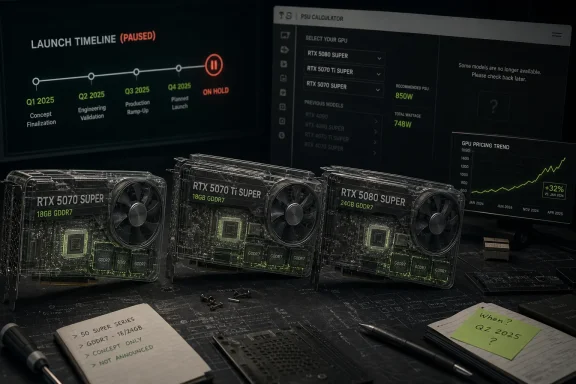
There is enough separate evidence to say Nvidia has considered or prepared the refresh. Seasonic’s PSU calculator briefly listed RTX 5070 Super, RTX 5070 Ti Super, and RTX 5080 Super entries, with board-power figures above their current counterparts. But Seasonic removed all three entries on July 9. As PC Gamer reported, that could mean the listings were placeholders or erroneous guesses; it could also mean Seasonic exposed information it was asked to take down. Neither explanation proves a launch, a delay, or a cancellation.
The evidence supports a narrower conclusion: the RTX 50 Super is a real-looking but still unannounced product plan whose economics may no longer work at a consumer-friendly price. That is a long way from “Nvidia abandoned it before launch,” and it leaves buyers with an inconvenient practical reality: there is no release date to wait for.
The proposed Super trio makes technical sense because it fixes the RTX 50 family’s most conspicuous memory split without needing a new GPU architecture.
Nvidia’s current RTX 5070 has 12GB of GDDR7 across a 192-bit memory interface, while the RTX 5070 Ti has 16GB on a 256-bit interface. The RTX 5080 also has 16GB on a 256-bit bus. The RTX 5070 Ti’s $749 launch price and RTX 5070’s $549 launch price have not protected buyers from substantially higher street pricing in 2026, but their memory configurations remain the official baseline.
The rumored Super configuration uses higher-density 3GB GDDR7 packages in place of the existing 2GB packages:
It is also why the rumored lineup continues to attract attention despite the absence of an announcement. A 24GB RTX 5080-class card would address a gap Nvidia left open when the 24GB RTX 4090 gave way to the 16GB RTX 5080. But a technically sensible product can still be a poor product to manufacture at a viable price.
That distinction matters when estimating an eventual MSRP. Graphics-card memory is purchased under volume contracts, not retail-style spot pricing, and board partners’ actual costs can vary by supplier, yield, allocation, and timing. No public record establishes that Nvidia’s incremental memory cost would equal the full difference suggested in the leak.
Still, the direction of travel is hard to dispute. Nvidia itself warned in its fiscal 2026 annual filing that memory supply constraints would be a headwind for Gaming entering fiscal 2027. Recent retail reporting also shows RTX 50-series prices moving upward, rather than normalizing as a mid-generation refresh approaches. PC Gamer’s late-July U.S. price tracking found an RTX 5080 at roughly $1,250 and an RTX 5070 Ti around $950, while the RTX 5090 had reached approximately $4,200 in one listed configuration. Those are market snapshots, not universal prices, but they explain why a memory-heavy refresh could arrive badly positioned.
A hypothetical $1,500 or $1,800 RTX 5080 Super is not inevitable. It is, however, the obvious risk if Nvidia tries to protect margins while adding 8GB of more costly GDDR7. At that point, the card would no longer be a corrective to the RTX 5080’s 16GB limitation. It would be another premium SKU competing against a distorted upper-end market.
Those figures would mean a 25W increase over the RTX 5070, a 50W increase over the RTX 5070 Ti, and a 55W increase over the RTX 5080. The higher power budgets fit the broad theory of a refresh with more memory and perhaps higher clocks. They do not confirm final specifications, memory capacities, cooler requirements, or a shipment schedule.
More importantly, the removal undermines a common reading of the leak cycle: that each appearance in a configurator brings the cards closer to retail. It can mean that. It can also mean a manufacturer inserted estimated compatibility data before a product was finalized. Seasonic has not publicly explained the listings or their removal, and Nvidia has said nothing about any RTX 50 Super card.
The practical takeaway for builders is uncomplicated. Do not buy a larger power supply, reserve a case around a 415W graphics card, or postpone a workstation deployment on the assumption that a specific Super model is imminent. There is no product page, price, driver support list, review program, release window, or warranty policy to plan around.
The reporting change folds PCs, game consoles, workstations, robotics, automotive, AI-RAN infrastructure, and related products into Edge Computing. Nvidia no longer reports Gaming as a separate top-line market platform in that release. That does not mean GeForce is being discontinued, nor does it prove that Nvidia redirected a particular supply of 3GB GDDR7 packages to RTX Pro or Rubin products.
It does show why the company can afford to be selective. Nvidia’s data-center business accounted for more than nine-tenths of quarterly revenue, and Nvidia’s own filing had already identified constrained memory supply as a Gaming headwind. If a 24GB GeForce refresh requires scarce components and produces awkward price points, Nvidia has every financial reason to delay it rather than launch a product that would amplify complaints about price and availability.
The missing piece is Nvidia’s actual decision. The company has not said whether the Super cards are canceled, delayed, reconfigured, or scheduled for a later event. No board partner has publicly shown a retail-ready card. No memory supplier has confirmed the reported pricing. The strongest theory is still a theory.
That report became more plausible as the year passed without a Super announcement, but it remains reporting about an unannounced roadmap. A delayed RTX 60 series does not prove an RTX 50 Super launch; Nvidia could preserve the current lineup longer, adjust existing SKUs, or release selected refresh models in limited volume. The product names appearing in a PSU calculator do not answer which option it will choose.
For Windows PC buyers, the decision should be based on the hardware and price in front of them. An RTX 5070 Ti near $950 and an RTX 5080 near $1,250 are already difficult value propositions compared with their launch MSRPs, and a speculative Super card cannot make either purchase better after the fact. Buyers who need 24GB specifically for local AI, rendering, or GPU-accelerated professional work should treat an RTX 50 Super as unavailable until Nvidia publishes a real product, rather than as a delayed bargain waiting just beyond the next rumor.
There is enough separate evidence to say Nvidia has considered or prepared the refresh. Seasonic’s PSU calculator briefly listed RTX 5070 Super, RTX 5070 Ti Super, and RTX 5080 Super entries, with board-power figures above their current counterparts. But Seasonic removed all three entries on July 9. As PC Gamer reported, that could mean the listings were placeholders or erroneous guesses; it could also mean Seasonic exposed information it was asked to take down. Neither explanation proves a launch, a delay, or a cancellation.
The evidence supports a narrower conclusion: the RTX 50 Super is a real-looking but still unannounced product plan whose economics may no longer work at a consumer-friendly price. That is a long way from “Nvidia abandoned it before launch,” and it leaves buyers with an inconvenient practical reality: there is no release date to wait for.
 The refresh would solve Blackwell’s clearest capacity problem
The proposed Super trio makes technical sense because it fixes the RTX 50 family’s most conspicuous memory split without needing a new GPU architecture.Nvidia’s current RTX 5070 has 12GB of GDDR7 across a 192-bit memory interface, while the RTX 5070 Ti has 16GB on a 256-bit interface. The RTX 5080 also has 16GB on a 256-bit bus. The RTX 5070 Ti’s $749 launch price and RTX 5070’s $549 launch price have not protected buyers from substantially higher street pricing in 2026, but their memory configurations remain the official baseline.
The rumored Super configuration uses higher-density 3GB GDDR7 packages in place of the existing 2GB packages:
- The rumored RTX 5070 Super would use six 3GB packages for 18GB on its 192-bit bus.
- The rumored RTX 5070 Ti Super would use eight 3GB packages for 24GB on a 256-bit bus.
- The rumored RTX 5080 Super would also use eight 3GB packages for 24GB on a 256-bit bus.
It is also why the rumored lineup continues to attract attention despite the absence of an announcement. A 24GB RTX 5080-class card would address a gap Nvidia left open when the 24GB RTX 4090 gave way to the 16GB RTX 5080. But a technically sensible product can still be a poor product to manufacture at a viable price.
The “$60 to $70 per chip” figure is a warning, not a verified bill of materials
VideoCardz’s anonymous source reportedly put a 3GB GDDR7 package at $60 to $70, compared with roughly $20 for the 2GB parts used today. If accurate, eight 3GB packages would imply $480 to $560 in memory-package cost alone for a 24GB RTX 5080 Super or RTX 5070 Ti Super. That arithmetic is straightforward; the underlying component-price claim is not publicly documented by Nvidia, Samsung, SK hynix, Micron, or a board partner.That distinction matters when estimating an eventual MSRP. Graphics-card memory is purchased under volume contracts, not retail-style spot pricing, and board partners’ actual costs can vary by supplier, yield, allocation, and timing. No public record establishes that Nvidia’s incremental memory cost would equal the full difference suggested in the leak.
Still, the direction of travel is hard to dispute. Nvidia itself warned in its fiscal 2026 annual filing that memory supply constraints would be a headwind for Gaming entering fiscal 2027. Recent retail reporting also shows RTX 50-series prices moving upward, rather than normalizing as a mid-generation refresh approaches. PC Gamer’s late-July U.S. price tracking found an RTX 5080 at roughly $1,250 and an RTX 5070 Ti around $950, while the RTX 5090 had reached approximately $4,200 in one listed configuration. Those are market snapshots, not universal prices, but they explain why a memory-heavy refresh could arrive badly positioned.
A hypothetical $1,500 or $1,800 RTX 5080 Super is not inevitable. It is, however, the obvious risk if Nvidia tries to protect margins while adding 8GB of more costly GDDR7. At that point, the card would no longer be a corrective to the RTX 5080’s 16GB limitation. It would be another premium SKU competing against a distorted upper-end market.
Seasonic’s deleted entries do not settle the question
The Seasonic calculator listings are the best public sign that the Super model names and approximate power envelopes existed somewhere beyond rumor accounts. PC Gamer recorded 275W for the RTX 5070 Super, 350W for the RTX 5070 Ti Super, and 415W for the RTX 5080 Super before the entries disappeared.Those figures would mean a 25W increase over the RTX 5070, a 50W increase over the RTX 5070 Ti, and a 55W increase over the RTX 5080. The higher power budgets fit the broad theory of a refresh with more memory and perhaps higher clocks. They do not confirm final specifications, memory capacities, cooler requirements, or a shipment schedule.
More importantly, the removal undermines a common reading of the leak cycle: that each appearance in a configurator brings the cards closer to retail. It can mean that. It can also mean a manufacturer inserted estimated compatibility data before a product was finalized. Seasonic has not publicly explained the listings or their removal, and Nvidia has said nothing about any RTX 50 Super card.
The practical takeaway for builders is uncomplicated. Do not buy a larger power supply, reserve a case around a 415W graphics card, or postpone a workstation deployment on the assumption that a specific Super model is imminent. There is no product page, price, driver support list, review program, release window, or warranty policy to plan around.
Nvidia’s earnings explain the incentives, but not the decision
How-To Geek correctly identifies Nvidia’s revised financial reporting as context worth watching. In the company’s first quarter of fiscal 2027, ended April 26, 2026, Nvidia reported $81.6 billion in total revenue. Data Center contributed $75.2 billion, while the newly defined Edge Computing platform contributed $6.4 billion.The reporting change folds PCs, game consoles, workstations, robotics, automotive, AI-RAN infrastructure, and related products into Edge Computing. Nvidia no longer reports Gaming as a separate top-line market platform in that release. That does not mean GeForce is being discontinued, nor does it prove that Nvidia redirected a particular supply of 3GB GDDR7 packages to RTX Pro or Rubin products.
It does show why the company can afford to be selective. Nvidia’s data-center business accounted for more than nine-tenths of quarterly revenue, and Nvidia’s own filing had already identified constrained memory supply as a Gaming headwind. If a 24GB GeForce refresh requires scarce components and produces awkward price points, Nvidia has every financial reason to delay it rather than launch a product that would amplify complaints about price and availability.
The missing piece is Nvidia’s actual decision. The company has not said whether the Super cards are canceled, delayed, reconfigured, or scheduled for a later event. No board partner has publicly shown a retail-ready card. No memory supplier has confirmed the reported pricing. The strongest theory is still a theory.
RTX 60 timing is even less certain than the Super story
The idea that RTX 60 will not arrive until 2028 should not be used to turn the Super rumor into a purchasing forecast. Tom’s Hardware reported in February that The Information expected no new Nvidia gaming GPU in 2026 and that the next generation could slip beyond 2027. Nvidia has not announced an RTX 60 family, a GeForce Rubin architecture, or any consumer release schedule.That report became more plausible as the year passed without a Super announcement, but it remains reporting about an unannounced roadmap. A delayed RTX 60 series does not prove an RTX 50 Super launch; Nvidia could preserve the current lineup longer, adjust existing SKUs, or release selected refresh models in limited volume. The product names appearing in a PSU calculator do not answer which option it will choose.
For Windows PC buyers, the decision should be based on the hardware and price in front of them. An RTX 5070 Ti near $950 and an RTX 5080 near $1,250 are already difficult value propositions compared with their launch MSRPs, and a speculative Super card cannot make either purchase better after the fact. Buyers who need 24GB specifically for local AI, rendering, or GPU-accelerated professional work should treat an RTX 50 Super as unavailable until Nvidia publishes a real product, rather than as a delayed bargain waiting just beyond the next rumor.
References
- Primary source: How-To Geek
Published: 2026-08-03T17:30:13+00:00
Loading…
www.howtogeek.com - Related coverage: tomshardware.com
MSI and Colorful raise Nvidia RTX 50-series prices in China by up to 59% across the entire lineup — change in distributer pricing suggests GPU price hikes are on the way | Tom's Hardware
AMD and Intel GPUs also receive price hikes.www.tomshardware.com - Related coverage: investor.nvidia.com
NVIDIA Corporation - NVIDIA Announces Financial Results for First Quarter Fiscal 2027
Record revenue of $81.6 billion, up 85% from a year ago Record Data Center revenue of $75.2 billion, up 92% from a year ago NVIDIA announces $80.0 billion additional share repurchase authorization and increases its quarterly cash dividend from $0.01 per share to $0.25 per share SANTA CLARA...investor.nvidia.com - Related coverage: nvidianews.nvidia.com
- Related coverage: tomshardware.com
Report claims Nvidia will not be releasing any new RTX gaming GPUs in 2026, RTX 60 series likely debuting in 2028 | Tom's Hardware
It might be two years before we see Nvidia launch new RTX GPUs.www.tomshardware.com - Related coverage: hwbusters.com
Loading…
hwbusters.com - Related coverage: hothardware.com
NVIDIA's RTX 50 Super GPUs Reportedly Reach Partners But There's A Major Hurdle
NVIDIA's RTX 50 Super refresh is reportedly 'ready' but stuck in limbo. Here is why GDDR7 memory shortages might keep these cards from hitting shelves.hothardware.com
- Related coverage: digitalcitizen.life
NVIDIA moves gaming revenue into new Edge Computing segment as consumer GPU demand slows
NVIDIA will no longer break out gaming revenue as a separate category in its earnings reports. Starting with fiscal 2027, gaming is being grouped under a new Edge Computing segment, which also includes PCs, game consoles, workstations, robotics, automotive, AI RAN base stations, and other client...www.digitalcitizen.life
- Related coverage: pcmrace.com
Las RTX 50 SUPER ya habrían llegado a los partners, pero NVIDIA frenó su lanzamiento por el precio de la memoria GDDR7 de 3 GB | PC Master Race Latinoamérica
La familia GeForce RTX 50 SUPER estaría mucho más avanzada de lo que indicaban los rumores anteriores, ya que al menos uno de los fabricantes asociados dewww.pcmrace.com - Related coverage: windowsforum.com
Nvidia RTX 60 2028 Delay Remains Unconfirmed as RTX 50 Super Rumors Shift | Windows Forum
Reports that Nvidia has pushed its GeForce RTX 60-series gaming GPUs to 2028 remain unconfirmed, despite fresh claims from NoobFeed and other outlets that...windowsforum.com - Related coverage: tomsguide.com
Nvidia RTX 60-series in early 2027? The leak sounds huge, but the numbers don’t add up | Tom's Guide
According to Red Gaming Tech, Nvidia looks set to launch the next generation RTX 60 Series GPUs in Q1 2027. But with the RTX 50 SUPER Series supposedly postponed (not cancelled) and the RAM pricing crisis, I have doubts.www.tomsguide.com - Related coverage: ciodive.com
Nvidia revenue jumps 85% on AI infrastructure demand | CIO Dive
The company segmented its data center revenue, with half of its earnings linked to hyperscalers and the other half to a broader customer base, including enterprises.www.ciodive.com
- Related coverage: investor.nvidia.com
- Related coverage: nvidianews.nvidia.com
- Related coverage: nvidia.com
NVIDIA GeForce RTX 5070 Family Graphics Cards
Get game-changing performance with the GeForce RTX 5070 Ti and RTX 5070, powered by NVIDIA Blackwell and unlock new experiences with the power of AI.www.nvidia.com - Related coverage: nvidia.com
New GeForce RTX 50 Series Graphics Cards & Laptops Powered By NVIDIA Blackwell Bring Game-Changing AI and Neural Rendering Capabilities To Gamers and Creators
Multiply performance by up to 8X using DLSS 4 with Multi Frame Generation, reduce PC latency by up to 75% with Reflex 2, and experience next-generation RTX Neural Rendering.www.nvidia.com - Related coverage: pcgamer.com
Seasonic has removed the RTX 50-series Super GPU variants from its PSU wattage calculator. Was it just guesswork or actual info revealed too soon? | PC Gamer
Still, CES 2027, perhaps?www.pcgamer.com - Related coverage: techspot.com
Nvidia RTX 5080 Super with 415W TDP appears in Seasonic PSU calculator | TechSpot
According to the PSU wattage calculator's listing, the RTX 5080 Super has a TDP of 415W. That aligns with previous rumors about the card, which placed its...www.techspot.com - Related coverage: notebookcheck.net
RTX 5080 Super surfaces on Seasonic PSU calculator with notably high power draw - Notebookcheck News
Seasonic's PSU wattage calculator has listed Nvidia's rumoured GeForce RTX 5080 Super, revealing a significantly higher 415 W power draw. The leak also includes the RTX 5070 Ti Super and RTX 5070 Super, suggesting Nvidia's upcoming refresh will be more power-hungry than its non-Super counterparts. www.notebookcheck.net
- Related coverage: lowyat.net
Alleged NVIDIA RTX 50 Super Series Appears In Seasonic PSU Calculator - Lowyat.NET
Rumours surrounding NVIDIA's GeForce RTX 50 Super Series GPU have been inconsistent, to say the least. Back at the start of the year, they said production waswww.lowyat.net - Related coverage: images.nvidia.com
- Related coverage: techolam.com
RTX 50-Series Super GPUs: What Seasonic’s PSU Calculator Reveals
Nvidia’s long-awaited RTX 50-series Super cards may finally be on the horizon, with power draw estimates surfacing in a widely used tool. The implications for pwww.techolam.com - Related coverage: videocardz.com
- Related coverage: thefpsreview.com
NVIDIA's RTX 50 Super Lineup Might Finally Be Real: RTX 5080 Super Spotted With a 415W TDP
Just when it looked like the memory crisis had quietly killed NVIDIA’s Super refresh, the RTX 5080 Super showed up where these things always seem to show up first: a power supply calculator. Seasonic has added the RTX 5080 Super to its PSU wattage calculator, listing a 415W TDP, 15% higher than...www.thefpsreview.com - Related coverage: tweaktown.com
RTX 5080 Super appears in Seasonic PSU calculator with 24GB GDDR7 and 415W TDP
The RTX 5080 Super has a 415W TDP and 24GB of GDDR7 memory, completing the set of three Super models now visible in Seasonic's PSU recommendation tool. www.tweaktown.com
- Related coverage: tomsguide.com
'Demand for GeForce RTX GPUs is strong': Nvidia reportedly won't discontinue RTX 5070 Ti GPU | Tom's Guide
Reported Nvidia statement contradicts recent reports of discontinued and cancelled RTX GPUs.www.tomsguide.com - Related coverage: techradar.com
Nvidia in 2025: year in review | TechRadar
RTX 5000 controversies, a triumph for DLSS, and a ton of AI profitswww.techradar.com - Related coverage: windowscentral.com
UPDATE: NVIDIA's RTX 5070 Ti isn't cancelled after all | Windows Central
DRAM shortages will continue to affect GPU supply throughout 2026.www.windowscentral.com - Related coverage: as.com
Nvidia presenta las nuevas gráficas GeForce RTX serie 50: precio, especificaciones y fecha de lanzamiento - Meristation
Así son las esperadas GeForce RTX serie 50 de Nvidia: RTX 5090, RTX 5080, RTX 5070 Ti y RTX 5070. Todo lo que hay que saber sobre estas nuevas GPU.as.com