
That distinction is more than rhetorical cleanup. As Mashable noted in its report on the call, Huang’s latest comments followed Sam Altman’s prediction that OpenAI may have an internal system it would call AGI by the end of 2026. But Huang’s answer was not evidence that a system matching human capability broadly and reliably exists. It was a deliberate effort to shift the conversation from a disputed label toward Nvidia’s preferred commercial measure: sustained demand for AI inference.
Nvidia’s official second-quarter fiscal 2027 results made that framing unusually explicit. Huang said AI had reached an “inflection point,” its tokens were “productive and profitable,” and “compute is revenue.” The company reported $96.2 billion in quarterly revenue, including $89.0 billion in Data Center revenue, and forecast $108 billion, plus or minus 2%, for the following quarter. Those are concrete results. AGI, by contrast, remains an undefined benchmark with no test Nvidia identified on the call.
 “For many tasks” is the qualifier that changes the claim
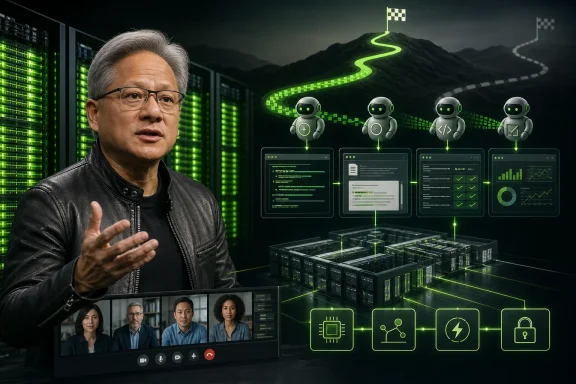
The viral version of Huang’s remarks strips out the important condition. In response to a question about recursive self-improvement and OpenAI’s stated AGI target, Huang said that agents can run continuously, reflect on prior work, update a skill file, and perform better on later tasks. He described this as “loosely coarse-grained self-improvement,” then added that for many tasks one could argue AGI had already been achieved.
That is a much narrower claim than “AI is generally intelligent” in the sense usually meant by researchers, regulators, or the public. It says current systems can complete some useful task loops: receive an assignment, use tools, save instructions or results, and reuse that information later. A coding agent that maintains a project-specific instruction file, a support agent that updates a troubleshooting playbook, or a data agent that records how it handled a recurring report could all fit Huang’s description.
None of that requires the underlying model to have autonomously redesigned itself. Huang specifically referred to a Markdown skills document being updated after a run. That is external memory and workflow state, not proof that the model’s learned parameters have changed, that it has acquired broad human judgment, or that it can safely generalize to unfamiliar high-stakes work.
For enterprise IT teams, the difference is operationally significant. An agent that improves its future output by writing notes can also preserve a bad assumption, a poisoned instruction, an overly broad access pattern, or an incorrect procedural shortcut. “It gets better next time” is not a security property. It is a reason to inspect what the agent stores and who can alter it.
Nvidia is defining the milestone through economic output
Huang’s real point was that the industry does not need to settle the AGI debate before it spends heavily on AI infrastructure. His three-part argument was straightforward: AI is doing productive work; that work produces profitable tokens; and more available compute would allow services to make more money.
In Nvidia’s vocabulary, tokens are the small units models process and generate when they reason, write, retrieve information, call tools, or interact with one another. A token becomes “profitable” only when a customer-facing product earns more from that work than it costs to run. The phrase is therefore less a measure of intelligence than a claim about unit economics.
That helps explain why Huang was discussing AGI during an earnings call rather than a research presentation. Nvidia sells the accelerators, networking, systems, and software needed when organizations run models continually. A chatbot used occasionally creates modest demand; fleets of background agents that read tickets, generate code, analyze documents, query business systems, and hand work to other agents use substantially more inference capacity.
Huang illustrated that future with personal agents running 24 hours a day on Nvidia DGX systems. But Nvidia did not provide a breakout showing how much of its $89 billion in quarterly Data Center revenue comes from autonomous-agent deployments, nor did it quantify how many customers are achieving profitable returns from them. The company’s revenue growth is independently visible in its results; the broader claim that agents have already made inference reliably profitable across the market is Nvidia’s business thesis, not a disclosed industry-wide metric.
The earnings report does provide a less glamorous constraint on that thesis: supply. Nvidia said it was not assuming any Data Center compute revenue from China in its third-quarter outlook. Huang also told analysts that Nvidia’s supply chain was under pressure, while CFO Colette Kress said customer demand was running ahead of what the company expected to fulfill. The near-term bottleneck, in Nvidia’s telling, is not whether AI can produce another impressive demo. It is the availability of chips, memory, power, and data-center capacity to operate AI at scale.
Huang made a similar claim in March — with a revealing limitation
This is not Huang’s first use of the AGI label. In a March interview with Lex Fridman, he answered “I think it’s now” when asked whether AI could start, build, and run a billion-dollar technology company. Reporting from TechSpot and TechRadar captured the caveat that followed: Huang said an agent might create a short-lived viral product, but the odds of 100,000 such agents building a company like Nvidia were “zero percent.”
That earlier exchange supplies the context missing from any headline declaring AGI complete. Huang’s working definition is economically practical and deliberately permissive. If an AI can create a commercial success under constrained conditions, he is willing to call that AGI. He is not claiming that present-day systems can reliably sustain a complex semiconductor company, manage its supply chain, formulate long-term strategy, resolve novel engineering problems, and bear accountability for the consequences.
The distinction has become harder to see because “AGI” is useful shorthand for radically capable AI, even though no cross-industry definition determines when the milestone has been reached. OpenAI, Microsoft, Nvidia, researchers, and investors can all use the same term while referring to materially different thresholds: an internal research system, an economically valuable agent, broad human-level task performance, or an autonomous organization.
Huang’s answer on August 26 rejects the premise that one date should resolve that ambiguity. But it also makes the label easier to deploy. If AGI can mean “already good enough at many tasks to make tokens profitable,” then claims of achievement become difficult to falsify and nearly impossible to compare between vendors.
What Windows and enterprise administrators should take from it
The near-term technology story is agentic software, not a confirmed arrival of human-level general intelligence. Organizations should treat the current generation of agents as software systems with unusually broad input channels and variable behavior, not as employees that have become trustworthy because their output looks competent.
A practical deployment standard should focus on the controls Huang’s framing leaves out:
- Agents should operate with narrowly scoped identities, separate credentials, and least-privilege access to files, repositories, SaaS applications, and administrative tools.
- Any persistent memory, skills file, runbook, or prompt repository should be version-controlled and reviewed, because it can shape later actions just as much as the model’s initial instructions.
- Tool calls that can alter production systems, change identity settings, send external communications, or commit code should require approval gates and produce audit logs.
- Teams should measure successful task completion, error rates, human rework, latency, and total inference cost rather than using model benchmarks or AGI marketing as a proxy for business value.
- A local DGX workstation or a cloud-based agent platform still needs the same endpoint hardening, network segmentation, patch discipline, secrets management, and data-governance controls applied to other high-value workloads.
The important part of Huang’s statement is not that a semantic finish line has disappeared. It is that Nvidia sees continuously running agents as the next major source of compute demand. For customers, the useful question is correspondingly concrete: whether an agent can complete a defined task more accurately, securely, and cheaply than the existing process—not whether its vendor has decided the word AGI now applies.