
NVIDIA’s new Skild AI customer story makes a large claim with a practical implication for industrial IT: a single robot-control model can be trained in simulation across humanoids, quadrupeds, wheeled machines and arms, then adapted to new hardware with little additional robot-specific training. For firms buying NVIDIA compute, Isaac Lab and Cosmos rather than designing bespoke robot software, the appeal is clear—move engineering effort from hand-tuning individual cells to operating a common data, simulation and deployment stack.
The important qualification is that NVIDIA’s July 31 case study is primarily a vendor account of Skild’s own demonstrations and architecture. Its most dramatic figures—“a millennium” of simulated experience in days, recovery from damage, and a tenfold ownership-cost reduction—do not come with benchmark protocols, hardware bills of materials, task definitions, production uptime data or independently published failure rates. Skild has now announced real industrial relationships, including work with ABB Robotics, Universal Robots, MiR and NVIDIA-linked manufacturing, but the public record still separates announced deployment plans from proof that one model has replaced conventional control stacks across a production fleet.
NVIDIA describes Skild’s training pipeline as a combination of Isaac Lab for reinforcement-learning simulation and Cosmos Transfer for synthetic visual variation. Isaac Lab generates the physics scenarios: thousands of robot instances, different morphologies and numerous environments running in parallel. Cosmos Transfer changes environmental appearance through text-directed generation, varying factors such as lighting, visual texture and scene conditions so that the policy does not become dependent on the exact images seen during simulation.
That division of labor is worth understanding. Physics simulation can model a robot’s joints, mass, collisions and sensors, but it can still produce a limited visual world. Generative augmentation adds visual diversity, which is intended to narrow the notorious sim-to-real gap—the difference between performance in a clean virtual environment and performance around imperfect sensors, reflective surfaces, moving people, changed inventory and poorly lit factory areas.
NVIDIA has been building this combination into a broader physical-AI platform rather than presenting Skild as a one-off. Its robotics materials position Isaac Lab as the GPU-accelerated training and learning environment, while Cosmos supplies world-generation and data-augmentation models. Skild is one of several robotics companies NVIDIA names as using the stack, alongside more established robot makers and research organizations.
For enterprise buyers, that means the relevant product is not a robot image from a demo reel. It is a workflow: generate or ingest environments, run large-scale parallel training on NVIDIA GPUs, evaluate policies, synthesize edge cases, tune on limited real-world data, then deploy inference to an on-robot computer such as NVIDIA Jetson. The central promise is that a change in a work cell becomes a data and validation problem rather than a months-long controls-integration project.
That is potentially valuable, but it also shifts operational responsibility. A company adopting this route needs simulation assets that accurately reflect its site, version control for models and environments, a process for collecting production exceptions, and a safety gate between a promising policy and machinery operating around people. The software can reduce per-robot customization; it does not remove the need for controls engineering, safety validation or site-specific integration.
Training one model across many body designs is supposed to make memorization harder. A locomotion strategy that only works for one specific leg length, joint arrangement or wheel configuration cannot satisfy training across a large population of virtual robots. The model must instead infer, from observations and recent outcomes, what body it has and how that body is responding.
This is closer to in-context adaptation than to a traditional robot program. The model’s weights are not necessarily being retrained on the factory floor when something changes. Rather, it observes that a command has an unexpected result—for example, a wheel command does not produce forward motion—and selects a different action pattern based on that evidence.
Skild’s published demonstrations include a wheeled-legged robot switching from rolling to walking after its wheels are jammed, a quadruped continuing after a software-simulated joint failure, and machines walking after leg extensions are attached. These are meaningful tests because they deliberately place a trained policy outside its nominal configuration.
But NVIDIA’s case study blurs two of those results. It says the model recovers from jammed wheels “within 2–3 seconds” and learns from broken legs after several attempts. Skild’s underlying September 2025 description assigns the two-to-three-second result to a simulated locked-knee scenario that turns the quadruped into a three-legged machine. The jammed-wheel example demonstrates a change from rolling to walking, but Skild’s public description does not attach that same two-to-three-second timing to it.
That may sound minor, yet it is the difference between a defined observation and a generalized marketing claim. For anyone evaluating the technology, recovery time has to be measured separately for each failure type, robot, payload, terrain, sensing configuration and safety constraint. A robot that changes gait in a controlled demo is not automatically a robot that can resume a production task safely after a real motor, encoder, battery or drive-train fault.
It does not identify the low-cost machines, specify whether the quoted price includes sensors, grippers, safety equipment, integration, edge compute, maintenance, support contracts or the NVIDIA training infrastructure, or define the expensive conventional systems used for comparison. A $250,000 figure may be plausible for a custom industrial installation, but an installed robotic cell includes more than the robot itself: guarding, conveyors, fixturing, machine vision, controls cabinets, commissioning, maintenance arrangements and application engineering can dominate the project cost.
The useful interpretation is narrower. Skild is claiming that a generalized policy can tolerate cheaper, noisier hardware and therefore reduce the amount of custom software and highly specialized machinery required for a deployment. That could lower the entry cost for automation where tasks are variable and volumes do not justify a traditional engineered cell.
It does not establish a universal robot-price comparison. Buyers should treat the $4,000-to-$15,000 number as a vendor deployment claim until Skild publishes the actual configurations and task-level operating economics. The more relevant test is cost per completed task at an agreed reliability and safety level, including the labor required when the robot encounters an exception.
This addresses a real constraint. Unlike web-scale language data, there is no comparably vast standardized corpus of robot actions paired with every possible sensor stream, robot geometry and outcome. Simulation supplies controlled action-and-result data at enormous volume; human video exposes the model to the visual diversity of homes, warehouses, streets and workspaces that a simulator cannot completely anticipate.
Still, watching a human perform a task does not by itself solve the robot-execution problem. Human hands, body proportions, contact sensing, reach, balance and dexterity differ sharply from a robotic arm or mobile platform. The harder step is mapping visual observation of a person to the forces, trajectories and safety limits of a machine with different joints and sensors. Skild says its training across many embodiments is designed to bridge that gap, but it has not publicly released the data-selection rules, the rights framework for the video corpus, benchmark datasets or comparative evaluation needed to assess the claim outside company demonstrations.
The current evidence does support the narrower conclusion: Skild is building around scale in synthetic simulation and visual pretraining instead of waiting for enough real robot demonstrations to accumulate. That is strategically aligned with NVIDIA’s own interest in selling the compute and software used to produce synthetic robotics data.
The phrase “small amounts” is doing substantial work. If a new robot, task or plant requires only a few hours of data and a predictable validation cycle, Skild’s approach could materially change how automation is procured. If each deployment still requires extensive data capture, simulation reconstruction, safety review and recovery engineering, then the foundation model may improve the tooling without delivering the advertised hardware-agnostic leap.
NVIDIA’s case study confirms that Skild is a serious user of Isaac Lab and Cosmos, and the announced industrial partnerships show that the effort is moving toward production settings. What it does not yet provide is the metric that matters most: independently measured task success, intervention rate and safe recovery across sustained real-world shifts. Until those figures emerge, the “one brain for any robot” message should be read as a promising architecture with early deployment commitments—not as a demonstrated replacement for application-specific industrial robotics.
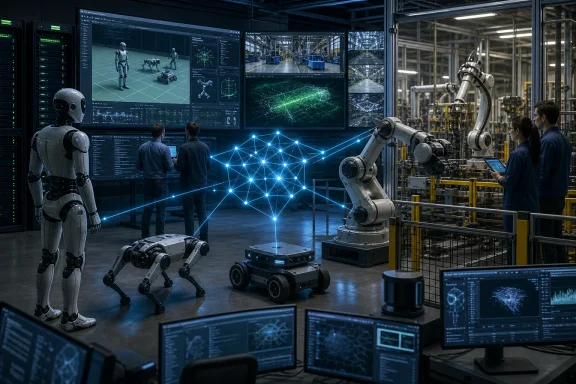 Isaac Lab and Cosmos are the product story behind the robot story
NVIDIA describes Skild’s training pipeline as a combination of Isaac Lab for reinforcement-learning simulation and Cosmos Transfer for synthetic visual variation. Isaac Lab generates the physics scenarios: thousands of robot instances, different morphologies and numerous environments running in parallel. Cosmos Transfer changes environmental appearance through text-directed generation, varying factors such as lighting, visual texture and scene conditions so that the policy does not become dependent on the exact images seen during simulation.That division of labor is worth understanding. Physics simulation can model a robot’s joints, mass, collisions and sensors, but it can still produce a limited visual world. Generative augmentation adds visual diversity, which is intended to narrow the notorious sim-to-real gap—the difference between performance in a clean virtual environment and performance around imperfect sensors, reflective surfaces, moving people, changed inventory and poorly lit factory areas.
NVIDIA has been building this combination into a broader physical-AI platform rather than presenting Skild as a one-off. Its robotics materials position Isaac Lab as the GPU-accelerated training and learning environment, while Cosmos supplies world-generation and data-augmentation models. Skild is one of several robotics companies NVIDIA names as using the stack, alongside more established robot makers and research organizations.
For enterprise buyers, that means the relevant product is not a robot image from a demo reel. It is a workflow: generate or ingest environments, run large-scale parallel training on NVIDIA GPUs, evaluate policies, synthesize edge cases, tune on limited real-world data, then deploy inference to an on-robot computer such as NVIDIA Jetson. The central promise is that a change in a work cell becomes a data and validation problem rather than a months-long controls-integration project.
That is potentially valuable, but it also shifts operational responsibility. A company adopting this route needs simulation assets that accurately reflect its site, version control for models and environments, a process for collecting production exceptions, and a safety gate between a promising policy and machinery operating around people. The software can reduce per-robot customization; it does not remove the need for controls engineering, safety validation or site-specific integration.
“Omni-bodied” training is Skild’s attempt to prevent overfitting
Skild calls its approach an “omni-bodied” brain: one model trained across radically different robot bodies and tasks. The company’s rationale, laid out in its own 2025 technical posts, is that a controller trained only for one quadruped or arm can learn a brittle answer to a narrow mechanical problem. Alter a joint, lock a wheel, change the payload or move the system to a new surface, and a narrowly trained policy may stop working.Training one model across many body designs is supposed to make memorization harder. A locomotion strategy that only works for one specific leg length, joint arrangement or wheel configuration cannot satisfy training across a large population of virtual robots. The model must instead infer, from observations and recent outcomes, what body it has and how that body is responding.
This is closer to in-context adaptation than to a traditional robot program. The model’s weights are not necessarily being retrained on the factory floor when something changes. Rather, it observes that a command has an unexpected result—for example, a wheel command does not produce forward motion—and selects a different action pattern based on that evidence.
Skild’s published demonstrations include a wheeled-legged robot switching from rolling to walking after its wheels are jammed, a quadruped continuing after a software-simulated joint failure, and machines walking after leg extensions are attached. These are meaningful tests because they deliberately place a trained policy outside its nominal configuration.
But NVIDIA’s case study blurs two of those results. It says the model recovers from jammed wheels “within 2–3 seconds” and learns from broken legs after several attempts. Skild’s underlying September 2025 description assigns the two-to-three-second result to a simulated locked-knee scenario that turns the quadruped into a three-legged machine. The jammed-wheel example demonstrates a change from rolling to walking, but Skild’s public description does not attach that same two-to-three-second timing to it.
That may sound minor, yet it is the difference between a defined observation and a generalized marketing claim. For anyone evaluating the technology, recovery time has to be measured separately for each failure type, robot, payload, terrain, sensing configuration and safety constraint. A robot that changes gait in a controlled demo is not automatically a robot that can resume a production task safely after a real motor, encoder, battery or drive-train fault.
The advertised cost reduction needs a clearer baseline
NVIDIA says Skild Brain has enabled successful deployment on robots costing $4,000 to $15,000, compared with conventionally customized systems costing more than $250,000, framing the result as a tenfold reduction in total cost of ownership. The statement is striking—and incomplete.It does not identify the low-cost machines, specify whether the quoted price includes sensors, grippers, safety equipment, integration, edge compute, maintenance, support contracts or the NVIDIA training infrastructure, or define the expensive conventional systems used for comparison. A $250,000 figure may be plausible for a custom industrial installation, but an installed robotic cell includes more than the robot itself: guarding, conveyors, fixturing, machine vision, controls cabinets, commissioning, maintenance arrangements and application engineering can dominate the project cost.
The useful interpretation is narrower. Skild is claiming that a generalized policy can tolerate cheaper, noisier hardware and therefore reduce the amount of custom software and highly specialized machinery required for a deployment. That could lower the entry cost for automation where tasks are variable and volumes do not justify a traditional engineered cell.
It does not establish a universal robot-price comparison. Buyers should treat the $4,000-to-$15,000 number as a vendor deployment claim until Skild publishes the actual configurations and task-level operating economics. The more relevant test is cost per completed task at an agreed reliability and safety level, including the labor required when the robot encounters an exception.
Human video is Skild’s scale play—and its unresolved boundary
Skild’s second data source is internet-scale video of people performing tasks. The company characterizes humans as biological robots whose actions can reveal affordances: clues about what objects can be grasped, pushed, opened, carried or otherwise manipulated. Its public materials say the model is trained using large-scale robot simulation and human video so it can acquire broad priors before being adapted to a physical machine.This addresses a real constraint. Unlike web-scale language data, there is no comparably vast standardized corpus of robot actions paired with every possible sensor stream, robot geometry and outcome. Simulation supplies controlled action-and-result data at enormous volume; human video exposes the model to the visual diversity of homes, warehouses, streets and workspaces that a simulator cannot completely anticipate.
Still, watching a human perform a task does not by itself solve the robot-execution problem. Human hands, body proportions, contact sensing, reach, balance and dexterity differ sharply from a robotic arm or mobile platform. The harder step is mapping visual observation of a person to the forces, trajectories and safety limits of a machine with different joints and sensors. Skild says its training across many embodiments is designed to bridge that gap, but it has not publicly released the data-selection rules, the rights framework for the video corpus, benchmark datasets or comparative evaluation needed to assess the claim outside company demonstrations.
The current evidence does support the narrower conclusion: Skild is building around scale in synthetic simulation and visual pretraining instead of waiting for enough real robot demonstrations to accumulate. That is strategically aligned with NVIDIA’s own interest in selling the compute and software used to produce synthetic robotics data.
Production deployments will decide whether the common brain is real
Skild’s March announcement with ABB Robotics, Universal Robots, MiR and NVIDIA raised the stakes beyond research demos. Reuters reported at the time that Skild and NVIDIA were planning deployment of the robot brain on Blackwell-system assembly lines, while Skild’s own announcement said the model would be fine-tuned with small amounts of real robot data and run on Jetson-powered systems.The phrase “small amounts” is doing substantial work. If a new robot, task or plant requires only a few hours of data and a predictable validation cycle, Skild’s approach could materially change how automation is procured. If each deployment still requires extensive data capture, simulation reconstruction, safety review and recovery engineering, then the foundation model may improve the tooling without delivering the advertised hardware-agnostic leap.
NVIDIA’s case study confirms that Skild is a serious user of Isaac Lab and Cosmos, and the announced industrial partnerships show that the effort is moving toward production settings. What it does not yet provide is the metric that matters most: independently measured task success, intervention rate and safe recovery across sustained real-world shifts. Until those figures emerge, the “one brain for any robot” message should be read as a promising architecture with early deployment commitments—not as a demonstrated replacement for application-specific industrial robotics.
References
- Primary source: NVIDIA
Published: Fri, 31 Jul 2026 19:35:16 GMT
Loading…
www.nvidia.com - Related coverage: nvidia.com
Loading…
www.nvidia.com - Related coverage: blogs.nvidia.com
Loading…
blogs.nvidia.com - Related coverage: skild.ai
Loading…
www.skild.ai - Related coverage: nvidianews.nvidia.com
Loading…
nvidianews.nvidia.com - Related coverage: skild.ai
Loading…
www.skild.ai - Related coverage: nvidia.cn
Loading…
www.nvidia.cn - Related coverage: developer.nvidia.com
Loading…
developer.nvidia.com - Related coverage: research.nvidia.com
Loading…
research.nvidia.com - Related coverage: research.nvidia.com
Loading…
research.nvidia.com - Related coverage: nvidianews.nvidia.com
Loading…
nvidianews.nvidia.com - Related coverage: assets.ascendientlearning.com
Loading…
assets.ascendientlearning.com - Related coverage: globenewswire.com
Loading…
www.globenewswire.com - Related coverage: sahmcapital.com
Loading…
www.sahmcapital.com - Related coverage: techcrunch.com
Loading…
techcrunch.com - Related coverage: startup.genisisiq.com
Loading…
startup.genisisiq.com - Related coverage: agentmarketcap.ai
Loading…
agentmarketcap.ai - Related coverage: contextwindows.ai
Loading…
www.contextwindows.ai - Related coverage: uk.finance.yahoo.com
Loading…
uk.finance.yahoo.com