
Geeky Gadgets’ August 8 report, based on ETA Prime’s hands-on coverage, presents the ONEXPLAYER 3 as a premium 8.8-inch OLED handheld that can handle games such as Cyberpunk 2077 and Forza Horizon 6 while offering a tablet and mini-laptop mode. The hardware case is persuasive. The performance case is promising. The purchase case is more complicated, because buyers are being asked to pay a steep premium for a first-generation Intel handheld platform whose headline advantage has yet to be measured on this exact device against ASUS’s current flagship.
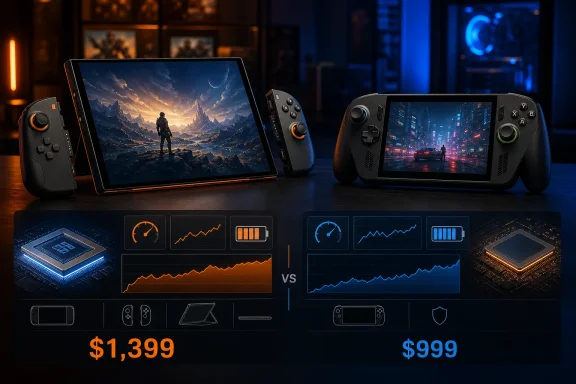 The Arc G3 Extreme advantage is real, but it is not yet an ONEXPLAYER-specific result
Intel introduced Arc G3 Extreme in May as a handheld-focused processor based on its Panther Lake-era architecture, pairing up to Arc B390 integrated graphics with XeSS upscaling, frame generation, precompiled shaders, and an Endurance Gaming mode. Intel’s own performance materials claim a 42% gaming lead over AMD’s Ryzen AI Z2 Extreme at 35 watts. As with all silicon-maker comparisons, that figure is a vendor claim based on selected games, settings, drivers, and a specific test system.
ComputerBase has since supplied the strongest independent corroboration. Its June testing placed an MSI Claw 8 EX AI+ with Arc G3 Extreme against the ROG Xbox Ally X, which uses AMD’s Ryzen AI Z2 Extreme. At matched 35W settings, ComputerBase reported an approximately 60% lead for Intel in its limited game suite, and its Forza Horizon 6 results showed 68 fps on the MSI at 1080p High with XeSS Ultra Quality versus 47 fps on the ASUS using FSR Quality. At 17W, the same comparison was 49 fps versus 33 fps.
Those results make clear that Arc G3 Extreme is a meaningful performance step for Windows handhelds. They do not establish that every Arc G3 Extreme handheld will produce exactly the same margins. Cooling capacity, firmware power behavior, memory configuration, display settings, driver versions, and manufacturer tuning can move handheld results materially. The ONEXPLAYER 3 may use the same B390-class graphics, but its 8.8-inch detachable design is not the MSI chassis ComputerBase tested.
That distinction is especially important for a device being promoted around versatility. A larger screen, removable controllers, kickstand hardware, and a tablet-like core can make the ONEXPLAYER 3 more flexible than a conventional fixed-grip handheld. They also create different thermal and ergonomic constraints than those of the Claw 8 EX AI+ or ASUS’s deeply sculpted Ally chassis. Until reviewers publish controlled, side-by-side benchmarks using retail ONEXPLAYER 3 hardware, “Arc G3 Extreme beats the Ally X” is the accurate shorthand; “the ONEXPLAYER 3 beats the Ally X by X percent” is not yet a settled finding.
“ROG Ally X” now identifies two very different ASUS machines
The comparison also needs a name check. ASUS still sells the 2024 ROG Ally X, a Ryzen Z1 Extreme handheld with 24GB of memory, an 80Wh battery, a 7-inch 1080p 120Hz IPS display, and a conventional Windows 11 interface. That model is substantially different from the newer ROG Xbox Ally X, which carries AMD’s Ryzen AI Z2 Extreme and boots into Microsoft’s controller-oriented Xbox full-screen experience.
ComputerBase’s Arc G3 Extreme comparison used the newer ROG Xbox Ally X. That is the relevant AMD rival for Intel’s newest handheld silicon. Comparing Arc G3 Extreme against the older Z1 Extreme-powered Ally X would produce a wider and less useful performance gulf, because it would be measuring a 2026 platform against a 2024 processor.
Geeky Gadgets refers broadly to the “ROG Ally X,” while its claims about Intel overtaking the handheld competition align more closely with the newer ROG Xbox Ally X. Buyers should not assume a review has used the same ASUS generation unless it identifies the processor. The difference is not cosmetic: the older model uses AMD’s Zen 4 and RDNA 3 silicon, while the newer Xbox-branded model moves to Ryzen AI Z2 Extreme.
ASUS lists the ROG Xbox Ally X at $999.99 in the United States. That price matters because the ONEXPLAYER 3’s reported entry price is $1,399 before optional accessories. The Intel system’s performance lead may be genuine, but it begins with a roughly $400 surcharge over the AMD-based ASUS handheld. That turns the ONEXPLAYER 3 into a specialist purchase, not a straightforward replacement for an Ally X owner.
The screen and form factor are the actual ONEXPLAYER 3 differentiators
The ONEXPLAYER 3’s strongest case is not a benchmark graph. It is the combination of an 8.8-inch, 1920×1200 OLED screen with a 144Hz refresh rate, variable refresh rate support, detachable controllers, and an integrated kickstand. PCWorld saw the machine at Computex and confirmed the basic three-mode concept: it can be used as a standard handheld, as a tablet with the controllers removed, or as a compact PC with the keyboard accessory.
That display is a noticeable specification advantage over ASUS’s 7-inch, 1920×1080, 120Hz IPS panel. OLED brings per-pixel black levels and stronger contrast, while the 16:10 aspect ratio provides more vertical room for Windows desktop work, older PC titles, browser windows, and productivity apps. The extra physical size should also make text more legible than it is on a 7-inch handheld.
The consequence is that ONEXPLAYER is selling a small Windows tablet that happens to have game controls, rather than a dedicated handheld that can occasionally be docked. That will appeal to users who want one portable Windows machine for Steam, Xbox PC games, emulators, video, remote desktop access, and light productivity.
It also means the ONEXPLAYER 3 inherits tablet-PC compromises. A large 8.8-inch device with an 85Wh battery will be heavier and less compact than the ROG Xbox Ally X. Geeky Gadgets notes that the battery and overall size may strain users with smaller hands during extended handheld sessions. The detachable controls solve one problem by allowing tabletop play, but they do not make the device lighter when it is being held.
The optional keyboard is another practical qualifier. “Mini-laptop mode” is not an included Windows experience in the way a physical keyboard deck is on a GPD Win device. It depends on buying and carrying another accessory, and the device will still be a very small touchscreen PC rather than a full notebook replacement.
Battery claims need to be read alongside the power settings
The ONEXPLAYER 3’s reported 85Wh battery is only modestly larger than the 80Wh pack in both generations of the ROG Ally X. The capacity alone will not create dramatically longer AAA gaming sessions; display size, OLED brightness, game settings, refresh rate, and total system power draw will determine runtime.
Geeky Gadgets cites roughly 3.5 hours at 17W and 2.5 hours at 25W in demanding games, along with 8.5 to 10 hours for light 2D and indie games at lower settings. Those are plausible categories of result, but they should not be treated as a universal battery rating. A 17W TDP is not the complete system draw, and a title with a high CPU load, high panel brightness, active frame generation, or aggressive fan curve can reduce runtime materially.
There is also a small specification inconsistency in early coverage. Geeky Gadgets, VideoCardz, and retail listings describe an 85Wh battery, while ComputerBase’s early announcement coverage listed 88Wh. The 85Wh figure appears more consistently across current sales coverage, but OneXPlayer has not made this easy for buyers by keeping the specification record uniform across its public materials. For a $1,399 handheld, that is an avoidable documentation problem.
Intel’s Endurance Gaming mode may improve lower-power play, but it should be understood for what it is: a dynamic trade between image quality, frame rate, and power consumption. It is useful when the goal is a longer session, not a free upgrade that preserves maximum-performance settings while extending battery life.
Storage expansion is convenient, but it is not a substitute for cheap internal SSD upgrades
The ONEXPLAYER 3 includes microSD expansion and a Mini SSD slot in addition to its internal storage. That is valuable for users with large retro libraries, media collections, and multiple Windows game launchers. A removable Mini SSD can also be more convenient than disassembling a handheld to replace an internal M.2 drive.
Convenience comes at a cost. OneXPlayer’s own Mini SSD store pricing lists 1TB and 2TB modules at a substantial premium compared with mainstream M.2 2230 or 2280 drives. Community reports have also raised concerns that reaching the internal SSD requires a deeper teardown than on devices such as the Steam Deck or ROG Ally X. The external-style Mini SSD slot is a welcome option, but buyers should price the storage configuration they actually need before treating the base model as a bargain.
Connectivity is broad, with USB4/Thunderbolt 4-class support, USB-A, a headphone jack, microSD, and Mini SSD expansion. That makes the ONEXPLAYER 3 better suited than most handhelds to a desk setup with an external display, Ethernet adapter, keyboard, mouse, or external GPU enclosure. Yet an eGPU dock, monitor, controller, and storage upgrades can quickly push an already premium handheld into gaming-laptop territory.
The ONEXPLAYER 3 has given Intel its most visually ambitious Windows handheld showcase so far, and independent testing shows Arc G3 Extreme has the performance to challenge AMD’s current flagship at the same power envelope. The concrete buying decision is simpler: pay $1,399 or more for the larger OLED screen, detachable design, and Intel performance ceiling, or spend $999 on ASUS’s more conventional ROG Xbox Ally X with a mature fixed-grip design and Microsoft’s Xbox full-screen software. The missing retail ONEXPLAYER 3-versus-ROG Xbox Ally X benchmark is the one comparison that would tell buyers whether the extra $400 buys a meaningful real-world advantage rather than a more elaborate specification sheet.
References
- Primary source: Geeky Gadgets
Published: August 8, 2026 at 12:00 PM UTC
Loading…
www.geeky-gadgets.com - Related coverage: heldgames.com
Loading…
heldgames.com - Related coverage: geeky-gadgets.com
Loading…
www.geeky-gadgets.com - Related coverage: reviewstown.com
Loading…
www.reviewstown.com - Related coverage: computerbase.de
Loading…
www.computerbase.de - Related coverage: pcworld.com
OneXPlayer 3 is a new Intel Arc G3 Extreme handheld gaming PC | PCWorld
PCWorld's Adam Patrick Murray is one of the first people to go hands-on with the OneXPlayer 3 at Computex 2026, and this Intel Arc G3 Extreme handheld PC looks promising thanks to its adoption of the detachable controller design popularized by the Nintendo Switch and Lenovo Legion Go.www.pcworld.com
- Related coverage: windowsforum.com
Loading…
windowsforum.com - Related coverage: the-gadgeteer.com
Loading…
the-gadgeteer.com - Related coverage: computerbase.de
Mit Intel Arc G3 Extreme-Chip: Gaming-Handheld OneXPlayer 3 kommt mit 8,8-Zoll-OLED-Display - ComputerBase
Der OneXPlayer 3 ist ein Handheld-PC mit Intels Arc G3 Extreme-Chip, der ein 8,8 Zoll großes AMOLED-Display mit bis zu 144 Hertz besitzt.www.computerbase.de
- Related coverage: tomshardware.com
Loading…
www.tomshardware.com - Related coverage: retrohandhelds.gg
Loading…
retrohandhelds.gg - Related coverage: arstechnica.com
Loading…
arstechnica.com - Related coverage: download.intel.com
- Related coverage: windowscentral.com
Loading…
www.windowscentral.com - Related coverage: pcgamer.com
Asus ROG Xbox Ally X handheld gaming PC review | PC Gamer
The latest Review,,,reviews, breaking news, comment, reviews and features from the experts at PC Gamerwww.pcgamer.com - Related coverage: pcgamer.com
Loading…
www.pcgamer.com - Related coverage: tomshardware.com
Intel challenges AMD’s handheld dominance with new Arc G3 chips — Panther Lake silicon brings up to 14 cores, Arc B390 graphics to handhelds | Tom's Hardware
Intel has lined up partners for the range, including Acer and OneXPlayer.www.tomshardware.com - Related coverage: as.com
Loading…
as.com - Related coverage: onexplayerstore.com
Loading…
onexplayerstore.com - Related coverage: indiegogo.com
Loading…
www.indiegogo.com - Related coverage: videocardz.com
Loading…
videocardz.com - Related coverage: droix.net
Loading…
droix.net - Related coverage: notebookcheck.net
OneXPlayer 3 launching globally in June 2026 with Intel Arc G3 Extreme and 144 Hz OLED display - Notebookcheck News
OneXPlayer has announced a new Windows gaming handheld. Launching globally in June 2026, the OneXPlayer 3 combines the Intel Arc G3 Extreme with a 144 Hz OLED display. The handheld features an 85 Wh built-in battery and Hall effect joysticks, too. www.notebookcheck.net
- Related coverage: androidauthority.com
Loading…
www.androidauthority.com - Related coverage: droix.co.uk
Loading…
droix.co.uk - Related coverage: hamhels.com
Loading…
hamhels.com - Related coverage: onexplayerstore.com
Loading…
onexplayerstore.com - Related coverage: duckittech.com
Loading…
www.duckittech.com - Related coverage: rog.asus.com
ROG Xbox Ally X | Gaming Handhelds|ROG USA
2025 ROG Xbox Ally X redefines handheld gaming with next-gen power, massive battery capacity, and upgraded design. Your ultimate portable gaming companionrog.asus.com - Related coverage: press.asus.com
Loading…
press.asus.com - Related coverage: rog.asus.com
Loading…
rog.asus.com - Related coverage: intel.com
Intel® Arc™ G-Series Processors for Handheld Gaming
Intel Arc G-Series processors for handheld gaming. Smooth gameplay at high settings, AI-powered XeSS 3, ray tracing, and battery life built to last.www.intel.com - Related coverage: newsroom.intel.com
Intel Arc G-Series Processors Set a New Standard for Handheld PC Gaming - Intel Newsroom
Intel® Arc™ G-Series processors combine leadership performance and power efficiency to deliver smooth, immersive gameplay with exceptional battery lifenewsroom.intel.com - Related coverage: intel.com
Loading…
www.intel.com - Related coverage: asus.com
Loading…
www.asus.com - Related coverage: edc.intel.com
Loading…
edc.intel.com - Related coverage: download.intel.com