
That distinction is more than semantics. A retailer can benefit from a customer arriving through ChatGPT or Gemini, while still losing valuable information if the AI platform owns the session, payment identity, order history and the customer-service entry point. Conversely, a retailer that receives the shopper in its own signed-in experience can connect the purchase to loyalty status, existing baskets, delivery preferences, returns and prior browsing behavior.
The evidence now points to a compromise taking shape: AI services are becoming the discovery layer, while retailers are building ways to reclaim the transaction before it becomes a generic marketplace checkout. OpenAI’s own evolution over the past year shows why.
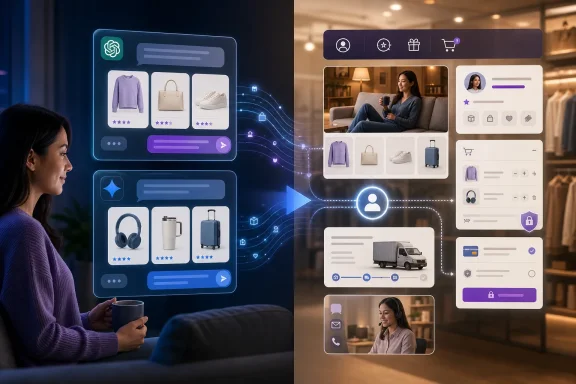 AI referrals are becoming unusually valuable traffic
Reuters cited Adobe Analytics data saying that 41% of U.S. consumers used generative AI for online shopping in June, while AI-referred retail visitors generated 41% more revenue per visit than visitors from traditional channels. That does not mean AI assistants have replaced search, retail apps or direct browsing. It means the smaller group of shoppers who arrive after asking a detailed question — such as for a specific bag, shade, budget, compatibility requirement or occasion — tend to arrive with a clearer purchase intent.
Earlier Adobe Analytics data reported by Reuters in June showed the same pattern at a higher level: AI traffic to retail sites was up 138% year over year in May, visitors referred by AI converted 54% better than shoppers from non-AI sources, and they spent 53% more time on retail sites. Those are useful numbers for merchants, but they should not be mistaken for proof that every chatbot mention creates a profitable sale. Adobe measures the traffic that reaches a retailer’s site; it cannot measure users who obtain an answer in a chatbot and never click through.
For retail technology teams, the practical change is that a product page can no longer be written solely for a keyword-driven results page. Large language models respond to specific constraints: “a waterproof carry-on under $200,” “a fragrance-free foundation for dry skin,” or “a suede bucket bag in this color.” Product titles, specifications, sizing information, availability, price, shipping restrictions and structured product feeds all become inputs into whether an AI system can confidently recommend an item.
That is why the retailer response looks familiar to anyone who watched search-engine optimization reshape e-commerce. The new work is often described as optimizing for AI, but the underlying task is stronger product data: clean catalogs, current inventory, detailed attributes, accurate variant information and pages a crawler or partner API can interpret. The important difference is that the output is frequently a single conversational recommendation rather than a page of ten blue links.
Reuters reported that Ulta Beauty is seeing double the conversion and intent from visitors coming through Gemini and ChatGPT, and is working with Google on shopping-cart and loyalty-program integrations in Gemini. Ulta’s preference that the actual transaction happen on Ulta.com is rational. A beauty retailer’s rewards account and repeat-purchase history can be more commercially useful than one isolated order.
The checkout fight is also a measurement fight
The phrase “customer data” can obscure what retailers are actually trying to preserve. Payment and fulfillment records are important, but the high-value information begins before checkout: which products a signed-in shopper compared, what they removed from a cart, what they bought together, what loyalty offers affected the decision, and whether they returned later for replenishment.
Walmart’s privacy notice spells out the kind of first-party information retailers collect on their own services: pages viewed, links clicked, items added to a cart or purchased, time spent in particular features, and the referring page. That data supports merchandising, inventory decisions, retail-media measurement and personalized recommendations. A referral from ChatGPT or Gemini still gives Walmart the source of traffic, but a handoff into a logged-in Walmart experience lets it tie the session to a far fuller customer record.
Walmart executives have been unusually candid about why a retailer wants that handoff. In a Morgan Stanley conference presentation this year, the company described moving from direct purchases in ChatGPT to an arrangement in which its Sparky shopping assistant opens inside ChatGPT and Gemini after a Walmart item is selected. The company said the shopper will be signed in, enabling Walmart to recognize items already added to that customer’s cart during the week and combine them into the shopping journey.
That is the commercial objective in one sentence: an AI service may originate the request, but the retailer wants its own system to recognize the shopper and resume the relationship. Walmart is not refusing AI distribution. It is ensuring the distribution channel does not sever account-level context.
There is a consumer consequence as well. A retailer-controlled checkout can apply member pricing, subscriptions, store credit, gift cards, delivery eligibility, pickup preferences and loyalty benefits that a generic AI checkout may not support. It can also provide a clearer route for returns, substitutions and order support. Those are not merely data-capture mechanisms; they are the operational systems that make large retail transactions work.
OpenAI’s retreat from a universal checkout explains the strategy
Reuters noted that OpenAI ended its original Instant Checkout approach in March and shifted its attention toward product discovery and merchant-operated checkout experiences. OpenAI has confirmed that change directly, saying the initial version of Instant Checkout did not provide the flexibility it wanted and that merchants can now use their own checkout experiences.
This is the material development behind the retail industry’s current posture. OpenAI launched Instant Checkout in September 2025 with Etsy sellers and plans for Shopify merchants, presenting it as a way to complete single-item purchases inside ChatGPT. The earlier system still left merchants responsible for order acceptance, payment processing, fulfillment, returns and support, but it placed the transaction interface inside ChatGPT.
That model made sense for low-friction purchases, yet it struggled with the realities of retail. A merchant’s checkout can involve authentication, promotion eligibility, tax treatment, split shipments, stock changes, subscription terms, reward balances, personalized financing, pickup windows and complex return policies. A single generic purchase flow cannot expose every retailer’s feature set without becoming a substantial commerce platform in its own right.
OpenAI’s new product-discovery approach is therefore an admission that product recommendation and retail checkout are separate technical problems. ChatGPT can identify items across the web, while the merchant’s own site, app or embedded experience handles the transaction that follows. The AI platform remains influential because it decides what gets surfaced, but it does not have to become the system of record for every retail order.
Walmart’s current approach fits that model. Its own materials describe the company as building an “agentic commerce” future through both internal technology and integrations with ChatGPT and Gemini. Sparky serves as the retail-specific layer after an external AI system has helped discover a Walmart product. This lets Walmart accept the AI referral without handing over the service layer that follows it.
Etsy shows where the boundary still breaks down
Etsy provides the clearest warning that a retailer can retain the commercial transaction and still lose part of the direct customer relationship. Etsy now supports some purchases through ChatGPT, Gemini, Google AI Mode and Microsoft Copilot for signed-in U.S. users. Its help documentation says that an order placed through one of those AI experiences is initially a guest order and is not automatically connected to an Etsy account.
The buyer can later associate the order with an Etsy account using the purchase email address, but that extra step matters. Until it happens, the marketplace has a weaker link between the transaction and the customer’s established account history. Etsy’s documentation says customers need to connect the order to leave a review, message the seller, seek help with an order or file a support request.
This is the unglamorous but consequential side of agentic commerce. The sale may have occurred, but account continuity, support entitlement and future personalization can still be fragmented. For marketplaces, where reviews, seller communications and repeat discovery are central to the product, a checkout that produces guest relationships has real costs.
It also complicates the suggestion that retailers can simply “keep” customer data. The answer depends on the integration. A merchant may receive the information needed to fulfill a purchase while an AI provider retains the user’s broader prompt history and discovery context. The platform can know that a user asked for “wedding invitations for 120 guests in October,” while the retailer may know only which invitation suite was ultimately ordered. Neither dataset is complete; each is valuable in different ways.
Reuters reported that The Knot is optimizing its content for ChatGPT discovery while trying to bring couples back to its own site for venue and invitation bookings. Its three decades of wedding-planning data are useful precisely because a complex event generates connected decisions over time. A chatbot can start the research process, but The Knot wants to remain where those choices turn into bookings, vendor comparisons and repeat planning sessions.
Product discovery is open; the customer relationship is not
Retailers should treat AI platforms as a new acquisition channel and measure them accordingly: referral volume, conversion rate, average order value, new-versus-returning customer mix, loyalty enrollment, return rates and repeat purchases. Tracking only chatbot-driven revenue will flatter the channel if the traffic converts well on a first purchase but fails to create durable customers.
The technical priority is to make product information legible to AI systems without allowing critical commerce functions to become anonymous handoffs. That means keeping inventory, feeds, attributes, prices and policies current; preserving campaign and referrer attribution; supporting account linking where it is available; and ensuring that loyalty, returns and support work after AI-originated orders.
The industry is not choosing between being visible in ChatGPT or controlling the customer relationship. It needs both. OpenAI’s move away from its original Instant Checkout model, Walmart’s plan to bring Sparky into ChatGPT and Gemini, and Etsy’s guest-order caveat all show the same result: AI may win the first interaction, but retailers are redesigning the journey to win everything after it.
References
- Primary source: Kuwait Times
Published: August 8, 2026 at 3:20 PM UTC
Retailers tap AI traffic but fight to keep customer data | Kuwait Times Newspaper
NEW YORK: As shoppers increasingly turn to ChatGPT and Google’s Gemini for product recommendations, retailers are racing to appear in chatbot results while re...kuwaittimes.com
- Related coverage: business.adobe.com
- Related coverage: business.adobe.com
- Related coverage: vi.web-platforms-vi.nyti.nyt.net
- Related coverage: futr.ai
How Do Chatbots Improve Customer Experience? | Futr
While companies are getting mixed results from their chatbot deployments, most organisations and experts will agree on one thing: When done right, chatbots improve customer experience in more ways than one.futr.ai - Related coverage: blog.google
Unlock new loyalty features in Google Ads & Merchant Center
Last updated on September 3, 202561% of US adults say the top draw of a personalized shopping experience is a loyalty program that’s tailored to their preferences. That’…blog.google