
OpenAI has the strongest public brand among major AI labs, but The Argument’s new poll does not establish that it is broadly loved. It shows something narrower and more useful: Americans recognize OpenAI far more readily than Anthropic or xAI, and people who recognize OpenAI rate it more favorably than people who recognize its rivals. For IT buyers and Windows users, the practical takeaway is that ChatGPT’s consumer reach is still doing more for OpenAI’s reputation than safety positioning, enterprise revenue, or Washington fights are doing for competitors.
The Argument’s survey of 3,008 registered voters, fielded from May 29 through June 3, reports that 13% had not heard of OpenAI, compared with 42% for Anthropic and 38% for xAI. Among respondents who knew each company, OpenAI posted net favorability of +11, against +3 for Anthropic. The publication’s accompanying Datawrapper chart gives the sample size and a ±2-point margin of error, but its public materials do not provide a questionnaire, crosstabs, sampling mode, weighting scheme, field vendor, or full response tables.
That missing documentation limits how far the result can travel. The poll supports the conclusion that OpenAI is the best-known AI lab in this survey. It does not, by itself, settle which company the public likes most overall, whether users prefer OpenAI’s products, or whether people see the company as more trustworthy with sensitive work data.
The result fits a far more robust pattern in independent polling: the public knows and uses chatbot products, while the corporate entities behind them remain comparatively abstract. Pew Research Center’s February 2026 survey found that 44% of U.S. adults had used ChatGPT, while just 6% had used Claude. Gemini reached 24%, Microsoft Copilot 17%, Meta AI 14%, and Grok 8%.
That creates an important naming problem in any “favorite AI lab” survey. Most people encounter ChatGPT, not “OpenAI”; Claude, not “Anthropic”; Copilot, not the Microsoft–OpenAI commercial relationship. A respondent who likes ChatGPT because it helps draft an email, troubleshoot a PowerShell command, or summarize a long document may register a favorable view of OpenAI without knowing much about OpenAI’s governance, model policies, cloud arrangements, or defense contracts.
Pew’s findings show the scale of that consumer advantage. Nearly half of adults report using AI chatbots, and 42% use them to search for information. Searchlight Institute reached a similar conclusion in its 2025 survey: the tool names were more familiar than the companies, while frequent users often treated AI as an alternative to conventional web search. ChatGPT’s familiarity is therefore less like a vote for a frontier-lab philosophy and more like the accumulated value of a product that consumers have actually used.
For Windows administrators, this distinction should be familiar. A user may say they “use AI” while referring to Copilot in Windows, Microsoft 365 Copilot, ChatGPT in a browser, GitHub Copilot, Edge’s built-in features, or an enterprise bot sitting behind Azure. Those products have different data boundaries, licensing terms, administrative controls, and model providers. A public-opinion lead for OpenAI says virtually nothing about which of those deployments an organization should approve.
Those are different measurements, and the difference matters. Searchlight’s December release did not say that 81% had never heard of Anthropic; it said 81% had not heard enough to have an opinion. That category can include people who recognize the name but lack a view, people who are uncertain, and people who have never heard of it. The Argument’s publicly visible text uses “had not heard” for its 42% figure.
The two surveys are directionally consistent: Anthropic was much less visible to the public than OpenAI and remains less visible. But subtracting 42 from 81 does not demonstrate a 39-point increase in name recognition, and it certainly does not establish the upper-end 53-point estimate offered in the article. That calculation combines unlike response options from surveys with different samples and, based on the material available publicly, different undisclosed methods.
Other polling supports the basic recognition gap without validating that claimed change. The Yale Youth Poll’s spring 2026 results found that 70% of voters were unfamiliar with Claude, while only 20% were unfamiliar with ChatGPT. The product-level gap is even wider than the company-level gap, which reinforces the central point: Anthropic’s reputation among AI practitioners, developers, and policy professionals has not yet become broad consumer recognition.
Anthropic’s enterprise success does not automatically change that. The company may be a meaningful force in API usage, coding tools, cloud marketplaces, and high-value corporate contracts, but those are weak pathways to household-name status. A systems administrator selecting Claude through Amazon Bedrock or Google Cloud does not necessarily create a consumer who can identify Anthropic in a poll.
Those figures do not mean The Argument’s poll is wrong. They show that the outcome shifts dramatically depending on the question context, the surrounding items, the sample, and whether the result is reported among everyone or only among those recognizing a brand. Change Research’s full-sample measure produces a strongly negative net score for OpenAI, while The Argument’s recognition-filtered measure produces a positive +11 net score.
The defensible conclusion is not that one poll should be discarded in favor of the other. It is that “the public’s favorite AI lab” is too sweeping a label for a measurement where the public is still forming opinions and where vast shares of respondents do not know at least one of the companies being rated.
The broader national mood is also considerably more skeptical than a company-favorability headline implies. Quinnipiac University found in March that 76% of Americans trusted AI-generated information hardly ever or only some of the time, while 80% said they were concerned about AI. Pew reported that 40% expected AI’s effect on society over the next 20 years to be negative, against 16% who expected a positive effect, and 63% said AI was advancing too quickly.
That skepticism does not prevent people from using AI. It means usage and trust are separate variables. A person can use ChatGPT weekly, rate OpenAI more favorably than an unfamiliar Anthropic, and still oppose unchecked deployment of AI in employment, government, military targeting, surveillance, or local data-center construction.
A February Morning Consult survey commissioned by the Information Technology and Innovation Foundation found substantial concern about AI-enabled mass surveillance and autonomous weapons. It also found that most respondents had heard little or nothing about the Anthropic–Defense Department dispute. Among those aware of it, views were divided, with more calling penalties against Anthropic government overreach than calling them necessary for national security.
That is a warning against reading elite controversy into mass-market awareness. Policy professionals may interpret Anthropic as the lab that drew a red line and OpenAI as the competitor willing to accommodate the Pentagon. The broader electorate appears more focused on the use of AI itself: whether there is human control, whether surveillance has legal limits, and whether companies and government are being transparent.
For organizations making technology decisions, company reputation is therefore a poor proxy for risk. The relevant questions remain operational: what model is being used, where prompts and files are processed, whether tenant data is retained or used for training, what audit logs exist, how identity and access are enforced, and whether administrators can control connectors and third-party actions.
But that advantage should be read as a distribution result. ChatGPT is the AI product many Americans have tried; OpenAI is consequently the lab many Americans can name. It is not a referendum on model quality, privacy, safety practices, enterprise support, or suitability for Windows and Microsoft 365 environments.
Anthropic has made progress in awareness, but the available polling does not prove a clean six-month surge, and its recognition remains well behind OpenAI’s. The immediate consequence is straightforward: the AI lab with the biggest public brand is still OpenAI, while the question of which lab deserves the public’s confidence remains unsettled—and cannot be answered by brand favorability alone.
That missing documentation limits how far the result can travel. The poll supports the conclusion that OpenAI is the best-known AI lab in this survey. It does not, by itself, settle which company the public likes most overall, whether users prefer OpenAI’s products, or whether people see the company as more trustworthy with sensitive work data.
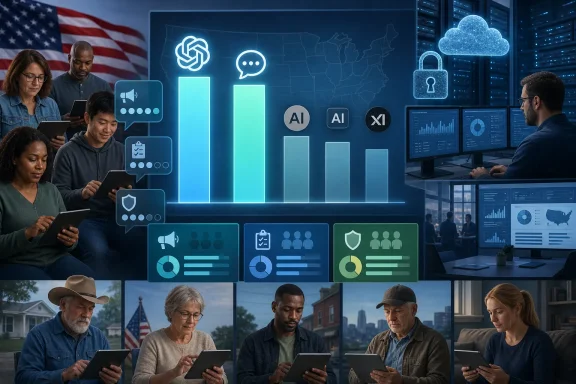 ChatGPT Has the Product Recognition That Corporate Brands Lack
The result fits a far more robust pattern in independent polling: the public knows and uses chatbot products, while the corporate entities behind them remain comparatively abstract. Pew Research Center’s February 2026 survey found that 44% of U.S. adults had used ChatGPT, while just 6% had used Claude. Gemini reached 24%, Microsoft Copilot 17%, Meta AI 14%, and Grok 8%.That creates an important naming problem in any “favorite AI lab” survey. Most people encounter ChatGPT, not “OpenAI”; Claude, not “Anthropic”; Copilot, not the Microsoft–OpenAI commercial relationship. A respondent who likes ChatGPT because it helps draft an email, troubleshoot a PowerShell command, or summarize a long document may register a favorable view of OpenAI without knowing much about OpenAI’s governance, model policies, cloud arrangements, or defense contracts.
Pew’s findings show the scale of that consumer advantage. Nearly half of adults report using AI chatbots, and 42% use them to search for information. Searchlight Institute reached a similar conclusion in its 2025 survey: the tool names were more familiar than the companies, while frequent users often treated AI as an alternative to conventional web search. ChatGPT’s familiarity is therefore less like a vote for a frontier-lab philosophy and more like the accumulated value of a product that consumers have actually used.
For Windows administrators, this distinction should be familiar. A user may say they “use AI” while referring to Copilot in Windows, Microsoft 365 Copilot, ChatGPT in a browser, GitHub Copilot, Edge’s built-in features, or an enterprise bot sitting behind Azure. Those products have different data boundaries, licensing terms, administrative controls, and model providers. A public-opinion lead for OpenAI says virtually nothing about which of those deployments an organization should approve.
The Anthropic Awareness Comparison Is Not a Clean Trend Line
The Argument’s sharpest claim is that Anthropic’s awareness has risen rapidly since December 2025. It juxtaposes its 42% “had not heard of Anthropic” finding with a Searchlight Institute result that said 81% had not heard enough about Anthropic to form an opinion.Those are different measurements, and the difference matters. Searchlight’s December release did not say that 81% had never heard of Anthropic; it said 81% had not heard enough to have an opinion. That category can include people who recognize the name but lack a view, people who are uncertain, and people who have never heard of it. The Argument’s publicly visible text uses “had not heard” for its 42% figure.
The two surveys are directionally consistent: Anthropic was much less visible to the public than OpenAI and remains less visible. But subtracting 42 from 81 does not demonstrate a 39-point increase in name recognition, and it certainly does not establish the upper-end 53-point estimate offered in the article. That calculation combines unlike response options from surveys with different samples and, based on the material available publicly, different undisclosed methods.
Other polling supports the basic recognition gap without validating that claimed change. The Yale Youth Poll’s spring 2026 results found that 70% of voters were unfamiliar with Claude, while only 20% were unfamiliar with ChatGPT. The product-level gap is even wider than the company-level gap, which reinforces the central point: Anthropic’s reputation among AI practitioners, developers, and policy professionals has not yet become broad consumer recognition.
Anthropic’s enterprise success does not automatically change that. The company may be a meaningful force in API usage, coding tools, cloud marketplaces, and high-value corporate contracts, but those are weak pathways to household-name status. A systems administrator selecting Claude through Amazon Bedrock or Google Cloud does not necessarily create a consumer who can identify Anthropic in a poll.
“Favorite” Depends on Who Counts and How the Question Is Scored
A separate national registered-voter survey conducted by Change Research in March 2026 illustrates why the wording and denominator cannot be treated as a technicality. That poll asked respondents to rate public figures, groups, and ideas, explicitly allowing “never heard of them.” It found OpenAI at 12% favorable and 49% unfavorable, with 5% saying they had never heard of it. Anthropic was 10% favorable and 17% unfavorable, but 47% had never heard of the company.Those figures do not mean The Argument’s poll is wrong. They show that the outcome shifts dramatically depending on the question context, the surrounding items, the sample, and whether the result is reported among everyone or only among those recognizing a brand. Change Research’s full-sample measure produces a strongly negative net score for OpenAI, while The Argument’s recognition-filtered measure produces a positive +11 net score.
The defensible conclusion is not that one poll should be discarded in favor of the other. It is that “the public’s favorite AI lab” is too sweeping a label for a measurement where the public is still forming opinions and where vast shares of respondents do not know at least one of the companies being rated.
The broader national mood is also considerably more skeptical than a company-favorability headline implies. Quinnipiac University found in March that 76% of Americans trusted AI-generated information hardly ever or only some of the time, while 80% said they were concerned about AI. Pew reported that 40% expected AI’s effect on society over the next 20 years to be negative, against 16% who expected a positive effect, and 63% said AI was advancing too quickly.
That skepticism does not prevent people from using AI. It means usage and trust are separate variables. A person can use ChatGPT weekly, rate OpenAI more favorably than an unfamiliar Anthropic, and still oppose unchecked deployment of AI in employment, government, military targeting, surveillance, or local data-center construction.
The Defense-Department Story Has Not Yet Rewritten Consumer Sentiment
The Argument frames the polling against the February confrontation involving Anthropic and the Defense Department over constraints on surveillance and autonomous weapons. That episode has clear policy relevance, but there is little evidence in public polling that it has already transformed company reputations.A February Morning Consult survey commissioned by the Information Technology and Innovation Foundation found substantial concern about AI-enabled mass surveillance and autonomous weapons. It also found that most respondents had heard little or nothing about the Anthropic–Defense Department dispute. Among those aware of it, views were divided, with more calling penalties against Anthropic government overreach than calling them necessary for national security.
That is a warning against reading elite controversy into mass-market awareness. Policy professionals may interpret Anthropic as the lab that drew a red line and OpenAI as the competitor willing to accommodate the Pentagon. The broader electorate appears more focused on the use of AI itself: whether there is human control, whether surveillance has legal limits, and whether companies and government are being transparent.
For organizations making technology decisions, company reputation is therefore a poor proxy for risk. The relevant questions remain operational: what model is being used, where prompts and files are processed, whether tenant data is retained or used for training, what audit logs exist, how identity and access are enforced, and whether administrators can control connectors and third-party actions.
Consumer Reach Is OpenAI’s Advantage, Not a Security Assessment
The Argument’s polling gives OpenAI a real advantage in awareness and a modest advantage in favorable impressions among people who can identify the companies. Pew’s much larger product-usage data explains why: ChatGPT has a reach that Claude, Copilot, Gemini, and Grok have not matched across the public.But that advantage should be read as a distribution result. ChatGPT is the AI product many Americans have tried; OpenAI is consequently the lab many Americans can name. It is not a referendum on model quality, privacy, safety practices, enterprise support, or suitability for Windows and Microsoft 365 environments.
Anthropic has made progress in awareness, but the available polling does not prove a clean six-month surge, and its recognition remains well behind OpenAI’s. The immediate consequence is straightforward: the AI lab with the biggest public brand is still OpenAI, while the question of which lab deserves the public’s confidence remains unsettled—and cannot be answered by brand favorability alone.
References
- Primary source: The Argument
Published: 2026-08-03T10:01:56+00:00
Loading…
www.theargumentmag.com - Related coverage: www2.itif.org
Loading…
www2.itif.org - Related coverage: quantusinsights.org
Loading…
quantusinsights.org - Related coverage: anthropic.com
Loading…
www.anthropic.com - Related coverage: pewresearch.org
Loading…
www.pewresearch.org