
Comnexa says it has been named an OpenAI Select Partner, giving the Jersey-based Salesforce consultancy a place in OpenAI’s new tiered channel programme as it begins selling AI advisory and implementation work to financial and professional-services firms. The immediate consequence for customers is access to a partner that can package OpenAI projects alongside existing Salesforce work; it is not, on the public record, proof of a jointly delivered customer deployment or a guarantee of preferential product access.
Channel Eye first reported Comnexa’s announcement, which says 30 members of its team have completed OpenAI training achievements covering use-case identification, workflow design, deployment planning and preparing API projects for production. Comnexa also says it will use the status to help clients connect AI to their existing systems, data and processes, with governance and adoption work included in the offer.
The timing is significant. OpenAI launched the OpenAI Partner Network on June 14, 2026, with Select, Advanced and Elite tiers, a stated $150 million ecosystem investment and a target of training and enabling 300,000 certified consultants by year-end. Comnexa is joining less than two months into that programme, when the commercial value of the badge is still being defined in public.
OpenAI describes Select, Advanced and Elite as progression tiers with requirements involving sales performance, technical capability, co-selling engagement and deployment experience. It does not publish the scoring thresholds, minimum revenue figures, required number of deployments or the benefits attached to each tier. That omission matters when a consultancy uses the status in procurement discussions: buyers can confirm the programme exists, but cannot independently map “Select” to a disclosed level of revenue, delivery scale or product specialization.
CRN, which reported on the network’s July rollout, described Select as the first of the programme’s three tiers. OpenAI’s own announcement makes clear that partners can progress through Select, Advanced and Elite; it does not present Select as an endorsement equivalent to the company’s highest-ranked global integrators or management consultancies.
The distinction is important because Comnexa’s public materials pair its OpenAI Select designation with its Salesforce Summit Partner standing. Those labels should not be treated as comparable credentials. Salesforce’s Summit tier is part of a mature partner programme with a long-established public hierarchy. OpenAI’s network is new, its thresholds remain unpublished, and its future specialist badges — including Codex, cybersecurity and agent specializations — are described by OpenAI as capabilities partners will be able to earn as the platform evolves.
Comnexa has not announced an OpenAI specialization. It has also not named a customer, deployment, product integration or measurable result that OpenAI has independently highlighted. The company is selling readiness and delivery capability, rather than claiming a flagship OpenAI customer case study.
That gap is worth spelling out because Channel Eye’s report relies on the company announcement, while OpenAI’s June launch material names a group of major partners but does not mention Comnexa. Neither OpenAI nor Comnexa has published a joint announcement explaining when Comnexa was admitted, whether it was part of the initial cohort, or what co-selling and support arrangements apply.
The report’s publishing metadata also merits a small correction in interpretation. It is dated August 5, 2026, while its last-modified timestamp is August 2, 2026 — a sequence consistent with a draft or pre-scheduled article, not evidence that the partner designation was granted on August 5. The actual approval date has not been publicly disclosed.
For IT buyers, the appropriate conclusion is straightforward: validate the partner status directly during supplier due diligence, and ask which specific OpenAI programme benefits will apply to the proposed engagement. A badge alone does not answer whether the consultancy can obtain solution-architecture help, bring in OpenAI specialists, participate in a joint sale, or provide support beyond ordinary API implementation.
Its newer Comnexa X materials make that positioning more concrete. The company says it uses OpenAI Codex to translate consultant instructions into Salesforce configuration, including Salesforce Flow XML, with a human Salesforce consultant reviewing changes before release. It describes use cases including onboarding and know-your-customer document triage, drafting proposals from knowledge bases, and marketing campaign briefing.
Those examples tell Windows and enterprise administrators where the technical work will actually land. The risk is not confined to a standalone AI chatbot. An AI project that drafts a response from a knowledge base, triages onboarding documents, or creates CRM workflow configuration can reach into identity controls, Salesforce permissions, document repositories, retention policy, audit logging and business approval paths.
Comnexa says its Codex-based configuration workflow does not share customer records or personally identifiable information with Codex, and that every proposed change is reviewed before deployment. Those are useful guardrails, but customers should treat them as design claims to verify within the statement of work and architecture. The boundary between “configuration patterns” and live business data depends on the data sources connected to the workflow, the prompts supplied by staff, the sandbox or production environment in use, and the permissions granted to integrations.
A Salesforce administrator should therefore ask for the exact technical model rather than accepting broad assurances about responsible AI. Is the work performed in a sandbox? Which OpenAI service and account type is being used? What data is transmitted for inference? Are prompts and outputs retained? Can the proposed Flow, Apex code, integration mapping or agent action be reviewed in source control before deployment? Who owns rollback when an AI-assisted configuration changes a client-facing process?
OpenAI’s partner programme does say that it intends to train and enable 300,000 certified consultants by the end of 2026. Yet OpenAI has not publicly published a detailed, buyer-facing catalogue showing how individual training achievements correspond to partner tier, technical specialization or verified production-delivery experience.
That is not unique to Comnexa. It is a limitation of evaluating a channel programme still in its opening months. The useful test is whether the supplier can demonstrate relevant work in the buyer’s own risk category: a regulated financial-services workflow needs a different evidence trail from a marketing-content assistant or internal coding tool.
Comnexa’s long-standing Salesforce work may give it a defensible advantage in that narrower setting. The company says it was founded in 2016 and focuses predominantly on financial and professional services; its public materials describe teams in Jersey, London, Portugal and Poland. The firm’s Salesforce practice should be more relevant to organisations seeking to change established onboarding, relationship-management or compliance workflows than to businesses looking for a broad, vendor-neutral AI transformation programme.
Before treating the new Select status as a procurement differentiator, prospective customers should ask Comnexa to provide concrete answers in writing:
The timing is significant. OpenAI launched the OpenAI Partner Network on June 14, 2026, with Select, Advanced and Elite tiers, a stated $150 million ecosystem investment and a target of training and enabling 300,000 certified consultants by year-end. Comnexa is joining less than two months into that programme, when the commercial value of the badge is still being defined in public.
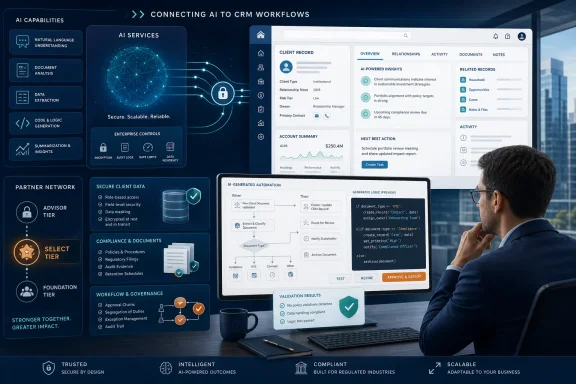 Select is an entry tier, not a specialist certification
OpenAI describes Select, Advanced and Elite as progression tiers with requirements involving sales performance, technical capability, co-selling engagement and deployment experience. It does not publish the scoring thresholds, minimum revenue figures, required number of deployments or the benefits attached to each tier. That omission matters when a consultancy uses the status in procurement discussions: buyers can confirm the programme exists, but cannot independently map “Select” to a disclosed level of revenue, delivery scale or product specialization.CRN, which reported on the network’s July rollout, described Select as the first of the programme’s three tiers. OpenAI’s own announcement makes clear that partners can progress through Select, Advanced and Elite; it does not present Select as an endorsement equivalent to the company’s highest-ranked global integrators or management consultancies.
The distinction is important because Comnexa’s public materials pair its OpenAI Select designation with its Salesforce Summit Partner standing. Those labels should not be treated as comparable credentials. Salesforce’s Summit tier is part of a mature partner programme with a long-established public hierarchy. OpenAI’s network is new, its thresholds remain unpublished, and its future specialist badges — including Codex, cybersecurity and agent specializations — are described by OpenAI as capabilities partners will be able to earn as the platform evolves.
Comnexa has not announced an OpenAI specialization. It has also not named a customer, deployment, product integration or measurable result that OpenAI has independently highlighted. The company is selling readiness and delivery capability, rather than claiming a flagship OpenAI customer case study.
The public partner directory has not yet caught up
There is a second, more practical wrinkle. As of August 5, OpenAI’s public Partner Network page and partner locator did not return a Comnexa listing in their indexed results, although Comnexa’s own website now identifies the business as an OpenAI Select Partner. That does not establish that Comnexa’s status is inaccurate: partner directories can lag announcements, and OpenAI’s public listing is clearly evolving. But it means the designation is presently corroborated by Comnexa’s statements rather than a visible OpenAI profile.That gap is worth spelling out because Channel Eye’s report relies on the company announcement, while OpenAI’s June launch material names a group of major partners but does not mention Comnexa. Neither OpenAI nor Comnexa has published a joint announcement explaining when Comnexa was admitted, whether it was part of the initial cohort, or what co-selling and support arrangements apply.
The report’s publishing metadata also merits a small correction in interpretation. It is dated August 5, 2026, while its last-modified timestamp is August 2, 2026 — a sequence consistent with a draft or pre-scheduled article, not evidence that the partner designation was granted on August 5. The actual approval date has not been publicly disclosed.
For IT buyers, the appropriate conclusion is straightforward: validate the partner status directly during supplier due diligence, and ask which specific OpenAI programme benefits will apply to the proposed engagement. A badge alone does not answer whether the consultancy can obtain solution-architecture help, bring in OpenAI specialists, participate in a joint sale, or provide support beyond ordinary API implementation.
Comnexa is positioning AI as a Salesforce delivery layer
Comnexa’s clearest commercial opportunity is not selling ChatGPT seats. It is adding AI workflows to the Salesforce estates it already manages for regulated and relationship-driven organisations. Its stated coverage — business development, onboarding, compliance, service delivery and relationship management — maps closely to the areas where a CRM consultancy already has process knowledge, permissions context and access to customer data models.Its newer Comnexa X materials make that positioning more concrete. The company says it uses OpenAI Codex to translate consultant instructions into Salesforce configuration, including Salesforce Flow XML, with a human Salesforce consultant reviewing changes before release. It describes use cases including onboarding and know-your-customer document triage, drafting proposals from knowledge bases, and marketing campaign briefing.
Those examples tell Windows and enterprise administrators where the technical work will actually land. The risk is not confined to a standalone AI chatbot. An AI project that drafts a response from a knowledge base, triages onboarding documents, or creates CRM workflow configuration can reach into identity controls, Salesforce permissions, document repositories, retention policy, audit logging and business approval paths.
Comnexa says its Codex-based configuration workflow does not share customer records or personally identifiable information with Codex, and that every proposed change is reviewed before deployment. Those are useful guardrails, but customers should treat them as design claims to verify within the statement of work and architecture. The boundary between “configuration patterns” and live business data depends on the data sources connected to the workflow, the prompts supplied by staff, the sandbox or production environment in use, and the permissions granted to integrations.
A Salesforce administrator should therefore ask for the exact technical model rather than accepting broad assurances about responsible AI. Is the work performed in a sandbox? Which OpenAI service and account type is being used? What data is transmitted for inference? Are prompts and outputs retained? Can the proposed Flow, Apex code, integration mapping or agent action be reviewed in source control before deployment? Who owns rollback when an AI-assisted configuration changes a client-facing process?
Training achievements are not the same as named production experience
Comnexa’s figure of 30 OpenAI training achievements is meaningful as evidence that the firm has invested in enablement. It is also narrower than it first appears. The announcement uses the term “training achievements,” including practitioner badges and accreditations, rather than naming 30 separately certified consultants. One person can earn more than one achievement, and neither Channel Eye nor Comnexa’s public material breaks the total down by person, role, exam, certification level or completion date.OpenAI’s partner programme does say that it intends to train and enable 300,000 certified consultants by the end of 2026. Yet OpenAI has not publicly published a detailed, buyer-facing catalogue showing how individual training achievements correspond to partner tier, technical specialization or verified production-delivery experience.
That is not unique to Comnexa. It is a limitation of evaluating a channel programme still in its opening months. The useful test is whether the supplier can demonstrate relevant work in the buyer’s own risk category: a regulated financial-services workflow needs a different evidence trail from a marketing-content assistant or internal coding tool.
Comnexa’s long-standing Salesforce work may give it a defensible advantage in that narrower setting. The company says it was founded in 2016 and focuses predominantly on financial and professional services; its public materials describe teams in Jersey, London, Portugal and Poland. The firm’s Salesforce practice should be more relevant to organisations seeking to change established onboarding, relationship-management or compliance workflows than to businesses looking for a broad, vendor-neutral AI transformation programme.
What customers should insist on before signing
The announcement promises to move clients beyond experimentation into ordinary business use. That is a much harder job than finding a plausible use case, particularly in a Salesforce environment where automation errors can create bad records, bypass approval controls or expose restricted client information.Before treating the new Select status as a procurement differentiator, prospective customers should ask Comnexa to provide concrete answers in writing:
- The proposal should identify the OpenAI products, model endpoints, tenant arrangement and any Salesforce connectors or middleware that will be used.
- The data-flow design should state what customer, employee, document and CRM data leaves the organisation’s controlled environment, as well as retention, encryption and regional-processing terms.
- The delivery plan should show the human approval steps for AI-generated CRM configuration, including testing, release management, rollback and audit evidence.
- The supplier should distinguish the team members who hold OpenAI training achievements from those who will architect, secure, test and support the actual deployment.
- The statement of work should define measurable business outcomes, because OpenAI partner status does not independently validate a customer’s expected return on investment.
References
- Primary source: channeleye.media
Published: 2026-08-05T08:00:21+00:00
Loading…
channeleye.media - Related coverage: comnexa.co.uk
About Comnexa | UK Salesforce Consulting Partner Since 2014
Founded in 2014, Comnexa is a UK Salesforce consulting partner trusted by financial services, wealth management and professional services firms across the UK, Ireland and Channel Islands. comnexa.co.uk
- Related coverage: openai.com
OpenAI and Amazon announce strategic partnership | OpenAI
OpenAI and Amazon announce a strategic partnership bringing OpenAI’s Frontier platform to AWS, expanding AI infrastructure, custom models, and enterprise AI agents.openai.com - Related coverage: openai.com
OpenAI to acquire Ona | OpenAI
OpenAI plans to acquire Ona to expand Codex with secure, persistent cloud environments, enabling long-running AI agents across enterprise workflows.openai.com - Related coverage: blogs.microsoft.com
The next phase of the Microsoft-OpenAI partnership - The Official Microsoft Blog
Amended Agreement Provides Long-Term Clarity The rapid pace of innovation requires us to continue to evolve our partnership to benefit our customers and both companies. Today, we are announcing an amended agreement to simplify our partnership and the way we work together, grounded in...blogs.microsoft.com - Related coverage: newsroom.accenture.com
Accenture Federal Services and OpenAI Partner to Accelerate Secure AI Adoption Across the Federal Government
Accenture Federal Services and OpenAI today announced a strategic collaboration to help U.S. federal agencies rapidly adopt, migrate, and scale advanced AI.newsroom.accenture.com - Related coverage: newsroom.boozallen.com

Booz Allen and OpenAI Partner to Deploy Mission-Ready AI | Booz Allen Hamilton Inc.
McLean, VA – Booz Allen Hamilton (NYSE: BAH) today announced a new partnership with OpenAI to promote advanced AI innovation across national security and critical infrastructure missions.
newsroom.boozallen.com
- Related coverage: prnewswire.com
EPAM and OpenAI Partner to Help Enterprises Unlock Higher Value Through Applied AI
/PRNewswire/ -- EPAM Systems, Inc. (NYSE: EPAM) announced today that it has joined the OpenAI Partner Network as an OpenAI Advanced Partner to help global... www.prnewswire.com
- Related coverage: kpmg.com
KPMG and OpenAI form Strategic Alliance to Advance AI-Native Enterprise Workflows
KPMG has been named an OpenAI Elite Partner, the highest tier within the OpenAI Partner Network.kpmg.com - Related coverage: eudia.com
OpenAI and Eudia Form Strategic Partnership
Eudia creates expert digital twins, encoding your best experts’ judgment into an Enterprise Brain that makes the business self-sufficient without scaling headcount. www.eudia.com
- Related coverage: partners.openai.com
OpenAI Partner Portal
partners.openai.com
- Related coverage: liberate.ai
Liberate Joins OpenAI Partner Network as Select Partner
Partnership brings OpenAI’s frontier models to insurance-native AI agents for sales, service and claimswww.liberate.ai - Related coverage: crn.com
OpenAI Inaugural Partner Network Is Officially Live; What Partners Need To Know
OpenAI Partner Network is now live for AI systems integrators, MSPs, AI model advisers and consultants who can provide AI solutions for OpenAI customers.www.crn.com - Related coverage: partners.openai.com
Login | OpenAI Partner Portal
OpenAI Partner Portal Customer Secure Login Page. Login to your OpenAI Partner Portal Customer Account.partners.openai.com - Related coverage: linkedotter.com
OpenAI Launches $150M Partner Network Targeting 300,000 Consultants in 2026: What B2B Tech Vendors Must Know
OpenAI launched a $150M Partner Network in 2026 with Select, Advanced, and Elite tiers targeting 300,000 certified consultants by year end. Here is what B2B tech vendors must know.www.linkedotter.com - Related coverage: digitalapplied.com
OpenAI Partner Network: The AI Consulting Channel Opens
OpenAI launched a $150M partner network on June 14, 2026, targeting 300,000 certified consultants. What the AI consulting channel race means for agencies.www.digitalapplied.com - Related coverage: murraycomputing.com
Murray Computing Joins OpenAI Partner Network
Murray Computing Group joins the OpenAI Partner Network as a Select Partner, deploying GPT-5.6 models into secure enterprise workflows.murraycomputing.com - Related coverage: linkedin.com
OpenAI Partner Network Launched with $150M Investment | OpenAI for Business posted on the topic | LinkedIn
We’re announcing the OpenAI Partner Network, a new program for partners around the world to build, sell, and deliver AI solutions with OpenAI. The program brings together trusted partners with deep industry expertise, global delivery capacity, and customer relationships to help enterprises...www.linkedin.com
- Related coverage: kingy.ai
OpenAI Partner Network: Program, Tiers, Costs, and Buyer Questions - Kingy AI
How the OpenAI Partner Network works, its partner tiers and specializations, and what buyers and applicants should verify.kingy.ai - Related coverage: cdn.openai.com
- Related coverage: cdn.openai.com
- Related coverage: d2k7ibm4ozrq3o.cloudfront.net
- Related coverage: capgemini.com
