
That is the concrete development behind the August 14 Zacks item, “Oracle Expands AI Database Offerings Through AWS Cloud: What’s Ahead?” But the timing needs correcting. AWS and Oracle documented the serverless service in June 2026, and Oracle followed with AWS Secrets Manager support on July 20. The August stock-market framing obscures the operational change: AWS-based teams can now provision an Oracle-managed database without first deploying dedicated Exadata infrastructure or Autonomous VM Clusters.
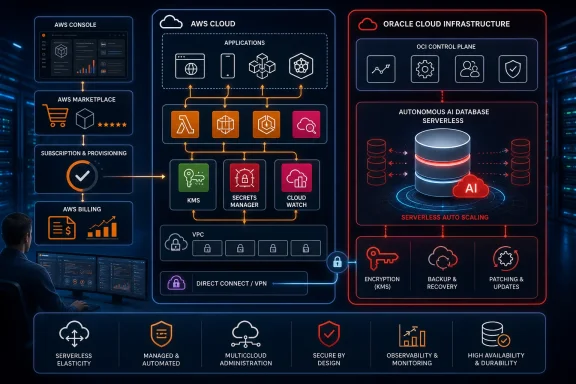
For enterprise administrators, this is primarily a procurement and operations change. Oracle’s database control plane remains involved, but the service is bought through AWS Marketplace, charged through AWS billing, and can draw on existing AWS commitments. That arrangement may appeal to organizations that have standardized cloud spending and identity workflows around AWS while still operating applications that depend on Oracle Database features.
 Serverless Oracle databases are now an AWS Marketplace product
AWS announced on June 17 that Oracle Autonomous AI Database Serverless, or ADB-S, was supported in Oracle Database@AWS. The service handles patching, tuning, scaling, backups and portions of security administration that would otherwise fall to database operations teams. AWS says customers can create instances from the AWS Management Console, CLI or APIs without provisioning dedicated Exadata capacity or VM clusters.
Oracle positions the service around four workload types: AI Transaction Processing, AI Lakehouse, AI JSON Database and Oracle APEX. The “AI” label here should be read carefully. It does not mean that subscribing to the database supplies a general-purpose model service comparable to Amazon Bedrock. Rather, Oracle is packaging database features intended for AI application development, including vector search and retrieval-augmented generation workflows, alongside conventional transaction and JSON database functions.
The practical distinction is significant for organizations with Oracle-dependent applications already moving infrastructure to AWS. Dedicated Exadata deployments remain relevant for large, tightly controlled estates and for configurations requiring particular performance or availability designs. ADB-S lowers the entry point for teams that need an Oracle-compatible managed database service but do not want to reserve dedicated database infrastructure before they can begin.
AWS initially listed ADB-S availability in US East (N. Virginia) and US West (Oregon). Oracle’s broader Oracle AI Database@AWS footprint has expanded beyond those regions, including additions in June across Northern California, Stockholm, Melbourne and Paris. Administrators should not assume that a region supporting Oracle Database@AWS automatically supports every database service or deployment model; the service and regional availability pages need to be checked together during design.
The AWS billing story has an OCI catch
Oracle’s public offer is the most consequential commercial change. It allows customers to subscribe on a pay-as-you-go basis through AWS Marketplace instead of waiting for Oracle to create a private offer. Oracle says the public offering has a one-month contract period with auto-renewal enabled by default, while AWS documentation describes the standard Marketplace flow of creating a contract and completing Oracle activation.
The service’s billing can appear alongside other AWS Marketplace charges, and Oracle says eligible customers may use Bring Your Own License arrangements or Oracle Unlimited License Agreements. For procurement groups measured against AWS commitments, that could simplify an otherwise awkward split between cloud infrastructure spending and Oracle licensing.
There is an important onboarding detail that deserves more attention than it receives in the launch material: Oracle’s public-offer documentation says a new OCI tenancy must be created during onboarding. It says only a private offer can link to an existing OCI tenancy. AWS’s onboarding guide, meanwhile, describes completing onboarding by linking an AWS account to an OCI tenancy, without making that public-versus-private limitation as prominent.
Those statements are not necessarily irreconcilable, but they leave a real implementation risk. A team expecting to attach a public Marketplace subscription to a heavily governed, existing OCI tenancy should validate the account-linking path with Oracle before accepting the offer. Creating a new tenancy can affect identity design, compartment structure, audit controls, support processes and the location of monitoring and policy administration. Oracle’s own documentation also warns that de-linking an account after purchase requires Oracle Support and is not immediate.
That makes this a service an enterprise should trial with deliberate account architecture, rather than a developer-led Marketplace subscription that later becomes production by accident.
AWS-native integrations reduce, but do not eliminate, split-plane administration
The database service is designed to fit AWS operations practices. AWS says ADB-S integrates with AWS Key Management Service for encryption, Amazon CloudWatch for monitoring, Amazon EventBridge for event handling and Amazon S3 for automated backups. Oracle added AWS KMS support for customer-managed encryption keys in late June, then added AWS Secrets Manager integration on July 20 for credentials used when creating, modifying, cloning and connecting to Autonomous AI Database instances.
The Secrets Manager addition is more useful than the marketing language suggests. A database platform can claim “automated” operations while leaving teams to distribute and rotate privileged credentials through scripts, ticket workflows or application configuration files. Using AWS Secrets Manager permits organizations to keep database credentials within the same secret-management tooling and IAM policy structure used by AWS-hosted applications, with rotation processes that can be standardized rather than improvised.
But AWS integration does not turn Oracle Database@AWS into an AWS-native database service in the same sense as Amazon RDS or Aurora. Oracle documentation makes clear that provisioning and service activation involve OCI, and Oracle owns the underlying database service. Operations teams will need clear escalation ownership for incidents spanning AWS networking, IAM, Marketplace billing, Oracle database behavior and OCI tenancy configuration.
This is especially relevant for Windows-heavy enterprise environments where applications may use Oracle client software, .NET data providers, Windows Server middleware or Microsoft Entra ID-centered identity processes. The database can sit closer to AWS-hosted applications, but it does not erase Oracle client compatibility testing, connection-string management, certificate handling, network segmentation or the need to coordinate Oracle and AWS support.
“What’s ahead” is a roadmap item, not a present capability
Oracle has also said it intends to make Exadata Database Service on Exascale Infrastructure available in all Oracle AI Database@AWS regions by the end of 2026. That is a roadmap commitment, not a generally available service today. Oracle has not published comparable detail on a firm rollout sequence, regional exceptions, pricing, migration mechanics or what configurations will be supported first.
The announced direction is clear enough: Oracle wants AWS customers to have an incremental path from serverless databases to dedicated Exadata-based deployments, without forcing the application estate to leave AWS. The company also says its Oracle AI Database@AWS service has reached 20 AWS regions, with two more planned, but those numbers should not be treated as a guarantee that every Oracle database service is available in every one of those locations.
For a database team, the immediate decision is narrower. ADB-S is suitable for evaluation where automated operations, elastic compute and AWS Marketplace procurement matter more than exact control over dedicated infrastructure. It is not a drop-in answer for every legacy Oracle deployment, particularly workloads with strict regional residency requirements, existing OCI-tenancy dependencies, custom backup designs, RAC-specific expectations or complex license terms.
Start with an account and region review
Organizations considering Oracle AI Database@AWS should treat the product as a multicloud service with a defined onboarding boundary. Before creating production databases, administrators should verify the selected AWS region supports the specific ADB-S service, decide whether a public or private offer fits the OCI tenancy model, and establish who owns incident triage across AWS and Oracle.
They should also test the operational path rather than only the database engine: Marketplace subscription approval, OCI activation, IAM permissions, secret rotation, KMS key access, CloudWatch visibility, backup recovery and cross-region disaster-recovery behavior. AWS advertises Autonomous Data Guard and cross-region recovery capabilities, but recovery objectives depend on the selected architecture and region pair, not on the presence of an “Autonomous” product name.
Oracle’s serverless AWS offer gives Oracle shops a lower-friction route to run managed Oracle databases next to AWS applications. The constraint is that it remains a jointly operated Oracle-and-AWS service, with Oracle tenancy and support dependencies that need to be designed before the first production workload is moved.
