
But the announcement, carried by IT Voice, describes an infrastructure change more than a wholly new product. Marg Pay has publicly advertised QR-based collection, SMS payment links, same-day settlement and automated reconciliation for years; its own site still describes it as an ERP-connected payment gateway. The important unanswered question is whether PayU is replacing Marg Pay’s former payments backbone, joining it as another processor, or handling new merchant onboarding while older routes remain in place.
That distinction will determine whether existing Marg customers need to do anything at all.
 Marg Pay’s core workflow predates PayU
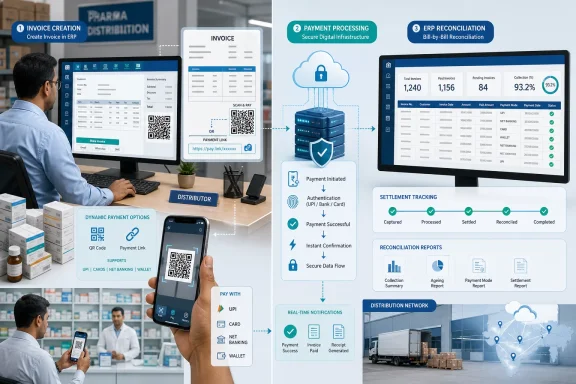
Marg ERP’s public Marg Pay material already promises the principal functions featured in the new announcement: generate a dynamic QR code against a bill, send payment links, upload outstanding invoices from the ERP, and automatically reconcile payments bill-by-bill. Marg’s current pharmaceutical software pages likewise market auto-reconciliation, QR collection and payment links as established Marg Pay functions.
The company had also made an earlier payments partnership public. In November 2020, Marg ERP announced that Paytm would support Marg Pay, including payment reconciliation across UPI, net banking, cards, wallets and other methods. That release went further, saying Paytm Payments Bank would power Marg Pay’s nodal bank account.
Neither PayU nor Marg ERP says what becomes of that arrangement now. There is no statement on whether the Paytm relationship has ended, whether PayU will take over settlement and fund-flow responsibilities, whether both providers will be available, or whether the change applies only to newly onboarded merchants. For customers, those are operational details, not corporate trivia: switching a payment aggregator can mean a new merchant agreement, revised settlement timing, altered support paths, or a fresh technical configuration.
The announcement confirms a PayU integration; it does not establish that Marg Pay itself is new, or that every existing Marg Pay merchant is moving to PayU.
The practical benefit is invoice matching, not the QR code
Digital payment acceptance is already commonplace in India. The harder problem for a distributor is determining which customer paid which bill, especially when one buyer has several invoices outstanding, pays a partial amount, or sends a transfer without an unambiguous reference. A QR code that contains the exact invoice amount and a payment link associated with a specific receivable can reduce that matching work substantially—provided the payment event, invoice number, bank settlement record and ERP posting remain consistently linked.
Marg’s announcement says retailers will generate dynamic QR codes against every invoice and receive automatic reconciliation in the ERP. It says distributors will issue invoice-specific payment links and have payments posted bill-by-bill. For a pharma stockist working through daily dispatches and credit collections from retailers, that is a more useful promise than generic online payment acceptance.
It also explains why this is a B2B collections product rather than a conventional checkout integration. The supplier already knows the customer and has already issued the invoice. The goal is to shorten the gap between billing and a confirmed, accounted-for payment while reducing cash handling and the staff time spent reconciling deposits.
PayU already offers payment links and describes reconciliation as a feature of its merchant platform. Its payment gateway supports UPI, cards, net banking, wallets and other methods, while PayU Payments says it holds Reserve Bank of India authorization to operate payment-aggregation business across online and offline use cases. Those credentials make PayU a plausible processor for Marg’s use case, but they do not answer the product-level questions Marg customers will face during rollout.
The missing migration details matter more than the partnership language
The public announcement does not disclose a rollout date, geographic scope, pricing, payment-method availability, merchant eligibility rules, settlement cut-off times, or how merchants already using Marg Pay will be treated. It does not identify the acquiring bank or settlement account structure, describe dispute and refund handling, or specify whether payment data will remain visible in a Marg dashboard, a PayU dashboard, or both.
There is also no indication of whether dynamic QR payments are restricted to UPI, whether links can accept cards and wallets, or whether payment-method fees differ by transaction type. Those details are consequential for businesses processing large invoice volumes, since even a small per-transaction difference can change the economics of moving collections from bank transfer or cash to a payment gateway.
Marg Pay’s own website says it is available to users of Marg ERP 9+ and describes a workflow in which businesses upload outstanding amounts to receive bill-level payments. The new statement presents a more deeply embedded “single connected environment” spanning ordering, payments and reconciliation. That could mean a smoother workflow inside the ERP, but the announcement does not say whether current users must upgrade, migrate data, re-onboard as PayU merchants, or change their bank-account settings.
For IT administrators and ERP support teams serving these businesses, the sensible assumption is that the integration may have onboarding and configuration consequences until Marg publishes a migration guide. A payment link appearing in an invoice is easy to see; the harder work sits behind it in merchant KYC, settlement-account verification, exception handling and financial-record integrity.
“Same-day settlement” still needs a definition
Marg ERP and PayU both point to faster collections and same-day settlement. That language deserves caution. A customer may complete a UPI payment immediately, but “settlement” can refer to several different events: the payment is authorized, the transaction appears in the gateway dashboard, it is reconciled against an invoice, or funds arrive in the merchant’s bank account.
Those stages can occur at different times. Transaction cut-offs, bank holidays, payment method, risk screening, refunds and failed or reversed payments can all affect when money is actually available. The announcement does not specify whether same-day settlement is a standard contractual service level, an option subject to merchant category and risk controls, or a marketing description carried over from Marg Pay’s existing product material.
The distinction is especially relevant in pharmaceutical distribution, where suppliers often extend credit to retailers and need predictable collections to replenish inventory. Automatic reconciliation can improve the visibility of receivables, but it does not eliminate failed payments, short payments, deductions, disputes, or the possibility that a customer pays one invoice while contesting another.
Marg’s claim that the system will reduce cash pilferage is reasonable as a design objective: moving a collection from cash into a traceable invoice-linked payment path reduces the number of manual handoffs. Yet neither company has published transaction-volume data, reconciliation-error rates, collection-cycle reductions or loss-prevention results from a pilot. For now, those operational gains remain vendor claims rather than independently measured outcomes.
PayU expands its distribution channel; Marg gains a regulated payments layer
The commercial logic is clear. Marg ERP gains a payments partner that says it is authorized by the RBI to operate as a payment aggregator and can supply broad payment-method coverage. PayU gains access to a vertical software platform whose customers already create invoices, manage inventory and collect receivables inside the same operational system.
Marg says its platform serves more than 10 lakh retailers, distributors, manufacturers and MSMEs. Its public pharmacy software page separately says it is used by more than 1.75 lakh chemists and medical stores. Those figures describe different customer groups, so they cannot be treated as a single verified installed-base number. Still, they illustrate why a payments provider would want an embedded position in Marg’s workflow rather than compete for merchants one by one.
The partnership is also set to extend to Marg’s eRetail application, which handles B2B ordering alongside payments and reconciliation. If that work reaches production as described, it could connect order creation, invoicing, payment collection and account posting in one chain. The value of that chain depends on its weakest handoff: whether a failed payment, partial collection or returned transaction reliably appears in the same ERP record that staff use for credit control.
For now, Marg customers should view the PayU announcement as a payments-infrastructure partnership with unresolved implementation details, not as proof that every Marg Pay capability has just arrived. The next material update needs to be a deployment notice: which Marg ERP versions qualify, whether existing Marg Pay accounts move automatically, which payment rails are enabled, what settlement schedule applies, and who owns support when an invoice says paid but the bank record does not.