
Notebookcheck reported the FC300-CS with an Intel Core Ultra 5 125U, two DDR5-5600 SO-DIMM slots, an M.2 2280 slot, and a 2.5-inch SATA bay. PCCooler’s own Computex 2026 announcement confirms the central design: the company calls the FC300 a modular all-in-one whose host and screen can operate together or separately, with independently replaceable compute and display modules.
That is a useful structural departure for Windows users who have watched all-in-ones become e-waste when either the panel, mainboard, or soldered memory reaches the end of its useful life. It is also a promise that needs more engineering detail before IT buyers should treat the FC300-CS as an upgradeable desktop standard.
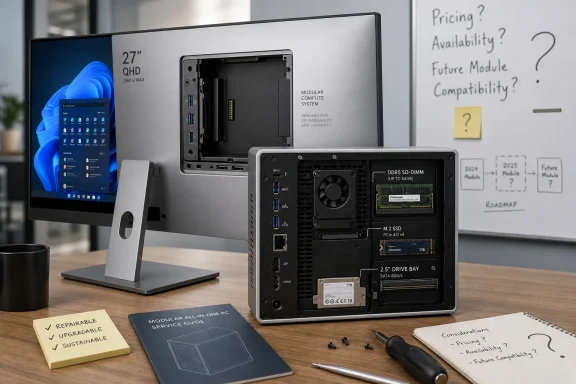 The FC300-CS separates the expensive parts
A conventional all-in-one marries three items with very different replacement cycles: a display that may be usable for years, a compact PC that ages faster, and storage and memory that may need service or expansion somewhere in between. PCCooler’s approach puts the PC portion in a removable host module attached to the display, rather than permanently embedding it behind the panel.
The immediate practical benefit is serviceability. If the computer unit fails, a repair shop or internal IT team could potentially replace the host without replacing a working 27-inch panel. If the display is damaged, the same logic could work in reverse. PCCooler also says the FC300 has expandable memory and storage, which is more meaningful than the modular chassis alone: users should be able to add capacity without needing a proprietary replacement module.
The distinction is important for Windows deployments because an all-in-one’s display often outlives its CPU platform, while corporate replacement cycles often do the opposite. A removable computer module could let an organization retain screens, stands, desks, and cabling while refreshing the Windows hardware behind them. That could lower disruption as well as waste.
PCCooler has demonstrated the FC300-CS concept publicly rather than merely showing a render. Its June 2026 Computex announcement described the system as a “split modular design,” and Korean technology site Quasarzone also reported seeing the Fusion Core FC300-CS at the show. Russian outlet PCNews published show-floor reporting that described a removable mini-PC integrated with a 27-inch monitor.
Still, the design should not be confused with an open standard. PCCooler has not said the host uses a VESA-mounted mini-PC, USB4 docking, an industry-standard compute-module specification, or another interface that third parties can support. The physical separation makes replacement possible; it does not yet prove that a future Intel, AMD, or Qualcomm module will fit, boot, cool correctly, or retain access to the screen’s full capabilities.
The current host is a 2023-era laptop platform
The FC300-CS compute module is built around Intel’s Core Ultra 5 125U, a first-generation Core Ultra U-series processor introduced in late 2023. Intel lists the chip as a 12-core, 14-thread part with a 15-watt base power rating, Intel Graphics integrated graphics, and support for DDR5-5600 memory. It includes the NPU that helped introduce Intel’s current “AI PC” branding, but it is not a current high-performance desktop processor.
That is not automatically a flaw. A 15-watt mobile chip is a sensible fit for an all-in-one host that needs to stay compact and quiet, and it should be capable for Microsoft 365, browser-heavy work, video calls, remote administration, light photo work, and general Windows 11 use. The two SO-DIMM slots matter here: PCCooler is avoiding the soldered-RAM design common in slim consumer systems and many all-in-ones.
But buyers should be clear about the performance class. Intel’s Core Ultra 5 125U uses the lower-tier Intel Graphics configuration rather than the stronger Intel Arc graphics found in some higher-power Meteor Lake H-series chips. A 27-inch 2560 × 1440 display running at a high refresh rate is attractive for desktop responsiveness, but it does not turn this machine into a serious local gaming or GPU-accelerated production workstation.
PCCooler’s storage configuration is more promising than many AIOs. One M.2 2280 slot accepting PCIe or SATA drives, alongside a 2.5-inch SATA III bay, means a buyer could preserve the included system drive while adding inexpensive bulk storage. For a family desktop, front-office machine, or kiosk-style deployment with local data requirements, that is materially better than a sealed single-drive design.
The unanswered question is whether replacing the host module will preserve these advantages. A future compute module could arrive with different memory slots, fewer storage bays, a different power envelope, or a revised connector layout. The company has announced replaceability, not a published generation-to-generation specification.
A 165Hz panel claim needs final-spec confirmation
Notebookcheck describes the FC300-CS as using a 27-inch QHD IPS display with a 165Hz refresh rate and 350 nits of brightness. PCCooler’s official Computex material also states that the FC300 has a 27-inch 2K, 165Hz display. For routine office work, 165Hz is not a purchasing necessity, but it can make window movement, scrolling, cursor motion, and general UI interaction feel appreciably smoother than the 60Hz panels that dominate all-in-one PCs.
There is a wrinkle in the early reporting. PCNews, which covered the FC300-CS from Computex, described the display as 2560 × 1440 at 120Hz, not 165Hz. That could indicate an early prototype, a show-floor specification error, or a panel configuration that changed before the reported launch. PCCooler’s 165Hz figure is the manufacturer’s current claim, but prospective buyers should wait for a final retail specification sheet before treating the refresh rate as settled.
The same restraint applies to inputs and outputs. PCCooler and Notebookcheck mention Wi-Fi 6, Bluetooth 5.2, Ethernet, USB, audio, and video connectivity, but neither published reporting establishes the exact number and speed of USB ports, whether USB-C includes high-bandwidth data or charging, whether display outputs can drive an external monitor, or whether the high-refresh panel supports adaptive-sync technologies. Those details determine whether the FC300-CS functions as a flexible desk hub or merely as a self-contained desktop.
For administrators, video output is particularly relevant. A modular all-in-one becomes more useful if the host can drive a second monitor during a transition, troubleshooting session, or desk expansion. PCCooler has indicated video output exists, but has not documented the port standard or supported resolutions and refresh rates.
The product’s long-term value depends on parts PCCooler has not promised
The FC300-CS is being presented as upgradeable because its display and computer unit can come apart. The more consequential issue is whether PCCooler will make replacement units available separately, in enough regions, at sensible prices, and for long enough to matter.
A detachable host is of limited value if the only compatible replacement is unavailable after the original system leaves retail. The same is true of the panel: a replaceable screen is helpful after accidental damage only if PCCooler stocks it and publishes a straightforward service path. PCCooler’s public warranty page lists a two-year warranty category for FC-series products in China, but the company has not announced U.S. or UK sales terms for the FC300-CS, let alone service-part pricing or regional repair arrangements.
PCCooler’s U.S. site currently emphasizes its established cooling, case, power-supply, fan, and accessory categories. The FC300 has appeared in the company’s Computex materials, but there is no clearly published U.S. retail listing, final product manual, or detailed configurator for the all-in-one. Calling this a launch is therefore premature if “launch” means a consumer can order one today.
The company also has not said whether the FC300-CS will ship with Windows 11, which edition it would use, whether it supports Windows Autopilot-style enterprise provisioning, or how firmware and driver updates will be delivered for the display-host connection. Those omissions are normal for a trade-show product, but they separate an intriguing hardware concept from something a business can standardize on.
A modular AIO is only as good as its module policy
PCCooler has put forward an idea that deserves more attention than another sealed all-in-one with inaccessible memory and a glued-in display. The FC300-CS appears to preserve the clean, desk-saving form factor people want from an AIO while restoring user-replaceable RAM, expandable storage, and a path to swap the central computer or screen.
For now, though, the strongest conclusion is modest: PCCooler has demonstrated a credible modular all-in-one architecture, not yet a proven upgrade platform. The Core Ultra 5 125U configuration should be evaluated as a capable low-power Windows desktop, while the claimed future-proofing should be evaluated only after PCCooler publishes module compatibility, standalone part availability, service instructions, pricing, and a release date.
Until those commitments arrive, the FC300-CS is a promising design with the right failure points exposed — and no evidence yet that replacement parts will remain available when users actually need them.
