
Broad + Liberty first reported the campaign after Upper Merion Township rejected plans for five large data-center sites near King of Prussia. The Chamber’s own August 25 announcement confirms the pledge and its sweeping list of services. Its core argument is easy to state: people who use internet services should not oppose construction of the physical facilities that provide computing capacity.
The trouble is that the pledge turns a dispute over where, how, and under what safeguards hyperscale AI data centers are built into a demand that residents reject modern computing altogether. That may make for a sharp campaign message, but it skips the facts driving the Pennsylvania backlash — including incomplete applications, grid-cost concerns, water use, local zoning authority, and whether a developer has an actual customer and power plan.
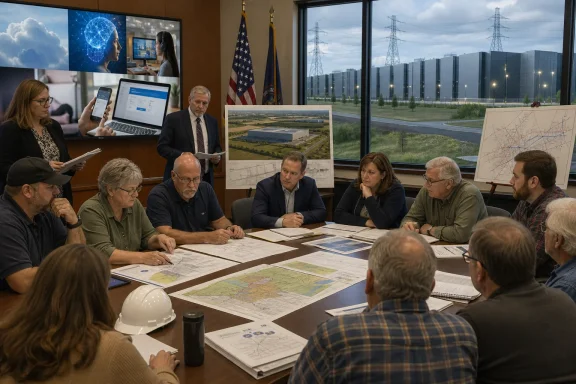 The pledge targets a narrower political fight than its list suggests
The Chamber asks would-be moratorium supporters to stop using social networks, artificial-intelligence tools, streaming services, e-commerce, payment apps, cloud backups, GPS, email, telehealth, video meetings, weather alerts, and business software. The list includes Microsoft Copilot and OneDrive alongside ChatGPT, Claude, iCloud, Google Photos, Netflix, YouTube, Venmo, PayPal, and Amazon.
Many of those services certainly depend on data centers. Microsoft 365, Azure, OneDrive, Teams, Copilot, Windows cloud features, endpoint-management services, and much of the security stack used by enterprise IT departments are delivered from distributed infrastructure rather than a server in a customer’s office. For Windows administrators, the premise that modern organizations rely on data centers is not controversial; it is operational reality.
But “data centers exist” does not settle the policy question raised by a proposed multi-million-square-foot campus in a particular township. Cloud services are supplied through networks of facilities already operating across regions and countries, often with very different locations, power arrangements, cooling designs, permits, ownership structures, and customer commitments. A household’s use of Outlook.com or Netflix does not answer whether a specific proposed AI campus has provided adequate site, traffic, emergency, water, power, and environmental documentation.
That distinction is especially important because the Chamber’s proposed pledge is aimed at supporters of broad moratoriums, while its public framing often reaches more broadly toward opponents of projects. Those are not automatically the same people. A resident can support data-center services and still favor rules that require developers to disclose projected electricity demand, fund needed grid upgrades, manage noise, secure local approval, and explain who will occupy the facility.
Upper Merion rejected plans over missing details, not digital services
The Upper Merion vote that anchors the Chamber’s campaign did not amount to a popular referendum on whether residents should retain access to the cloud. WHYY, The Philadelphia Inquirer, Fox 29, and Data Center Dynamics each reported that the township’s Board of Supervisors rejected five applications from developer MLP Ventures after a contentious process involving a proposed campus totaling roughly 4.6 million square feet.
WHYY reported that township officials said applications lacked fundamental materials, including landscape, traffic-impact, emergency-management, and sanitary-sewer plans. Other local coverage similarly described supervisors’ objections as a lack of project-specific detail and incomplete information about impacts on the community. The board’s action therefore offers a poor fit for the pledge’s implied binary: use technology or oppose the infrastructure that supports it.
The case also undercuts a habit in the broader data-center debate: treating all objections as resistance to technology itself. Residents may object to a facility’s proximity to homes or schools, its scale, its power draw, noise from generators and cooling equipment, construction traffic, water demands, or a developer’s failure to explain the project. Those objections can be tested against plans, permits, engineering studies, and enforceable conditions. A symbolic personal boycott cannot do that work.
For IT professionals, there is a familiar parallel. An organization can depend on Microsoft Azure while still demanding a vendor’s uptime commitments, data-residency terms, incident disclosures, capacity planning, and contractual remedies. Dependence on a service is not a waiver of due diligence. The same principle applies when local governments evaluate facilities that consume land, transmission capacity, water, and public infrastructure.
Harrisburg has already chosen regulation over an outright ban
Pennsylvania’s political response has moved well beyond the Chamber’s rhetorical setup. On August 18, Gov. Josh Shapiro signed Executive Order 2026-05, creating the state’s Responsible Infrastructure Development, or GRID, requirements for proposed data centers seeking Commonwealth permits.
The order requires local approval before the Pennsylvania Department of Environmental Protection reviews a project’s permit application under the new process. It also requires developers to make legally binding commitments on energy affordability, environmental protection, transparency, community engagement, and workforce and economic-development standards. Proposed data centers are also removed from the state’s Fast Track permitting program, and state agencies are barred from signing nondisclosure agreements for data-center projects.
The order is consequential because it accepts the premise that data centers are an important part of modern computing while rejecting the idea that every proposed project should receive expedited treatment. The Shapiro administration says more than 100 projects have appeared in public databases, 58 have engaged with DEP at some level, 15 have applied for at least one DEP permit, and only five had all permits needed for their first phase of operation.
Those numbers point to the issue the pledge leaves largely untouched: a proposal is not the same thing as a viable data center. A developer may have land, promotional materials, or preliminary applications without a secured power arrangement, detailed environmental plan, financing, customer commitment, or local approval. Pennsylvania’s new process is designed to separate those categories before state permitting moves forward.
Republican gubernatorial candidate and state Treasurer Stacy Garrity has likewise called for a pause to give municipalities time to update zoning rules, according to WGAL and The Allegheny Front. That is a different policy from a permanent ban, and different again from the Chamber’s proposed pledge amendment. The significant point is that both sides of the gubernatorial contest are responding to local-control and infrastructure concerns, not advocating an end to cloud computing.
Economic claims need the same scrutiny as project applications
The Chamber argues that Pennsylvania is well placed to host data centers because of its energy resources and its position in electricity exports, natural gas, nuclear generation, and total energy production. It also points to major announced investments from Amazon Web Services and Blackstone-backed QTS, plus claims of significant statewide economic activity.
There is a genuine economic opportunity here. Data-center construction brings spending on equipment, construction, electrical work, networking, facilities management, and services. The workloads supported by those facilities include enterprise applications, public cloud platforms, cybersecurity systems, scientific computing, media delivery, and the AI products now being integrated into Windows and Microsoft 365 deployments.
Still, economic-impact figures require context. The Chamber has cited a $14.4 billion contribution to Pennsylvania’s economy for 2023, while an economic-contribution study hosted by the Pennsylvania Power and Communications Coalition describes a broader annual GDP contribution of $22.4 billion for 2023 and $26.8 billion for 2024 when cross-state spillover effects are included. Such totals are useful indicators of scale, but they are not guarantees that an individual township will gain enough tax revenue or permanent employment to offset local infrastructure costs.
The permanent-job question deserves particular care. Hyperscale facilities can require enormous capital investment and substantial construction labor, but their ongoing staffing levels vary substantially by design, automation, security requirements, tenant mix, and whether the operator already has regional staff. Communities evaluating a site should ask for project-specific commitments rather than relying on statewide multipliers or comparisons to Northern Virginia.
That is also where Pennsylvania’s GRID requirements matter. The state says developers must report energy and water information and make enforceable commitments intended to prevent residential and business customers from absorbing project-related costs. Whether those rules deliver on that promise will depend on the permits, agreements, utility planning, and public disclosures behind each project — not on whether critics continue to use a smartphone.
What the pledge gets right — and what it avoids
The Chamber is right about one central fact: digital life is physical. Windows PCs authenticate to cloud services, sync files, receive security intelligence, host video meetings, access online records, and increasingly run AI-assisted features through infrastructure located somewhere. Calling that infrastructure invisible has helped make data-center development easy to ignore until a project reaches a local planning board.
Yet visibility should produce better decisions, not a loyalty test. If Pennsylvania wants data-center development that supports Microsoft customers, cloud-dependent businesses, and AI growth without shifting unplanned costs to nearby residents, the practical questions are concrete:
- Developers should disclose the facility’s expected electricity demand, water use, backup-generation design, traffic impact, noise controls, and build-out phases before local approval.
- Utility and regulatory commitments should establish who pays for generation, transmission, and distribution upgrades required by a project.
- Municipalities should know whether a proposal has a credible customer, financing, power path, and enforceable community-benefit commitments before granting approvals.
The “No Technology Pledge” will probably draw attention to how thoroughly data centers underpin modern services. It does not answer the question Pennsylvania communities are actually being asked: whether a particular developer, at a particular location, with a particular power and water plan, has earned permission to build.
