

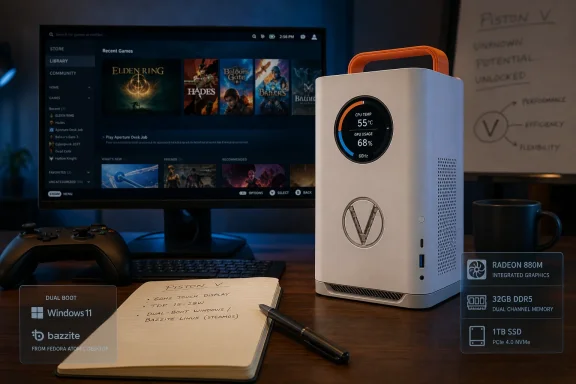
The first reporting, from Tbreak, says ETA Prime received the machine preconfigured for Windows 11 and Bazzite, a Fedora-based gaming Linux distribution that can boot directly into Steam’s controller-first interface. The Piston V’s styling—an upright white enclosure with orange handle, circular display and a piston-in-a-V emblem—may be memorable, but its absent vendor is the part that changes this from an ordinary mini-PC launch into an unresolved hardware sighting.
For Windows users, the interesting part is less the case than the configuration. A dual-boot gaming PC with a Windows installation for broad game and anti-cheat compatibility, plus Bazzite for a console-like Steam interface, is a sensible idea. But until somebody takes ownership of the hardware, the Piston V is best viewed as a demonstration unit, not evidence of a new Steam Machine competitor.
The Radeon 880M correction is important
Early descriptions of the Piston V have mixed up the Ryzen AI 9 365’s graphics configuration, referring in some cases to Radeon 890M graphics. AMD’s own specifications are clear: the Ryzen AI 9 365 is a 10-core, 20-thread Strix Point processor with a 15W-to-54W configurable power range and Radeon 880M integrated graphics, comprising 12 graphics cores at up to 2.9GHz.
That is not a trivial naming error. Radeon 890M is AMD’s higher-tier integrated GPU configuration, normally paired with more graphics cores in chips such as the Ryzen AI 9 HX 370. A buyer expecting 890M-class graphics could reasonably expect a different performance profile than the 880M can deliver, particularly in games where shared system memory and GPU compute capacity are already the limiting factors.
Tbreak reports that the Piston V runs at up to 54W, the top of AMD’s configured range for this processor. That setting helps explain why the compact machine can run demanding titles including Cyberpunk 2077, Marvel’s Spider-Man 2 and Ratchet & Clank: Rift Apart at 1080p in ETA Prime’s testing. It does not turn the system into a discrete-GPU gaming desktop.
The distinction matters most where frame generation is involved. Frame-generation technologies can improve the number displayed by an FPS counter, but they do not remove the underlying rendering load or provide the same responsiveness as equivalent performance achieved through native rendering. ETA Prime’s reported results show that the Piston V can make modern games playable with aggressive settings choices, upscaling and frame generation; they do not establish that Radeon 880M delivers uncompromised 1080p gaming.
For a mini PC built around an integrated GPU, memory configuration is equally consequential. The reported 32GB of DDR5-5600 is welcome because the Radeon 880M uses system memory rather than dedicated VRAM. Yet the video does not establish memory timings, cooling behavior during long sessions, sustained clock speeds, noise, firmware maturity, or whether the 54W limit can be maintained without throttling. Those are precisely the details that separate an impressive short benchmark from a dependable living-room PC.
Bazzite is not SteamOS, and that affects support
The Piston V reportedly ships with Bazzite rather than Valve’s SteamOS. That makes its front-end experience familiar to Steam Deck users—Bazzite supports Steam Gaming Mode and is designed for controller-oriented gaming PCs—but it does not make the device a Valve-certified SteamOS machine.
The difference is practical, particularly for support. Bazzite is independently developed and uses a Fedora-derived, image-based operating system model. Valve does not control its update schedule, hardware validation, recovery tooling or compatibility policy for the Piston V. A manufacturer that ships Bazzite would need to provide its own firmware updates, driver guidance, recovery images and troubleshooting documentation if it expects the machine to work like a finished console.
This is where the Piston V’s anonymity becomes more than a curiosity. Windows 11 is broadly familiar and supports a huge range of PC games, launchers and peripherals, but a bespoke mini PC can still require device-specific work for drivers, front-panel displays, USB behavior, sleep states, HDMI audio and firmware updates. On Bazzite, the round display and touch controls introduce another layer of hardware integration that needs someone accountable for maintaining it.
Tbreak says the circular screen can function as a secondary Windows display for live system information such as CPU use, GPU load, temperatures and memory use. Under Bazzite’s gaming mode, however, it is reportedly less configurable. That limitation is an early warning against treating the screen as a mature feature rather than a novelty: it appears useful for a Windows desktop setup, but its purpose is far less clear when the PC is running a full-screen console-style interface from the couch.
The display is also reportedly fixed at 60Hz. That is sufficient for telemetry, media controls and a secondary desktop panel, but it means the front screen is not a high-refresh companion for game streaming or fast-moving visual content. It should be judged as an instrument panel, not as a second gaming monitor.
The hardware is plausible; the product is not yet complete
The port selection reported by Tbreak—USB Type-A, USB-C, HDMI, dual Ethernet and a 3.5mm audio jack—suggests the Piston V is intended to serve as more than a Steam launcher. Dual Ethernet is especially unusual on a consumer-oriented gaming mini PC and could make sense for a compact homelab, router-adjacent system or small office deployment, provided the ports are backed by known controller hardware and stable drivers.
But none of those use cases can be assessed without a maker. The missing information is substantial:
- There is no published manufacturer name or company address.
- There are no firmware, BIOS or driver downloads.
- There is no statement on regional availability, certifications, repair arrangements or warranty coverage.
- There is no indication whether the design is headed for retail, crowdfunding, OEM rebranding or simply limited evaluation distribution.
- There is no independent reporting confirming a launch schedule, price or production partner beyond ETA Prime’s unit and Tbreak’s account of it.
That last point is the central one. A machine shown to one reviewer can demonstrate that a design exists, but it cannot demonstrate that the company behind it can deliver replacements, updates or support after sale. Mini-PC buyers have learned this repeatedly: a polished enclosure and strong benchmark run are much easier to produce than a reliable BIOS update process and long-term customer service.
The Piston V also arrives as the Ryzen AI 9 365 is no longer AMD’s newest mobile-derived silicon tier. Its processor remains capable, and AMD specifies 50 TOPS of NPU performance alongside the Radeon 880M, but its appeal depends on packaging and price rather than cutting-edge CPU branding. If the device eventually commands a premium because of the circular touchscreen and distinctive chassis, buyers will need to compare it against established mini-PC vendors offering known warranties and support histories.
Wait for a name, a price and a recovery image
For now, the Piston V is an intriguing proof of concept: a 54W Ryzen AI 9 365 mini PC that combines Windows 11 with a SteamOS-like Bazzite environment, and packages the result in a case that does not resemble the usual black box. ETA Prime’s demonstration suggests the hardware can deliver credible integrated-graphics gaming with the expected compromises.
What it does not establish is whether a customer will ever be able to purchase the same configuration, install a firmware fix, restore the factory software, or obtain help if the front display or dual-boot setup breaks. Until a manufacturer steps forward with those basics, the Piston V is a mystery machine in the literal sense—and shoppers should keep their money in their pockets.
References
- Piston V mini PC: mystery SteamOS box with Ryzen AI 9 365 tbreak.com · 2026-08-12T05:04:27+00:00