
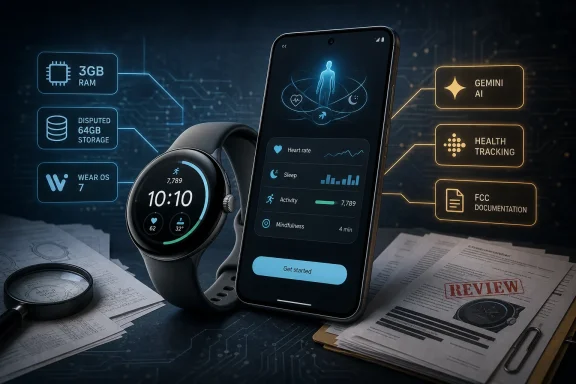
Google’s Pixel Watch 5 is real enough to have appeared in U.S. FCC paperwork and, more recently, in a device-selection screen inside Google’s own Health app. But the most consequential claims in NokiaPowerUser’s August 4 leak — 64GB of storage, 3GB of RAM, and more on-watch Gemini processing — do not all carry the same evidentiary weight. The available record supports an incremental Pixel Watch arriving soon; it does not yet support treating every listed specification or health feature as settled.
The timing is no longer mysterious. Google has scheduled its Made by Google hardware event for August 12, 2026, in New York, and 9to5Google reported that the company’s invitation teases the next Pixel generation without publicly naming every device. Android Central separately reported that “Google Pixel Watch 5” briefly appeared as a setup option in the Google Health app, an unusually concrete pre-release sign that pairing support is already being prepared.
For Pixel Watch 4 owners, the practical message is more restrained than the leak’s “wait for it” verdict: the Watch 5 looks likely to be a refinement, and the software headline — Wear OS 7 — is already available to eligible older Pixel Watches. The hardware case for upgrading rests on memory, storage, price, charging and any new sensors Google confirms next week. At present, several of those details remain either single-sourced or unsupported.
NokiaPowerUser presents Wear OS 7 as a central Pixel Watch 5 upgrade, but Google began rolling Wear OS 7 to eligible Pixel Watches on June 16. Google’s own announcement says the release brings Live Updates, a remote media-output switcher, connected-device integration and power optimizations that can improve battery life by up to 10% for average users upgrading from Wear OS 6.
That changes how the software claim should be read. A Pixel Watch 5 may ship with Wear OS 7, but it will not give buyers exclusive access to the operating system’s major public features. Pixel Watch 2, Pixel Watch 3 and Pixel Watch 4 owners are already the relevant comparison group, rather than owners of a device stranded on an older platform.
Google has also been explicit that its more ambitious Gemini Intelligence features arrive later in 2026 on select Wear OS 7 devices. Those planned features include Create My Widget, which builds custom dashboards from natural-language prompts, and multi-step task automation in supported apps. Google has not said that Pixel Watch 5 will be the only compatible watch, nor has it published a final supported-device list.
The distinction matters because the source material turns a staged software rollout into a new-device capability. If Google enables Gemini Intelligence on Pixel Watch 4, the Watch 5’s software advantage becomes smaller immediately. If it reserves certain functions for newer hardware, Google will need to identify which functions and why.
That does not prove that no local work happens on a watch. Wearables routinely perform local tasks such as sensor processing, wake-word handling and some inference. It does show that Google has not made the claimed independence from the phone part of its public Gemini model.
Google’s existing documentation also provides the actual access methods: a long press of the manufacturer-designated button, the “Hey Google” hotword when the display is awake, a watch-face complication, or a Gemini tile. A Gemini complication on a new watch face would therefore be plausible, but it would not establish a wholly new “Gemini Watch Face” product category or prove on-device generative processing.
The privacy implication is worth keeping in view. Google says Gemini on the watch uses the permissions selected for the Google app that hosts the digital-assistant functions. If precise location access is enabled, Gemini can use the watch’s precise location. Any Pixel Watch 5 AI pitch will consequently be about both convenience and the same account, location and app-data permissions that underpin Gemini on other Google devices.
There is some reporting support for the RAM portion. GoogleWatchBlog reported on July 23 that a Pixel Watch 5 entry in Google Play Console identified a device codename, “godric,” and listed 3GB of RAM. That is still one outlet’s account of a console listing rather than a public Google specification sheet, but it is a more traceable claim than a generic leak table.
The storage claim is weaker. NokiaPowerUser lists 64GB, yet the other pre-launch reporting reviewed for this story — including the FCC coverage, the color-and-pricing reports, the Google Health app appearance, and the claimed Play Console discovery — does not independently confirm a 64GB configuration. GoogleWatchBlog’s report about the alleged console data discusses the 3GB memory figure but does not report 64GB storage.
As of August 5, the correct status is therefore uneven: 3GB RAM has been reported from a purported Play Console listing; 64GB storage remains uncorroborated in the available reporting. Readers should not assume the two claims rise or fall together simply because they appeared side by side in one comparison table.
There is another material omission in the source report: no confirmed processor change. Google’s Pixel Watch 4 uses Qualcomm’s Snapdragon W5 Gen 2 with a Cortex-M55 coprocessor. GoogleWatchBlog claimed the Watch 5 would retain an older Qualcomm SW5100 family platform, a claim that conflicts with the expectation of a fresh chipset but has not been independently verified. Until Google publishes the processor, storage type and battery figures, “more RAM equals smoother performance” is plausible analysis, not a demonstrated result.
Leaked imagery and color reporting have also converged on a familiar round Pixel Watch silhouette in 41mm and 45mm sizes. 9to5Google, citing Dealabs and Nieuwe Mobiel, reported four case colors: Natural Silver, Dark Anthracite, Pyrite and Warm Gold. Its reporting says Warm Gold may be limited to the 41mm model, while the others could span both sizes.
Android Central’s Google Health app report reinforces the visual continuity, though with an important caveat. The setup process showed artwork that looked like Pixel Watch 4 imagery, which may mean the app was using a placeholder rather than revealing the final Watch 5 design. It is credible evidence of software support, not final proof of bezel thickness, case dimensions or charging hardware.
NokiaPowerUser’s promise of backward-compatible bands and charging pucks should be separated into two claims. Band compatibility is plausible if Google retains the existing attachment system, but Google has not confirmed it for Pixel Watch 5. Charger compatibility is even less safe to assume: the Pixel Watch 4 already uses a Quick Charge Dock, and charging changes can be invisible in marketing images while breaking compatibility with earlier accessories. Existing owners should wait for Google’s accessory matrix before buying a Watch 5 on the assumption that every band and charger will transfer.
As a result, “AI sleep coach,” proactive recovery prompts and analysis of skin-temperature variance may describe new presentation or advice layers, but they do not establish new sensing hardware. No reviewed regulatory filing or Google support material verifies a new Pixel Watch 5 health sensor, a revised clinical metric, or the availability terms for any enhanced Fitbit guidance.
That is important for buyers because Fitbit-derived readiness and sleep features often vary by country, account status, subscription terms and device generation. A feature shown in a pre-release render is not a promise that it will ship in every market or be free after any trial period expires. NokiaPowerUser did not identify those conditions.
Google has less than a week to close these gaps. The August 12 event should settle the processor, memory, storage, battery, sensors, bands, chargers, pricing and Gemini feature eligibility in one release. Until then, the defensible conclusion is narrower: Pixel Watch 5 appears headed for a familiar 41mm-and-45mm design with new colors and likely more RAM, while the headline 64GB storage, on-device Gemini claim, health additions and accessory compatibility remain unconfirmed.
For Pixel Watch 4 owners, the practical message is more restrained than the leak’s “wait for it” verdict: the Watch 5 looks likely to be a refinement, and the software headline — Wear OS 7 — is already available to eligible older Pixel Watches. The hardware case for upgrading rests on memory, storage, price, charging and any new sensors Google confirms next week. At present, several of those details remain either single-sourced or unsupported.
 Wear OS 7 is already a Pixel Watch 4 feature
NokiaPowerUser presents Wear OS 7 as a central Pixel Watch 5 upgrade, but Google began rolling Wear OS 7 to eligible Pixel Watches on June 16. Google’s own announcement says the release brings Live Updates, a remote media-output switcher, connected-device integration and power optimizations that can improve battery life by up to 10% for average users upgrading from Wear OS 6.That changes how the software claim should be read. A Pixel Watch 5 may ship with Wear OS 7, but it will not give buyers exclusive access to the operating system’s major public features. Pixel Watch 2, Pixel Watch 3 and Pixel Watch 4 owners are already the relevant comparison group, rather than owners of a device stranded on an older platform.
Google has also been explicit that its more ambitious Gemini Intelligence features arrive later in 2026 on select Wear OS 7 devices. Those planned features include Create My Widget, which builds custom dashboards from natural-language prompts, and multi-step task automation in supported apps. Google has not said that Pixel Watch 5 will be the only compatible watch, nor has it published a final supported-device list.
The distinction matters because the source material turns a staged software rollout into a new-device capability. If Google enables Gemini Intelligence on Pixel Watch 4, the Watch 5’s software advantage becomes smaller immediately. If it reserves certain functions for newer hardware, Google will need to identify which functions and why.
Gemini on a watch still depends on the paired phone
The report’s strongest overreach is the suggestion that an additional gigabyte of RAM will allow more Gemini requests to be handled locally on the watch rather than routed through a phone. Google’s published Gemini-on-Wear-OS support documentation says users need an Android phone connected to the watch and must set Gemini as the digital assistant on that connected phone. It also says the feature is rolling out gradually by supported language and region.That does not prove that no local work happens on a watch. Wearables routinely perform local tasks such as sensor processing, wake-word handling and some inference. It does show that Google has not made the claimed independence from the phone part of its public Gemini model.
Google’s existing documentation also provides the actual access methods: a long press of the manufacturer-designated button, the “Hey Google” hotword when the display is awake, a watch-face complication, or a Gemini tile. A Gemini complication on a new watch face would therefore be plausible, but it would not establish a wholly new “Gemini Watch Face” product category or prove on-device generative processing.
The privacy implication is worth keeping in view. Google says Gemini on the watch uses the permissions selected for the Google app that hosts the digital-assistant functions. If precise location access is enabled, Gemini can use the watch’s precise location. Any Pixel Watch 5 AI pitch will consequently be about both convenience and the same account, location and app-data permissions that underpin Gemini on other Google devices.
The 3GB RAM claim has one trail; 64GB storage does not
Google’s official Pixel Watch 4 specification page lists 32GB eMMC storage and 2GB SDRAM for both the 41mm and 45mm models. So the supposed move to 3GB RAM and 64GB storage would be a meaningful step up if confirmed, particularly for downloaded music, offline maps, apps and cached workout data.There is some reporting support for the RAM portion. GoogleWatchBlog reported on July 23 that a Pixel Watch 5 entry in Google Play Console identified a device codename, “godric,” and listed 3GB of RAM. That is still one outlet’s account of a console listing rather than a public Google specification sheet, but it is a more traceable claim than a generic leak table.
The storage claim is weaker. NokiaPowerUser lists 64GB, yet the other pre-launch reporting reviewed for this story — including the FCC coverage, the color-and-pricing reports, the Google Health app appearance, and the claimed Play Console discovery — does not independently confirm a 64GB configuration. GoogleWatchBlog’s report about the alleged console data discusses the 3GB memory figure but does not report 64GB storage.
As of August 5, the correct status is therefore uneven: 3GB RAM has been reported from a purported Play Console listing; 64GB storage remains uncorroborated in the available reporting. Readers should not assume the two claims rise or fall together simply because they appeared side by side in one comparison table.
There is another material omission in the source report: no confirmed processor change. Google’s Pixel Watch 4 uses Qualcomm’s Snapdragon W5 Gen 2 with a Cortex-M55 coprocessor. GoogleWatchBlog claimed the Watch 5 would retain an older Qualcomm SW5100 family platform, a claim that conflicts with the expectation of a fresh chipset but has not been independently verified. Until Google publishes the processor, storage type and battery figures, “more RAM equals smoother performance” is plausible analysis, not a demonstrated result.
The familiar casing and colors are the best-supported leaks
The physical design story is more solid. FCC-related reporting from Droid Life and 9to5Google identified four Pixel Watch 5 model numbers — G25QD, G1XJ6, G0F3Y and GFW3R — and found Wi-Fi and LTE connectivity in the filings. The filings substantiate that Google is preparing multiple wearable variants, but they do not reveal RAM capacity, storage, battery longevity, display dimensions or Fitbit software.Leaked imagery and color reporting have also converged on a familiar round Pixel Watch silhouette in 41mm and 45mm sizes. 9to5Google, citing Dealabs and Nieuwe Mobiel, reported four case colors: Natural Silver, Dark Anthracite, Pyrite and Warm Gold. Its reporting says Warm Gold may be limited to the 41mm model, while the others could span both sizes.
Android Central’s Google Health app report reinforces the visual continuity, though with an important caveat. The setup process showed artwork that looked like Pixel Watch 4 imagery, which may mean the app was using a placeholder rather than revealing the final Watch 5 design. It is credible evidence of software support, not final proof of bezel thickness, case dimensions or charging hardware.
NokiaPowerUser’s promise of backward-compatible bands and charging pucks should be separated into two claims. Band compatibility is plausible if Google retains the existing attachment system, but Google has not confirmed it for Pixel Watch 5. Charger compatibility is even less safe to assume: the Pixel Watch 4 already uses a Quick Charge Dock, and charging changes can be invisible in marketing images while breaking compatibility with earlier accessories. Existing owners should wait for Google’s accessory matrix before buying a Watch 5 on the assumption that every band and charger will transfer.
Fitbit’s health features need a confirmed hardware basis
The health section is almost entirely prospective. Pixel Watch 4 already has red and infrared SpO2 sensors, ECG-compatible electrical sensors, a multi-path optical heart-rate sensor, cEDA, a far-field skin-temperature sensor, a barometer and a magnetometer. Google also already markets Fitbit features such as Cardio Load and Daily Readiness Score across the current Pixel Watch line.As a result, “AI sleep coach,” proactive recovery prompts and analysis of skin-temperature variance may describe new presentation or advice layers, but they do not establish new sensing hardware. No reviewed regulatory filing or Google support material verifies a new Pixel Watch 5 health sensor, a revised clinical metric, or the availability terms for any enhanced Fitbit guidance.
That is important for buyers because Fitbit-derived readiness and sleep features often vary by country, account status, subscription terms and device generation. A feature shown in a pre-release render is not a promise that it will ship in every market or be free after any trial period expires. NokiaPowerUser did not identify those conditions.
Google has less than a week to close these gaps. The August 12 event should settle the processor, memory, storage, battery, sensors, bands, chargers, pricing and Gemini feature eligibility in one release. Until then, the defensible conclusion is narrower: Pixel Watch 5 appears headed for a familiar 41mm-and-45mm design with new colors and likely more RAM, while the headline 64GB storage, on-device Gemini claim, health additions and accessory compatibility remain unconfirmed.
References
- Primary source: nokiapoweruser.com
Published: 2026-08-04T15:34:56+00:00
Google Pixel Watch 5 Leaks: Wear OS 7, Gemini AI, 64GB Storage & Specs - NPowerUser
Pixel Watch 5 leaks reveal Wear OS 7, deeper Gemini AI features, and doubled storage—inside a familiar design. Here is everything we know so far. - Read in Google News on NPowerUser nokiapoweruser.com
- Related coverage: androidcentral.com
Pixel 11 Made by Google 2026 launch event: How to watch and what to expect | Android Central
From the new Pixel 11 series, the new Pixel Watch 5, and everything in between, we've got you covered.www.androidcentral.com - Related coverage: androidcentral.com
Pixel Watch 5 shows up again before launch, this time in one of Google's own apps | Android Central
The Pixel Watch 5 has appeared in Google's own Health app.www.androidcentral.com - Related coverage: t3.com
Google Pixel 11 in glorious picture leak alongside Pixel Watch 5 - see all the colours | T3
Will there be anything left to reveal at the Made by Google event?www.t3.com - Related coverage: tomsguide.com
Google Pixel 11 Pro Fold images just leaked ahead of launch — see it from every angle (including a weird LED) | Tom's Guide
The forthcoming Google Pixel 11 Pro Fold has appeared in leaked images, including peeks at the Pixel Watch 5 and new Pixel Buds.www.tomsguide.com - Related coverage: forbes.com
Google Pixel Watch 5 Models Surface In FCC Filing Ahead Of Expected Launch
Google is expected to announce the Pixel Watch 5 series within weeks, and the devices appear to have passed through the FCC ahead of the launch, revealing key features.www.forbes.com - Related coverage: blog.google
Wear OS 7 makes your smartwatch even smarter
Wear OS 7 brings new glanceable features — and select devices will get Gemini Intelligence later this year.blog.google - Related coverage: support.google.com

Use Gemini on your smartwatch - Gemini Apps Help
When you chat with Gemini on your smartwatch, Gemini works as your conversational AI assistant to help you do things like: Stay connected Handle tasks across apps Answer questions Recall imp
support.google.com
- Related coverage: support.google.com
Google Pixel Watch Update - June 2026 - Google Pixel Watch Community
support.google.com
- Related coverage: store.google.com
- Related coverage: techadvisor.com
Google Pixel Watch 5 LTE Model Listing Explained – Tech Advisor
FCC listings for the four Pixel Watch 5 models appear baffling, but there might be a simple answerwww.techadvisor.com
- Related coverage: 9to5google.com
Google Pixel Watch 5 seemingly surfaces with four variants and even more questions
As another year goes by since the last Pixel hardware launch, the Pixel Watch 5 is beginning to surface online...9to5google.com - Related coverage: droid-life.com
Pixel Watch 5 Just Got Major Confirmations
Google's new Pixel Watch 5 lands at FCC, confirms connectivity, satellite SOS, several sizes, and clues us in on release date.www.droid-life.com - Related coverage: gadgets360.com
Google Pixel Watch 5 FCC Listing Reveals UWB, LTE Connectivity and Satellite SOS Support | Technology News
Google's Pixel Watch 5 has reportedly cleared FCC certification in four variants. The filings reveal LTE, Wi-Fi, Bluetooth, NFC, Ultra Wideband, and satellite SOS support across the lineup, while also hinting that Google may skip a Wi-Fi-only model. The smartwatch is expected to launch alongside...www.gadgets360.com - Related coverage: engadget.com
Wear OS 7 Arrives To Pixel Watches With Gemini AI And Live Updates
Wear OS 7 is now live for Pixel watches, with a new interface, notifications and Gemini features.www.engadget.com - Related coverage: wareable.com
Google Wear OS 7: Compatible watches and new features explained
 www.wareable.com
- Related coverage: storage.googleapis.com
- Related coverage: gadgets360.com
Google Pixel Watch 5 Official-Looking Renders Reveal Watch Face and New Colour Options | Technology News
Google Pixel Watch 5 has surfaced in leaked press renders showing four colour options, updated bands and a new watch face. The smartwatch is expected to launch in 41mm and 45mm sizes with Wi-Fi and LTE variants. Earlier leaks also point to a price increase, Wear OS 7 and availability from August 20.www.gadgets360.com - Related coverage: newsbytesapp.com
This is what the Pixel Watch 5 will look like
Leaked renders from OnLeaks unveil the Pixel Watch 5 in four striking finishes: Dark Anthracite, Natural Silver, Warm Gold, and Pyrite, ahead of Google's official launch event.www.newsbytesapp.com - Related coverage: 9to5google.com
Pixel Watch 5 leaks detail higher price, new 'Pyrite' color
Ahead of Google’s launch event which is now confirmed for August 12, a pair of new leaks reveal some of...9to5google.com - Related coverage: meteoraweb.com
- Related coverage: nieuwemobiel.nl
Pixel Watch 5 renders gelekt: dit zijn de 4 kleuren en bandjes
De eerste renders van de Google Pixel Watch 5 bevestigen de vier kleuren die wij exclusief meldden. Pyrite blijkt een matgouden kast met groen bandje. Bekijk alle kleuren, bandjes en de nieuwe wijzerplaat.www.nieuwemobiel.nl - Related coverage: gazyekichi96.com
新色が美しい。Pixel Watch 5の公式プレス画像判明 | xPeria lEaker
今回thetidechartがGoogle Pixel Watch 5の公式プレス画像を公開したので簡単にまとめたいと思います。 今回thetidechartがGoogle Pixel Watch 5の公式プレス画像を公開したので簡単にまとめたいと思います。gazyekichi96.com - Related coverage: play.google.com
- Related coverage: tuttoandroid.net
Google Pixel Watch 5: trapelano le info su colorazioni e prezzi
Un noto portale francese ha diffuso tutti i dettagli su varianti, colorazioni e prezzi in euro di Google Pixel Watch 5. www.tuttoandroid.net
- Related coverage: memeburn.com
Pixel Watch 5 Price and Colors Leak Ahead of August Launch - Memeburn
Leaked Pixel Watch 5 pricing reveals a $50 increase to $399 for the base model, matching Apple Watch Series 11. Four colors confirmed ahead of the August 12 Made by Google event.memeburn.com - Related coverage: netzwelt.de
Leak: Pixel Watch 5 in Bildern | NETZWELT
Einem Leak zufolge soll die Pixel Watch 5 in diesen Farben erhältlich sein.www.netzwelt.de
- Related coverage: android-mt.ouest-france.fr
- Related coverage: youtube.com
- Related coverage: store.google.com
- Related coverage: developers.google.com
- Related coverage: blog.google
- Related coverage: developers.google.com
- Related coverage: tomsguide.com
This is the Pixel 11 Pro Fold — and this is when pre-orders officially start | Tom's Guide
Google just teased its own Pixel 11 foldable phone and confirmed the pre-order date.www.tomsguide.com - Related coverage: t3.com
Google finally accepts that Apple AirTag exists, here's its own "Pixel Tag" ahead of launch | T3
We have a picture of Google's first own-branded trackerwww.t3.com - Related coverage: techtimes.com
Pixel 11 Event Locked for August 12: 2nm Tensor G6 and $900 Base Price Expected
Google Pixel 11 arrives August 12 at a Made by Google event in New York City, with four phones starting at $900. The Tensor G6 chip brings TSMC’s 2nm process and Gate-All-Around transistors towww.techtimes.com - Related coverage: phonearena.com
Google Pixel Watch 5 release date expectations, price estimates, and upgrades - PhoneArena
Here's everything we know so far about the Pixel Watch 5.www.phonearena.com - Related coverage: technosports.co.in
Google Announces August 12 Event for Pixel 11 & Watch 5
Google announces an event on August 12 for Pixel 11 and Pixel Watch 5, unveiling new features and designs.technosports.co.in - Related coverage: 1und1.de
Google Pixel 11: Lohnt sich das Warten? - 1&1
Google Pixel 11: Erfahre, welche Neuerungen aktuell erwartet werden und ob sich das Warten im Vergleich zu einem aktuellen Pixel-Modell lohnt.www.1und1.de - Related coverage: podcasts.apple.com
Phones Show Chat - Émission - Apple Podcasts
Écoutez le podcast Phones Show Chat de la chaîne Ted Salmon sur Apple Podcasts. podcasts.apple.com
- Related coverage: get.google.com
Accessories for Google Devices – Made for Google
Shop the latest compatible Made for Google accessories including Google Pixel phone cases, USB-C wired and wireless headphones, Nest display and Nest Cam mounts, Google Pixelbook protective sleeves, and more!get.google.com - Related coverage: googlewatchblog.de
Pixel Watch 5: Google verrät Spezifikationen der neuen Smartwatches - mehr Speicher und ein altbekannter SoC
Jetzt hat Google selbst einige technische Daten der Pixel Watch 5 geleakt. Man setzt auf bewährtes, aber auch auf mehr RAM.www.googlewatchblog.de - Related coverage: youtube.com
- Related coverage: storage.googleapis.com

