
Sony has confirmed it will continue toward ending physical game-disc production for new PlayStation releases in January 2028, despite the backlash that followed its announcement earlier this month. In Sony’s first-quarter financial Q&A, CFO Lin Tao said the company had considered the decision carefully and would “cautiously” move ahead as digital distribution becomes the default across entertainment.
As reported by Windows Central, Tao also acknowledged that physical media carries emotional weight for players. That recognition does not change Sony’s plan: new PlayStation games arriving from January 2028 will be digital-only, whether purchased through the PlayStation Store or sold by retailers as download codes.
Sony’s own PlayStation Blog had already drawn an important boundary around the announcement. Games released on disc before the cutoff are not suddenly being invalidated, and physical versions already in circulation will remain usable. The real change is that publishers will no longer be able to launch new PlayStation titles on optical media after the deadline.
Sony’s financial data makes the business rationale plain. During the quarter, 82% of PlayStation 4 and PlayStation 5 full-game software sales were digital, leaving physical discs at 18%.
That does not mean the remaining physical audience is trivial. Discs still provide a resale market, lendable copies, options for buyers with slow or capped connections, and a practical preservation path when a title is delisted or a storefront changes terms. A downloaded game, by contrast, is generally a license tied to an account, platform policies, and the continued availability of supporting infrastructure.
Sony is treating the sales mix as a mandate to simplify its supply chain and reduce manufacturing, distribution, and retail dependence. For collectors and preservation-minded players, however, the concern is not nostalgia. It is the loss of a durable, transferable fallback when digital access fails.
But current reporting points in a different direction. Windows Central has reported that Microsoft is developing a disc-to-digital entitlement program codenamed Positron, designed to let eligible Xbox disc owners associate games with their Microsoft accounts as digital licenses. The same reporting has suggested that Project Helix, Microsoft’s next-generation Xbox hardware effort, may not include an internal disc drive.
Positron could be a meaningful migration tool if it arrives as described. It would make an older Xbox library more portable across digital-only hardware, Windows PCs, cloud services, and future consoles. But it is not equivalent to continuing physical support: converting a disc into an account-bound license exchanges a tangible copy for access governed by Microsoft’s ecosystem.
Microsoft has not formally announced Positron or confirmed Project Helix’s final hardware configuration. Until it does, Xbox still has time to make physical compatibility — whether through an internal drive, an official external drive, or continued retail disc publishing — part of its next-generation strategy.
The next decision belongs to Microsoft. Sony has made the industry’s digital-first direction explicit; Xbox can either offer a counterweight or confirm that physical console gaming is approaching its last major transition.
Sony’s own PlayStation Blog had already drawn an important boundary around the announcement. Games released on disc before the cutoff are not suddenly being invalidated, and physical versions already in circulation will remain usable. The real change is that publishers will no longer be able to launch new PlayStation titles on optical media after the deadline.
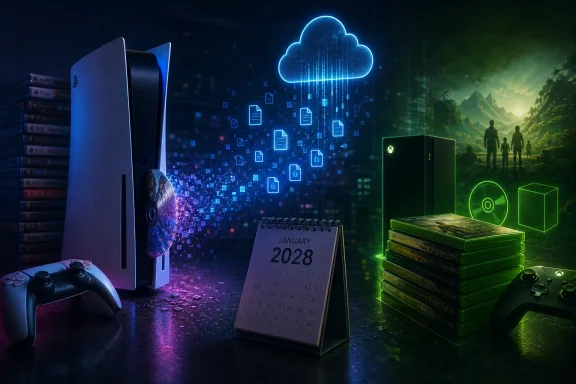 The Numbers Explain Sony’s Decision — Not Its Ownership Problem
Sony’s financial data makes the business rationale plain. During the quarter, 82% of PlayStation 4 and PlayStation 5 full-game software sales were digital, leaving physical discs at 18%.That does not mean the remaining physical audience is trivial. Discs still provide a resale market, lendable copies, options for buyers with slow or capped connections, and a practical preservation path when a title is delisted or a storefront changes terms. A downloaded game, by contrast, is generally a license tied to an account, platform policies, and the continued availability of supporting infrastructure.
Sony is treating the sales mix as a mandate to simplify its supply chain and reduce manufacturing, distribution, and retail dependence. For collectors and preservation-minded players, however, the concern is not nostalgia. It is the loss of a durable, transferable fallback when digital access fails.
Xbox Has an Opening — but May Be Heading the Same Way
Microsoft could turn Sony’s decision into a straightforward Xbox advantage by committing to a disc drive for its next console. There is a sizeable audience that would welcome a platform willing to preserve used-game purchases and offline installation options, particularly after years of digital storefront shutdowns and licensing removals across the industry.But current reporting points in a different direction. Windows Central has reported that Microsoft is developing a disc-to-digital entitlement program codenamed Positron, designed to let eligible Xbox disc owners associate games with their Microsoft accounts as digital licenses. The same reporting has suggested that Project Helix, Microsoft’s next-generation Xbox hardware effort, may not include an internal disc drive.
Positron could be a meaningful migration tool if it arrives as described. It would make an older Xbox library more portable across digital-only hardware, Windows PCs, cloud services, and future consoles. But it is not equivalent to continuing physical support: converting a disc into an account-bound license exchanges a tangible copy for access governed by Microsoft’s ecosystem.
Microsoft has not formally announced Positron or confirmed Project Helix’s final hardware configuration. Until it does, Xbox still has time to make physical compatibility — whether through an internal drive, an official external drive, or continued retail disc publishing — part of its next-generation strategy.
The next decision belongs to Microsoft. Sony has made the industry’s digital-first direction explicit; Xbox can either offer a counterweight or confirm that physical console gaming is approaching its last major transition.
References
- Primary source: Windows Central
Published: 2026-07-31T15:17:19+00:00
Sony refuses to back down from killing physical media despite massive backlash; I hope Xbox doesn't follow their example, even though it's likely it will | Windows Central
Sony finally responds to gamers criticizing its decision to cease production of physical game discs, and its response has only added gasoline to the ongoing fiery debate about game preservationwww.windowscentral.com - Related coverage: gamesradar.com
PlayStation ditching physical games is "a bridge across the bad years" of high hardware costs, analyst says, but it means "casuals and youngsters will drift off to mobile, PC, and free-to-play even faster" | GamesRadar+
Killing physical media boards up one of the cheapest doorways into PlayStationwww.gamesradar.com - Related coverage: gamespot.com
Sony Confirms PlayStation Disc Production Will End In 2028 - GameSpot
End of an era.www.gamespot.com - Related coverage: techcrunch.com
Sony to end physical PlayStation game disc production in 2028 | TechCrunch
Sony will stop producing physical discs for all new PlayStation games beginning in 2028, as the company embraces an all-digital future.techcrunch.com - Related coverage: arstechnica.com
Sony announces end of PlayStation discs, parts of digital store in the same day - Ars Technica
“We will own nothing, it's truly sad.”...arstechnica.com - Related coverage: cbsnews.com
Sony to stop making physical discs for PlayStation starting in 2028 - CBS News
After January 2028, new games will be available exclusively in digital format from the PlayStation Store and at retailers, Sony said.www.cbsnews.com