
Palo Alto Networks has added a direct Prisma AIRS API integration for Claude Enterprise that can stop a prompt before it reaches Anthropic’s model. The August 5 announcement describes a synchronous inference hook: Claude sends the prompt to Prisma AIRS, Prisma applies a configured security profile, and Claude receives an allow-or-deny verdict before inference begins.
For organizations already paying for Palo Alto Networks Enterprise DLP and running Claude Enterprise, that is the meaningful change. Instead of relying on browser controls, proxy routing, post-event audit logs, or each developer’s local Claude Code configuration, administrators can put a centrally managed inspection point in front of Claude prompts across the enterprise tenant.
Palo Alto Networks says the hook can use existing DLP definitions, including exact data matching, pattern detection, trainable classifiers, custom “confidential” classifications, and policies for source code credentials. It also says Prisma AIRS will inspect for prompt injection, jailbreak attempts, malicious code or URLs, toxicity, and custom topic restrictions.
The company’s announcement is technically specific about the direction of traffic: this release governs input prompts. That is a useful boundary to understand before treating it as complete Claude security.
Palo Alto Networks’ stated setup is straightforward at the Claude Enterprise administration layer. An administrator adds a Prisma AIRS webhook endpoint in Claude’s inference-hook settings, supplies an
The design is a marked change from Palo Alto Networks’ earlier Claude Code integration, published in November 2025. That implementation used Claude Code hooks: locally configured scripts that scan developer prompts and tool calls, and can also inspect model responses and tool outputs such as WebFetch results before they are reused.
The new integration is server-side and tenant-oriented. It does not depend on a developer installing or maintaining a hook in a
Palo Alto Networks is pitching that operational difference as “unified governance across all Claude surfaces,” naming Claude Code, Claude.ai, and Claude Cowork. The qualification is that the control begins with Claude Enterprise organization settings. A personal Claude.ai account, an unmanaged Claude Code install, or any Claude use outside the configured Enterprise tenant is not brought under this hook merely because the company has deployed Prisma AIRS elsewhere.
That makes identity and tenant enforcement the first implementation task. Security teams need to know which users are actually using their managed Claude Enterprise identity and which are taking the same material to personal accounts, alternate AI services, local tools, or an unapproved model endpoint. A pre-inference hook is strong for traffic it sees; it cannot govern traffic that bypasses the tenant entirely.
In practice, that means an organization may be able to carry over the same controls used for SaaS, browser, endpoint, email, network, and cloud channels. A policy built around exact data matching can recognize actual customer records instead of merely flagging a nine-digit string that resembles a Social Security number. A source-code policy can reject exposed API tokens or environment secrets. Document classification can recognize material related to human resources, litigation, or a pending transaction even where conventional regular expressions would find nothing.
This helps close a weakness in many early AI rollouts: DLP policy often exists, but the model interface becomes a separate exception requiring separate rules, logging, ownership, and training. Palo Alto’s approach ties Claude prompts to the company’s broader classification system and compliance reporting. A policy update made to a common data definition should, according to the company, appear in Claude at the same time it appears across other covered channels.
There is a practical benefit for Windows administrators here. Claude Code can be useful for PowerShell work, application troubleshooting, deployment packaging, Windows configuration analysis, and code refactoring—but those uses also routinely put credentials, internal hostnames, scripts, environment files, logs, and proprietary source into prompts. Preventing a secret from being submitted is better than discovering it later in a conversation review.
The feature’s business value will depend on the quality of the policies it inherits. Broad rules that block every code fragment, server name, or financial term will drive users toward unapproved tools. Weak policies will offer a reassuring dashboard without stopping meaningful leakage. Enterprises should start with high-confidence categories: known secrets, regulated identifiers, exact customer datasets, and narrowly defined sensitive document classes. The initial rollout should record denial rates, false positives, and the business cases that users abandon when a policy triggers.
The vendor’s API documentation confirms that the Prisma AIRS runtime service scans prompts and responses in real time, using an API key or OAuth token and a named AI security profile. It also documents a maximum 2 MB payload for a synchronous scan request, along with limits for URLs and some contextual-grounding fields. Palo Alto has not stated in the Claude announcement whether those general runtime API constraints map one-for-one to the new inference-hook integration, but the underlying inspection service is the same API family.
That omission matters for large Claude workflows. A developer may submit a substantial configuration bundle, log collection, source file, or generated context window. A business user may attach or paste a long document. Administrators should test the treatment of oversized prompts and attachments rather than assume that “every Claude interaction” includes every possible payload size and format.
More importantly, the announcement does not disclose the failure behavior. It says Prisma returns an allow or deny verdict, but does not say what Claude Enterprise does if the Prisma AIRS endpoint is slow, unreachable, suffers a regional outage, rejects a malformed request, or returns an unexpected response. A fail closed implementation preserves the security boundary but can halt Claude work during an outage. A fail open implementation preserves availability but creates the precise uncontrolled path the feature is meant to eliminate.
Palo Alto Networks also does not publish a latency target for this integration. Its wider Prisma AIRS AI Gateway material advertises low latency for gateway deployment, but that is a different architecture and cannot be assumed to describe inference hooks. Teams should measure real prompt latency with their own DLP profiles, especially where exact data matching, machine-learning classification, URL analysis, and AI-specific threat detectors are all enabled.
That is the key difference from Palo Alto’s November 2025 Claude Code-hooks material, which explicitly described scanning prompts and tool calls before use and scanning responses and tool outputs before they reached the user or subsequent agent steps.
Those are separate control points. A malicious instruction hidden in a web page retrieved by an agent may arrive after the user’s original prompt has already passed the new Enterprise hook. A harmful command suggested by a model may need enforcement at the endpoint or tool-execution layer. A sensitive document generated by Claude may require output DLP, download controls, and audit review. The new hook can reduce one important exposure—what the user sends into Claude—but it does not eliminate the need for those other controls.
That is not a flaw unique to Prisma AIRS. It is the normal consequence of securing agentic systems with several different data flows. The useful outcome is that enterprises can finally put a firm pre-inference gate in front of managed Claude use; the mistake would be calling that a complete security architecture.
Before moving from a pilot to production, security and platform teams should establish:
For enterprises already standardized on Enterprise DLP and Claude Enterprise, the next step is a controlled pilot with failure testing and representative developer and business workloads. The immediate consequence is clear: once the hook is enabled, a blocked secret or regulated record should never become a Claude prompt in the first place.
The documentation reportedly confirms configurable request timeouts, with five seconds as the default, and lets organizations choose the failure posture if their security endpoint is unavailable, errors, or times out. Administrators can either block the request or allow it to proceed without inspection—making the availability-versus-security decision an explicit tenant setting rather than an undocumented implementation detail.
Anthropic also provides staged rollout controls, including shadow mode, percentage-based enforcement, and role-based exclusions. Denied requests are recorded in the organization’s Activity Feed, and users receive a policy-block message based on the verdict reason and administrator-defined guidance.
The current beta still does not enforce on Claude’s generated responses. It receives extracted attachment text rather than raw files or image bytes, excludes voice mode and Claude Platform API traffic, and does not extend to Claude deployments through Amazon Bedrock or Google Cloud.
Palo Alto Networks says the hook can use existing DLP definitions, including exact data matching, pattern detection, trainable classifiers, custom “confidential” classifications, and policies for source code credentials. It also says Prisma AIRS will inspect for prompt injection, jailbreak attempts, malicious code or URLs, toxicity, and custom topic restrictions.
The company’s announcement is technically specific about the direction of traffic: this release governs input prompts. That is a useful boundary to understand before treating it as complete Claude security.
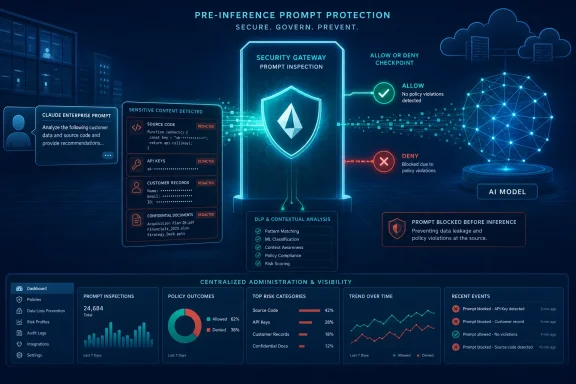 The new hook moves enforcement into Claude Enterprise
Palo Alto Networks’ stated setup is straightforward at the Claude Enterprise administration layer. An administrator adds a Prisma AIRS webhook endpoint in Claude’s inference-hook settings, supplies an x-pan-token header, then transfers a one-time Claude signing secret into Prisma AIRS. Palo Alto says it stores that secret in an encrypted edge key-value map and uses it to verify that incoming calls genuinely originated from Claude.The design is a marked change from Palo Alto Networks’ earlier Claude Code integration, published in November 2025. That implementation used Claude Code hooks: locally configured scripts that scan developer prompts and tool calls, and can also inspect model responses and tool outputs such as WebFetch results before they are reused.
The new integration is server-side and tenant-oriented. It does not depend on a developer installing or maintaining a hook in a
.claude configuration file, and it can apply one policy decision consistently to users working in managed Claude Enterprise environments. For a company trying to prevent employees from pasting a customer database extract, a private signing key, an acquisition plan, or a patient record into Claude, central deployment is considerably more practical than endpoint-by-endpoint enforcement.Palo Alto Networks is pitching that operational difference as “unified governance across all Claude surfaces,” naming Claude Code, Claude.ai, and Claude Cowork. The qualification is that the control begins with Claude Enterprise organization settings. A personal Claude.ai account, an unmanaged Claude Code install, or any Claude use outside the configured Enterprise tenant is not brought under this hook merely because the company has deployed Prisma AIRS elsewhere.
That makes identity and tenant enforcement the first implementation task. Security teams need to know which users are actually using their managed Claude Enterprise identity and which are taking the same material to personal accounts, alternate AI services, local tools, or an unapproved model endpoint. A pre-inference hook is strong for traffic it sees; it cannot govern traffic that bypasses the tenant entirely.
Existing DLP policies can now become a hard stop
The most persuasive part of this release is not prompt-injection detection, which remains a noisy and fast-moving problem, but policy reuse. Palo Alto Networks says existing Enterprise DLP rules can be applied to Claude without recreating them in another administration console.In practice, that means an organization may be able to carry over the same controls used for SaaS, browser, endpoint, email, network, and cloud channels. A policy built around exact data matching can recognize actual customer records instead of merely flagging a nine-digit string that resembles a Social Security number. A source-code policy can reject exposed API tokens or environment secrets. Document classification can recognize material related to human resources, litigation, or a pending transaction even where conventional regular expressions would find nothing.
This helps close a weakness in many early AI rollouts: DLP policy often exists, but the model interface becomes a separate exception requiring separate rules, logging, ownership, and training. Palo Alto’s approach ties Claude prompts to the company’s broader classification system and compliance reporting. A policy update made to a common data definition should, according to the company, appear in Claude at the same time it appears across other covered channels.
There is a practical benefit for Windows administrators here. Claude Code can be useful for PowerShell work, application troubleshooting, deployment packaging, Windows configuration analysis, and code refactoring—but those uses also routinely put credentials, internal hostnames, scripts, environment files, logs, and proprietary source into prompts. Preventing a secret from being submitted is better than discovering it later in a conversation review.
The feature’s business value will depend on the quality of the policies it inherits. Broad rules that block every code fragment, server name, or financial term will drive users toward unapproved tools. Weak policies will offer a reassuring dashboard without stopping meaningful leakage. Enterprises should start with high-confidence categories: known secrets, regulated identifiers, exact customer datasets, and narrowly defined sensitive document classes. The initial rollout should record denial rates, false positives, and the business cases that users abandon when a policy triggers.
“Synchronous” also means Claude depends on the policy path
Palo Alto Networks repeatedly emphasizes synchronous enforcement. That is the correct model if the objective is prevention: no “allow now, alert later” window exists before Claude reads the content. But a synchronous control point also becomes part of the request path for every protected prompt.The vendor’s API documentation confirms that the Prisma AIRS runtime service scans prompts and responses in real time, using an API key or OAuth token and a named AI security profile. It also documents a maximum 2 MB payload for a synchronous scan request, along with limits for URLs and some contextual-grounding fields. Palo Alto has not stated in the Claude announcement whether those general runtime API constraints map one-for-one to the new inference-hook integration, but the underlying inspection service is the same API family.
That omission matters for large Claude workflows. A developer may submit a substantial configuration bundle, log collection, source file, or generated context window. A business user may attach or paste a long document. Administrators should test the treatment of oversized prompts and attachments rather than assume that “every Claude interaction” includes every possible payload size and format.
More importantly, the announcement does not disclose the failure behavior. It says Prisma returns an allow or deny verdict, but does not say what Claude Enterprise does if the Prisma AIRS endpoint is slow, unreachable, suffers a regional outage, rejects a malformed request, or returns an unexpected response. A fail closed implementation preserves the security boundary but can halt Claude work during an outage. A fail open implementation preserves availability but creates the precise uncontrolled path the feature is meant to eliminate.
Palo Alto Networks also does not publish a latency target for this integration. Its wider Prisma AIRS AI Gateway material advertises low latency for gateway deployment, but that is a different architecture and cannot be assumed to describe inference hooks. Teams should measure real prompt latency with their own DLP profiles, especially where exact data matching, machine-learning classification, URL analysis, and AI-specific threat detectors are all enabled.
Prompt protection is not full agent containment
The release is being presented alongside claims about runtime threats, malicious code, URLs, and prompt injection. The announcement itself, however, describes a workflow in which Claude posts a payload before reading a prompt and receives a verdict. It does not say that inference hooks inspect Claude’s generated responses, downloaded artifacts, tool calls, Model Context Protocol traffic, filesystem operations, browser activity, or commands executed by Claude Code.That is the key difference from Palo Alto’s November 2025 Claude Code-hooks material, which explicitly described scanning prompts and tool calls before use and scanning responses and tool outputs before they reached the user or subsequent agent steps.
Those are separate control points. A malicious instruction hidden in a web page retrieved by an agent may arrive after the user’s original prompt has already passed the new Enterprise hook. A harmful command suggested by a model may need enforcement at the endpoint or tool-execution layer. A sensitive document generated by Claude may require output DLP, download controls, and audit review. The new hook can reduce one important exposure—what the user sends into Claude—but it does not eliminate the need for those other controls.
That is not a flaw unique to Prisma AIRS. It is the normal consequence of securing agentic systems with several different data flows. The useful outcome is that enterprises can finally put a firm pre-inference gate in front of managed Claude use; the mistake would be calling that a complete security architecture.
What administrators should verify before enabling it
The published material confirms the product integration and its basic prompt path, but it leaves several operational details unaddressed. No independent outlet had reported deployment results, pricing, regional availability, supported Claude Enterprise plans, or a rollout schedule as of August 6.Before moving from a pilot to production, security and platform teams should establish:
- Whether the configured Claude Enterprise hook covers every enabled surface in their tenant, including Claude Code and Cowork, rather than assuming product names equal enforcement coverage.
- Whether files, pasted documents, long contexts, and non-text content are included in the payload sent for inspection, and how over-limit content is handled.
- Whether an unavailable Prisma AIRS endpoint causes Claude to deny the prompt, allow it, retry it, or present a user-visible error.
- Which data is retained by Prisma AIRS for inspection, reporting, troubleshooting, and correlation, and where that processing occurs.
- Whether denied prompts expose enough user guidance to correct an accidental policy breach without revealing sensitive classification logic.
For enterprises already standardized on Enterprise DLP and Claude Enterprise, the next step is a controlled pilot with failure testing and representative developer and business workloads. The immediate consequence is clear: once the hook is enabled, a blocked secret or regulated record should never become a Claude prompt in the first place.
Update: Anthropic’s hook documentation adds tool-call coverage and failure controls (August 6, 2026)
According to Unite.AI’s review of Anthropic’s newly published inference-hooks documentation, the beta does more than inspect employee-submitted prompts: it also checks tool calls and tool responses before returned data is placed back into Claude’s context. That includes connected MCP tools, skills, and plugins, addressing a gap in the initial Palo Alto Networks announcement’s description of the prompt path.The documentation reportedly confirms configurable request timeouts, with five seconds as the default, and lets organizations choose the failure posture if their security endpoint is unavailable, errors, or times out. Administrators can either block the request or allow it to proceed without inspection—making the availability-versus-security decision an explicit tenant setting rather than an undocumented implementation detail.
Anthropic also provides staged rollout controls, including shadow mode, percentage-based enforcement, and role-based exclusions. Denied requests are recorded in the organization’s Activity Feed, and users receive a policy-block message based on the verdict reason and administrator-defined guidance.
The current beta still does not enforce on Claude’s generated responses. It receives extracted attachment text rather than raw files or image bytes, excludes voice mode and Claude Platform API traffic, and does not extend to Claude deployments through Amazon Bedrock or Google Cloud.
References
- Primary source: Palo Alto Networks
Published: 2026-08-05T16:35:03+00:00
Loading…
www.paloaltonetworks.com - Related coverage: paloaltonetworks.com
Loading…
www.paloaltonetworks.com - Related coverage: jobs.paloaltonetworks.com
Loading…
jobs.paloaltonetworks.com - Related coverage: docs.paloaltonetworks.com
Loading…
docs.paloaltonetworks.com - Related coverage: support.claude.com
Loading…
support.claude.com - Related coverage: blinkops.com
Loading…
www.blinkops.com - Related coverage: claudeers.com
Loading…
claudeers.com - Related coverage: builder.aws.com
Loading…
builder.aws.com - Related coverage: claude-code-log.com
Loading…
claude-code-log.com - Related coverage: leanpub.com
Loading…
leanpub.com - Related coverage: jobtoday.com
Loading…
jobtoday.com - Related coverage: robertmullins.info
Loading…
www.robertmullins.info - Primary source: unite.ai
Published: 2026-08-05T17:12:01+00:00
