

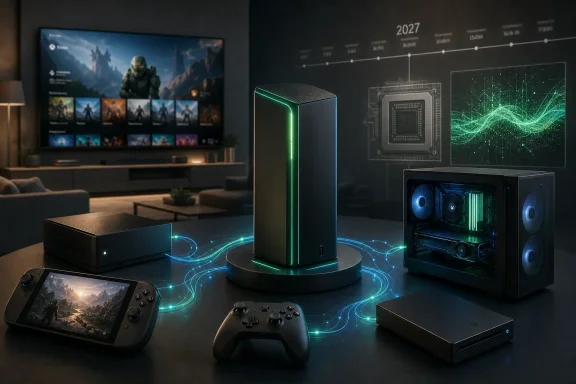
Microsoft’s own public record still calls Project Helix a single “next-generation first-party console.” In its March 11 GDC briefing, Xbox said that console is being designed to run Xbox console games and PC games, using a custom AMD system-on-chip and the next generation of DirectX and FSR technologies. Microsoft also said it plans to ship alpha hardware to developers during 2027.
Those two statements can coexist. A device family could mean multiple Helix models, but it could just as easily mean one flagship console surrounded by accessories, Windows-based Xbox experiences, cloud endpoints, or partner hardware. For Windows and PC gaming users, the important development is not proof of a Series X/S-style split. It is that Microsoft is continuing to frame Helix as a platform that crosses the old console-PC boundary.
Microsoft’s public Helix description remains singular
The key reporting from IGN is Sharma’s refusal to answer whether Helix will be disc-less. Instead, she said Microsoft had been working on a “great next generation and a great family of devices for Helix,” with more information to come.
That wording is meaningful because it departs from Microsoft’s March description, which repeatedly used the singular: “console,” “first-party console,” and “Project Helix.” At GDC, Xbox vice president Jason Ronald described a high-performance machine intended to play both Xbox console and PC titles. Microsoft also tied the platform to AMD, FSR Next, DirectX, four generations of backward compatibility, and a 2027 developer-hardware milestone.
None of that documentation identifies a second console, a handheld Helix, a lower-cost model, a detachable disc drive, or a release date. Microsoft has not published a product lineup, specifications, prices, storage capacities, physical-media policy, regional rollout plan, or compatibility rules for games bought outside the Xbox Store.
So the responsible reading is narrower than “Microsoft confirms multiple next-gen Xbox consoles.” It has not done that. The company has confirmed a console named Project Helix and has now, through Sharma’s remarks reported by IGN, used broader language around the hardware surrounding it.
“Family” could mean hardware tiers — but it does not have to
Xbox has precedent for treating a generation as a hardware family. The Xbox Series X and Xbox Series S were launched as two differently priced systems: one positioned around higher performance and an optical drive, the other as a smaller all-digital entry point. A Helix equivalent would offer Microsoft an obvious way to pursue performance at one end and affordability at the other.
But the present market makes that approach harder than it was in 2020. Supporting multiple console performance targets creates work for developers, particularly when the lower-end device shares the same release requirements as the premium model. The Series S has repeatedly become part of debates over feature parity, memory limits, and whether developers can bring demanding current-generation games to Xbox without compromises.
Sharma’s public comments this year make affordability an unmistakable Helix concern. In a June interview covered by Pure Xbox, she argued that the next system would only become expensive “if we do not innovate,” describing hardware pricing and the business model as problems Microsoft was trying to solve. In the later BBC conversation reported by GamesRadar+ and Windows Central, she again linked the next generation to efficiency and affordability alongside performance.
That does not tell us whether Microsoft will use a cheaper console SKU, subscription bundles, a modular design, cloud options, or subsidized hardware tied to services. It does explain why a device family would be commercially attractive. A single maximum-specification machine might help Microsoft make a technical statement, but it risks excluding exactly the audience Sharma says Xbox needs to reach.
The disc question remains deliberately unanswered
The immediate question that produced Sharma’s “family of devices” line was whether Project Helix would include a disc drive. Microsoft still has not answered it.
The BBC interview has been independently reported by GamesRadar+ and Windows Central, which quoted Sharma saying the industry needs to think about affordability and efficiency, while also acknowledging that players value physical media. Both reports confirm the central fact: Xbox’s CEO would not commit to disc support for the Helix generation.
That omission has practical consequences. A Helix model without an optical drive would not simply change how buyers install games. It would change resale, lending, used-game purchases, and preservation expectations, even if Microsoft offers a generous backward-compatibility program. A separate drive-equipped model, an optional drive, or a disc-to-digital migration path would each solve different pieces of that problem, and none should be assumed from the words “family of devices.”
Microsoft has separately announced a disc-to-digital entitlement initiative for selected older physical titles. Xbox says the aim is to help players move libraries forward by granting digital benefits to certain disc owners. That is useful for preserving access to eligible games across devices, but it is not a confirmation that Helix itself will read discs, nor is it a universal conversion program for every Xbox title ever released.
The distinction matters most to people with substantial Xbox 360, Xbox One, and Series X libraries. Backward compatibility is only as convenient as the method Microsoft provides for proving ownership. A disc drive verifies a disc locally; a digital entitlement shifts that proof into Microsoft’s account and licensing systems. Those are very different models, even when the same game remains playable.
Windows is increasingly part of the hardware pitch
The strongest confirmed part of Helix is its PC relationship. Microsoft’s March GDC post explicitly says Helix is designed to play Xbox console and PC games. It also connected the project to Xbox Play Anywhere, a catalog of more than 1,500 games whose purchases and saves can travel between console and Windows PC.
At the same event, Microsoft announced Xbox mode for Windows 11 in select markets. The company described it as a controller-oriented Xbox experience that retains Windows’ openness and lets users move between productivity and gaming. That software direction is relevant to Helix because it demonstrates the model Microsoft is building toward: Xbox identity, libraries, and interface spread across Microsoft hardware and Windows PCs rather than confined to one console shell.
Microsoft’s April strategy post makes the split clearer. Under its hardware priorities, the company listed Project Helix, accessories, and the stabilization of the current Xbox generation. Elsewhere, it described cloud gaming across TVs and lower-cost devices. The company is therefore already using “hardware” as a broad category, while positioning console, PC, mobile, cloud, and accessories as connected ways into Xbox.
That context makes an expansive interpretation of Sharma’s language plausible. A “family” could include a Helix console paired with purpose-built controllers, storage options, display accessories, Windows Xbox mode, and cloud-friendly devices without requiring Microsoft to build several separate Helix consoles. The reporting does not establish which version is real.
What PC and Xbox players should watch for next
The next concrete milestone is developer hardware in 2027. If Microsoft keeps that timetable, developers will need firm answers well before retail launch on performance targets, Xbox console-PC compatibility, storage, account licensing, and the minimum system expectations for games that span Helix and Windows.
For buyers, four unanswered questions will determine whether “family of devices” becomes a useful choice or merely a marketing umbrella:
- Microsoft needs to say whether Helix launches as one console or multiple performance and price tiers.
- Microsoft needs to explain whether physical Xbox games work directly, convert to digital licenses, or require a separately purchased optical drive.
- Microsoft needs to define what “PC games” means on Helix, including whether the system runs a Windows-like environment, supports outside storefronts, or relies on a curated Xbox compatibility layer.
- Microsoft needs to publish how Play Anywhere, cloud saves, backward compatibility, and existing digital licenses carry across the new hardware.
For now, the confirmed story is a change in Microsoft’s language, not a product reveal. Project Helix remains a singular, AMD-powered next-generation Xbox console in Microsoft’s official documentation, with alpha units due to developers in 2027. Sharma’s “family of devices” remark signals that the final consumer offering may be wider than that one box — but Microsoft has yet to say where the family begins or ends.