

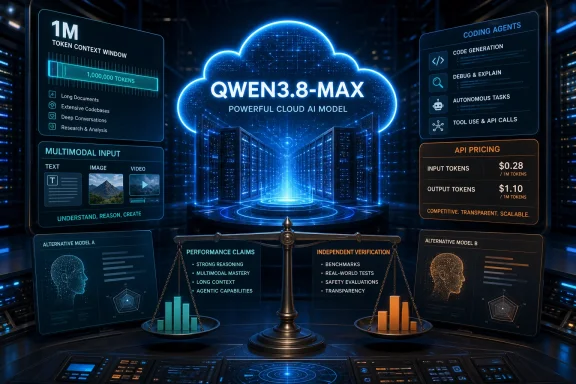
Techloy’s central criticism — that Alibaba had made performance claims without publishing figures — accurately described the Qwen3.8-Max preview announced on July 19. The company said then that the model was “second only” to Fable 5, but offered no model card, public evaluation protocol, active-parameter count, or standard API tariff. South China Morning Post and AP both reported the claim as Alibaba’s own positioning, not as an independently established ranking.
The August 3 general-availability release improves the operational picture. Alibaba now publishes the model identifier, qwen3.8-max, an API endpoint, rate limits, pricing, cache charges, and context limits. It also says the model can run long-horizon coding projects and professional workflows. But the evidence needed to turn a launch comparison into a buying decision remains uneven: Qwen’s headline benchmark claims are vendor-run results, while Kimi K3 has shipped its weights, architecture details, license, and a far more reproducible deployment record.
For Windows developers and IT teams, the practical conclusion is simple: Qwen3.8-Max is worth testing as a hosted model for multimodal and long-context work. It is not yet proven as a wholesale replacement for Claude Fable 5 or Kimi K3 in production coding agents.
Qwen3.8-Max has moved beyond the preview, but not into local deployment
Alibaba describes Qwen3.8-Max as a sparse mixture-of-experts, or MoE, model with 2.4 trillion total parameters and 95 billion active parameters per token. The second figure is the one that determines much of the real inference burden; total parameters alone are a poor guide to speed, cost, or hardware requirements in an MoE design.
That active-parameter number is a meaningful improvement over the July preview, when Alibaba promoted the 2.4 trillion total-parameter figure without saying how much of the model would run for each request. At 95 billion active parameters, Qwen3.8-Max is still a datacenter-class system. Even if its full weights arrive as promised, it will not be a practical local model for a Windows workstation with one or two consumer GPUs.
Alibaba has said the open weights for both Qwen3.8-Max and a smaller Qwen3.8-27B model will arrive “next week.” As of August 4, that is still a promise, not a published repository, license, quantization package, or deployment recipe. The distinction matters. A cloud API that calls itself open-weight-adjacent does not give an enterprise the ability to audit, self-host, isolate, or retain a model after a vendor changes terms.
Moonshot’s Kimi K3 is ahead on that measure. Its GitHub repository publishes a 2.8-trillion-parameter MoE architecture with 104 billion active parameters, 896 experts, 16 selected experts per token, a 1,048,576-token context window, deployment guidance for vLLM and SGLang, and a named Kimi K3 license. Kimi K3’s model weights are available now; Qwen3.8-Max’s are not.
That gives Kimi a concrete advantage for organizations evaluating on-premises AI, private-cloud inference, or reproducible agent workflows. It does not mean Kimi is easier to run on a desktop. Both systems are enormous. But Kimi has crossed the line from a provider-controlled service into something an infrastructure team can inspect and plan around.
The price comparison is real, but “cheap” depends on the workload
Alibaba’s published Qwen3.8-Max pricing is straightforward for standard requests:
- Qwen3.8-Max costs $2 per million input tokens and $6 per million output tokens.
- Reused input through Alibaba’s implicit cache costs $0.25 per million tokens.
- Moonshot lists Kimi K3 at $3 per million input tokens, $15 per million output tokens, with cache hits priced at $0.30 per million tokens.
On paper, Qwen is one-third cheaper on input and 60 percent cheaper on output than Kimi K3. That is a consequential gap for coding agents, especially ones that repeatedly feed a repository, build logs, test failures, tool results, and a growing task history back to the model.
The cache rate is the more interesting number. Long-running Windows automation and coding tasks often reuse a large prefix: project instructions, policy files, source-tree summaries, dependency inventories, and prior tool output. At $0.25 per million cached input tokens, Qwen could be economical for agents that maintain a stable context and make many iterative calls.
There is still a catch. The cost of an agent job is not the model’s posted token rate. It depends on how often the agent loops, how much hidden reasoning it produces, whether a framework resends its complete history, how it handles failed tool calls, and whether it needs a more capable fallback model for hard tasks. A model that finishes a task in three tool turns can be cheaper than one with lower token prices that spends 20 turns repairing its own work.
Alibaba’s $2/$6 pricing therefore establishes Qwen3.8-Max as a serious value contender. It does not prove it delivers the best cost per completed pull request, resolved incident, or generated application.
Alibaba’s benchmark story is narrower than the headline suggests
The August 3 Qwen release material, as summarized by MarkTechPost and reproduced in developer forums, includes a benchmark matrix that places Qwen3.8-Max ahead of Fable 5 on several document, visual-reasoning, CAD, and terminal-oriented tests. The same comparison reportedly shows Qwen behind Fable 5 on harder software-engineering and general-agent measures including SWE-bench Pro, FrontierSWE, Humanity’s Last Exam, and Toolathlon Verified.
That split is more useful than Alibaba’s original “second only to Fable 5” line. It says Qwen’s apparent strengths are multimodal work, documents, visual grounding, and certain structured professional tasks — precisely the areas Alibaba emphasizes in its product description. It also indicates that the model does not broadly equal Fable 5 across the kinds of agentic software work that most developers would use to justify a flagship model’s cost.
The material caveat is provenance. These are Alibaba’s results, using its chosen prompts, harnesses, reasoning settings, tools, retries, and comparison configurations. Even where a benchmark is public, those details can move the result sharply. A coding-agent score is never just a property of raw model weights; it is a result produced by the model, its system prompt, the agent scaffold, the terminal environment, the available tools, time limits, and grading rules.
Kimi K3 has the same vendor-evaluation caveat on many of its launch numbers, but Moonshot published considerably more implementation detail around its model and its evaluation setup. Its repository explicitly distinguishes cited scores, third-party leaderboard results, and Moonshot-run benchmarks. It also discloses when models are paired with different coding harnesses, an important qualification when comparing an API model to Claude Code, Codex, or Kimi Code.
A direct Qwen-versus-Kimi claim therefore needs more than comparing two rows from two different launch tables. The numbers must be rerun under the same harness and budget. Neither company has provided that neutral, end-to-end comparison.
Arena results are useful signals, not a universal scoreboard
The Techloy report points to Arena’s crowdsourced leaderboards, where Qwen3.8-Max has been reported as a top Chinese text model and a leading vision model. Those results are more independent than a vendor slide, but they have a limited meaning: they capture user preferences in a particular blind-comparison environment, not guaranteed performance on every enterprise task.
Arena itself explains that its Code Arena evaluates agents that plan, edit files, execute code, render applications, and receive pairwise human votes. That is valuable because it measures more than isolated code completions. But it also means the leaderboard is sensitive to the exact model version, tool setup, prompt mix, latency, and how users judge a finished app’s appearance and behavior.
The latest publicly indexed Code Arena snapshot available before Qwen3.8-Max’s release put Claude Opus 5 Max first and Kimi K3 Max second on overall web-development tasks. It predates Qwen3.8-Max’s appearance, so it cannot substantiate a claim that Qwen has overtaken Kimi in code generation. Any post-launch rank should be treated as preliminary until enough votes accumulate and Arena publishes a stable listing for the exact qwen3.8-max endpoint.
This is where marketing shorthand becomes dangerous. “No. 2 in vision,” “top Chinese text model,” and “second only to Fable 5” can all be true within their own narrow measurement frames while producing no single answer to the question an engineering manager actually has: which model will complete our work reliably at an acceptable cost?
What Windows developers should test before routing real work to Qwen
QwenCloud says Qwen3.8-Max supports OpenAI- and Anthropic-compatible tools and lists Claude Code, Cursor, Cline, OpenCode, Codex, and OpenClaw among supported clients. That lowers the friction of a controlled evaluation. It also makes it easy to mistake compatibility for equivalence.
Before changing a default model in a Windows development workflow, teams should run the same bounded task set through Qwen3.8-Max, Kimi K3, and their existing Claude configuration. Include a repository bug fix, a multi-file feature, a PowerShell automation task, a document-extraction job, an image or screenshot interpretation task, and a long-context issue involving build output or support logs. Record completion rate, tool-call count, wall-clock time, retry behavior, test pass rate, and total billed tokens.
Keep prompts, tools, permissions, model effort settings, and fallback behavior fixed. Do not compare a Qwen run in one agent framework against Kimi Code or Claude Code in another and call the difference a model result.
Qwen3.8-Max’s strongest verified advantage today is its combination of a 1 million-token context window, multimodal API, low cache price, and lower standard token price than Kimi K3. Its weakest point is not a demonstrated technical failure; it is the gap between Alibaba’s sweeping frontier-model claim and the still-limited independent evidence behind it. The promised open-weight release will determine whether Qwen becomes a platform teams can run and audit — or remains an aggressively priced API with a very large number attached to it.
References
- Qwen 3.8 Max Is Here: How It Actually Compares to Claude Fable 5 and Kimi K3 Techloy · 2026-08-03T10:13:55+00:00