
As reported by Sonic State and detailed on Ravine DSP’s product pages, the update is aimed at producers who have been leaning on duplicated plug-in instances and extensive DAW automation merely to switch an effect between a handful of settings. Instead, a single hosted effect can become a performance-controlled, scene-based processor inside the Inter::State workspace.
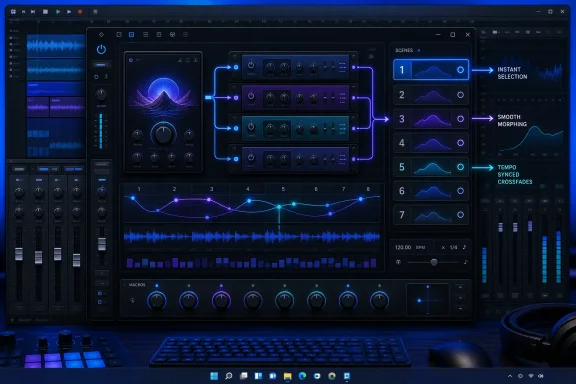 Eight snapshots per hosted effect
Slot Scenes can save a hosted plug-in’s parameter configuration and, optionally, its mixer settings. The three transition modes cover distinct use cases: Selector provides immediate recall; Morph continuously blends between adjacent scene slots; and Crossfade makes beat-aware moves from the current state to a selected destination over a musical duration.
That distinction matters for Windows users working in Ableton Live, Cubase, Reaper, or other VST3 hosts. A distortion can jump between utility and aggressive settings, a filter can be swept across prepared states, or an ambience chain can transition over bars without requiring a crowded set of automation lanes.
Ravine DSP says its zero-latency Auto-Gain system is intended to manage level changes caused by extreme scene shifts, reducing the chance that automated tonal changes also produce unexpected clipping or large volume jumps.
A host designed to keep routing in one insert
Inter::State remains a fixed-layout effects host with three racks and a unified routing view. It supports serial, parallel, multiband, and send-style configurations, while preserving MAIN, RACK, and SLOT-level mixing controls within one plug-in instance.
The practical appeal is project portability: users can save a rack or an entire Inter::State session and reopen it in another compatible DAW with hosted plug-in states, macro mappings, and modulators retained. Slot Scenes are included in those saved configurations, making them more useful than a temporary live-performance feature.
The included Inter::State[Bridge] plug-in also exposes eight shared macros from a single instrument-track surface. Ravine DSP says subscribed Inter::State instances can receive those controls through zero-latency shared memory, avoiding virtual MIDI routing for project-wide control.
Windows availability and pricing
Inter::State 1.3 is available as a 64-bit VST3 plug-in for Windows 10 and Windows 11; AU support is offered for macOS. The update is free for existing owners, and Ravine DSP offers a seven-day unrestricted trial.
The Founders Edition is priced at $69 or €60, with the developer planning an eventual increase to $99 or €85. For Windows-based producers whose sessions have turned into forests of copied effects and automation clips, version 1.3’s key change is simple: effect-state changes can now live inside the host rather than across the arrangement.
