
SecurityBrief Asia reported the launch on August 26, while Google Cloud and Anyscale published their joint announcement a day earlier, on August 25. The underlying release is real and documented in the Ray 2.58.0 documentation as ray.experimental.sandbox. But the most important detail is buried beneath the launch language: this is an alpha security component, not a turnkey guarantee that agent-generated code is safe.
For admins building reinforcement-learning pipelines, coding-agent evaluations, or tool-using LLM systems, the change removes a familiar architectural split. Previously, an organization generally had to operate a separate sandbox service alongside Ray, or send risky execution jobs to a hosted provider. Ray Sandboxes fold that lifecycle into the cluster scheduler. That can simplify operations, but it also puts configuration decisions about network access, images, Linux capabilities, and host placement directly into the hands of the Ray application and platform team.
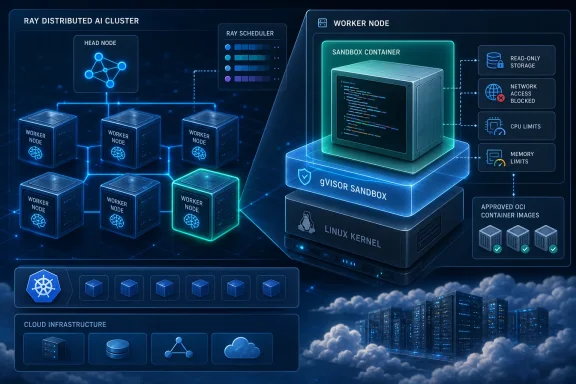 Ray Actors Now Represent Sandboxed Environments
Google Cloud’s announcement describes each high-level sandbox as a Ray Actor. The Ray scheduler selects the host node and reserves resources; the actor provides the remote control plane; and gVisor runs the code behind the execution boundary on that node.
That arrangement is more consequential than a new helper API. In a normal Ray deployment, actors, tasks, accelerator reservations, placement groups, autoscaling, retry behavior, and cluster observability already determine where work runs and how it recovers. Treating a sandbox as an actor means a post-training framework can create isolated rollout environments with the same controls it uses for trainers and inference workers.
The API starts with a standard OCI-compatible image and returns an actor handle. A calling application can run commands, inspect state, upload and download artifacts, terminate a process, or delete the entire environment. Ray’s documentation also exposes SandboxRuntime, a lower-level interface for creating local gVisor sandboxes and modifying the OCI specification before gVisor receives it.
That latter feature deserves attention from security engineers. OCI-spec customization lets operators tune process limits and remove Linux capabilities, but it also means the effective isolation policy may differ from one Ray workload to the next. A central platform team cannot assume that every job requesting a “sandbox” is using identical constraints unless it enforces those settings through image policy, admission controls, code review, or a managed wrapper around the Ray API.
gVisor Adds a Boundary, but It Does Not Replace Cluster Security
The new Ray component uses gVisor’s runsc runtime. Unlike a conventional runc container, where application system calls reach the host Linux kernel more directly, gVisor implements much of the Linux system-call interface in userspace. Google positions this as an additional layer between untrusted code and the node kernel, reducing exposure to container escapes and host-kernel vulnerabilities.
The architectural advantage is clear for AI systems that generate Python, shell commands, or tool invocations dynamically. Running that code in the same worker process as an orchestration service creates obvious risk: it can consume resources, inspect available credentials, probe internal services, or exploit a runtime weakness from a privileged position. A gVisor-backed environment narrows that exposure without requiring a full virtual machine or microVM for every rollout.
But “sandboxed” should not be read as “safe regardless of configuration.” Ray’s own documentation says the package is alpha and may change or disappear before reaching stable status. Anyscale also says that the overall security properties depend on configuration of both the sandbox and surrounding infrastructure, and says recommended hardened configurations are still being developed.
The defaults provide a useful baseline. Ray documents a read-only root filesystem by default, with only the configured working directory writable. It also defaults sandbox networking to none, blocking outbound interfaces unless an application explicitly opts into another mode. CPU and memory limits are enforced through cgroups, helping prevent one job from consuming a node’s resources.
Those defaults will only protect teams that preserve them. A workload granted public egress can contact external services. A workload that receives broad Linux capabilities or a writable filesystem has a larger attack surface. A sandbox that is allowed to pull arbitrary images from an uncontrolled registry turns the container image itself into part of the trust decision. The gVisor process boundary remains valuable, but it cannot compensate for permissive network, identity, image, and Kubernetes policies.
The GKE Launch Is Not the Same as a GKE-Only Feature
SecurityBrief described the release as being made available for Google Kubernetes Engine, which accurately reflects the launch’s Google Cloud focus and the deployment material published around it. Google Cloud’s demonstration and stated scale testing are tied to GKE. Anyscale says it has scaled the architecture on GKE to 100,000 sandboxes in 20 seconds across thousands of nodes, though that is a vendor-reported result rather than an independently published benchmark.
The Ray documentation, however, frames the library more broadly than a GKE-only service. Its stated prerequisites are Linux on x86_64 or Arm64, Ray 2.58.0 or later, and the runsc binary installed and available in the system path on every node that will host a sandbox. Kubernetes is a natural target because of Ray’s existing KubeRay tooling, but the component is part of open-source Ray rather than a separately branded GKE control-plane product.
That distinction matters for infrastructure planning. Teams running Ray on self-managed Kubernetes, other cloud Kubernetes offerings, or Linux virtual machines may be able to test the library if they meet the runtime requirements. They should not assume the polished GKE examples translate unchanged to another environment, particularly for node preparation, image distribution, cgroup delegation, network policy, and identity handling.
It also means Windows administrators should view this as a Linux cluster capability, not a new Windows sandbox mechanism. The current documented platforms are Linux x86_64 and Arm64. Windows-based development workstations can drive Ray jobs or build application code, but nodes executing these gVisor sandboxes require Linux.
Installation Is a Node-Image and Operations Project
Upgrading a Python package alone is not sufficient. Every Ray worker eligible to execute sandboxed jobs must have gVisor’s runsc binary installed and reachable through $PATH. In an immutable Kubernetes environment, that normally means rebuilding the Ray worker image, validating the runtime in a staging cluster, and ensuring autoscaled node pools launch with the same image.
The operational work continues beyond the image build. Container images used by sandboxes must be available from registries that worker nodes can reach. Ray’s documentation notes that image pull failures can be mitigated by checking registry access or pre-populating the image cache. At high concurrency, registry throttling, cold image pulls, and memory pressure may become more immediate bottlenecks than Ray scheduling itself.
Teams also need to decide where sandbox actors are allowed to land. A broad Ray cluster may contain nodes with sensitive internal network access, cloud service identities, mounted storage, or high-value training data. The sensible first deployment is a dedicated worker pool for sandbox execution with narrow service-account permissions, restricted egress, controlled images, resource quotas, and no access to production control-plane credentials.
Google and Anyscale have not published a final production hardening guide for Ray Sandboxes. Their own development backlog lists unresolved work around image handling, Python dependency management, suspend-and-resume behavior, gVisor version pinning in tests, and an unexplained need for --ignore-cgroups in continuous-integration testing. Those are normal early-release gaps, but they reinforce the point that this is an engineering preview for controlled environments rather than an automatic production replacement for a mature isolation platform.
Early Compatibility Limits Narrow the First Use Cases
Anyscale’s Harbor integration makes the intended use case especially visible. Harbor runs coding-agent evaluations such as SWE-Bench and Terminal-Bench, where each trial needs an isolated environment. Ray Sandbox can act as a native Harbor environment, letting trials execute under gVisor on cluster nodes.
The integration is not universal. Anyscale says public task images work immediately, while some benchmark workflows need per-task images available through a reachable registry. Tasks requiring Docker Compose, GPU access, or allowlist-based networking are currently rejected in that integration. GPU-backed sandboxes, a REST interface independent of Ray, filesystem snapshots, and port exposure are identified as future work rather than present-day features.
That makes the strongest first deployment candidate relatively narrow: CPU-oriented, short-lived, containerized code execution with no network access, modest file-transfer needs, and a tightly controlled image set. It is a credible fit for code-generation evaluation, reinforcement-learning rollouts, and bounded tool calls. It is less ready for agent workflows that need nested containers, GPU devices, arbitrary external access, persistent state, or complex service dependencies.
Treat Ray 2.58 Sandboxes as a Controlled Pilot
Google Cloud and Anyscale have solved an important integration problem: isolated execution no longer has to be managed as a separate system outside a Ray cluster. For organizations already committed to Ray, that lowers the friction of separating model-generated code from orchestration and training processes.
The launch does not eliminate the need for platform engineering. The sandbox library is experimental, gVisor must be deployed on every eligible Linux worker, and the defaults can be weakened by ordinary application configuration. Start with a dedicated node pool, network="none", read-only roots, explicit CPU and memory limits, approved OCI images, and a test workload that does not require privileged access or GPUs.
Ray 2.58 gives distributed AI teams a promising building block. The practical consequence is that sandboxing has moved into the same operational plane as Ray scheduling—where a weak cluster policy can undermine it, and a disciplined one can make model-generated execution far less dangerous.