
Remnant: From the Ashes is still an unusually effective co-op shooter on PC, but the common shorthand around it now needs correction: it did not launch under Arc Games, and its procedural campaign does not rebuild itself every time a player loads a save. Those details change what a returning player should expect from Gunfire Games’ 2019 game—and who now controls it.
The supplied overview correctly identifies the game as Gunfire’s third-person blend of shooting, dodge-based action combat, crafting, and rotating encounters. It also correctly points to the Root as the dimensional invader that has devastated Earth. But its publisher line collapses seven years of ownership changes into a statement that is historically wrong and presently incomplete.
Gunfire Games announced an August 20, 2019 launch for PC, PlayStation 4, and Xbox One, while Steam’s current store record lists August 19, 2019—likely a storefront timing and time-zone discrepancy rather than evidence of separate releases. At launch, the publisher was Perfect World Entertainment, as contemporaneous Gunfire, Xbox Wire, and review material records. Arc Games is the corporate descendant of that publishing operation, not the original launch publisher.
The more important current change came after Embracer’s 2025 divestment of Arc Games and Cryptic Studios. Embracer said the publishing rights for the Remnant franchise would move from Arc Games to THQ Nordic, which already owns both the Remnant IP and Gunfire Games. Arc remains listed as a co-publisher on the PC storefront alongside THQ Nordic, which explains why store metadata can still look contradictory.
For prospective players, the practical conclusion is straightforward: Remnant: From the Ashes is a finished, older Windows game with a live storefront presence and online co-op, but it is no longer a title whose publishing future should be read through Arc Games alone. THQ Nordic is the company holding the franchise’s publishing rights going forward.
The overview’s biggest gameplay overstatement is the claim that worlds rearrange “each time you load in.” Remnant does use procedural generation, but it is a controlled campaign roll, not a perpetual reshuffle of every room whenever the game is launched.
When a new campaign is created, the game assembles a route using selected map tiles, dungeons, events, bosses, and item opportunities. A run can therefore contain a different world boss, side dungeon, quest chain, or reward path than another player’s run. PC Gamer and RPGamer both documented that campaign-level structure at launch: the broad progression remains recognizable, while individual dungeon placements, events, and boss assignments can differ substantially.
That distinction matters for anyone chasing a specific weapon mod, trait, ring, boss material, or alternate kill reward. Logging back into the same campaign does not give a fresh chance at missing content. Players need to reroll the campaign or, once unlocked, use Adventure Mode to generate a new version of an individual biome.
The game preserves character progress through that process. Weapons, armor, traits, scrap, and crafting materials remain with the character, while story progress and quest items tied to the rolled world are reset. That design is why Remnant remains more replayable than a conventional linear shooter: its replay value is based on collecting missing encounters and gear, not on replaying a freshly randomized campaign every time the player presses Continue.
It is also why the game can be confusing for newcomers. A friend can describe a boss, a merchant encounter, or a dungeon puzzle that simply does not exist in another player’s current world state. That is working as designed, not a broken quest chain.
The full game is larger than that snapshot suggests. The Swamps of Corsus expansion, released in April 2020, expanded that biome with additional content and added Survival Mode. Subject 2923, released in August 2020, added a story continuation, new locations on Earth, Ward Prime, and the frozen world of Reisum.
Gunfire’s current game page and THQ Nordic’s official site both list Reisum alongside the original locations. So a player buying or revisiting the Complete Edition is dealing with five named worlds or realms beyond Ward 13, not merely the four-area campaign described in many launch-era summaries.
The DLC split also matters narratively. The base campaign reaches a conclusion, but Subject 2923 is the expansion that follows the Dreamer program and pushes the Root conflict toward a more definitive ending. Players who only finish the original campaign have seen the foundation of the story; they have not seen all of the game’s authored conclusion.
That is a useful distinction in 2026, because the original game is now often approached backward through Remnant II. The first game stands on its own mechanically, but Subject 2923 is the content most relevant to players who want the fullest bridge into the sequel’s setting.
The game’s strongest system is the weapon-mod layer. Mods charge through combat and give firearms secondary abilities, including healing fields, elemental attacks, summons, defensive tools, and crowd-control effects. Boss materials can be converted into weapons or mods, so victories often feed directly into build experimentation rather than simply increasing a damage number.
GameSpot’s original review found that this system becomes more consequential in co-op, where three players can combine survivability, status effects, direct damage, and support abilities. The official game site confirms the limit: it is the host plus up to two other players, for three players total, not three teammates in addition to the host.
Co-op is not an automatic easy mode. Enemy health and encounter pressure scale for the group, and boss fights frequently demand cleaner positioning rather than indiscriminate damage output. A coordinated team can make difficult content more manageable, but an unprepared three-player party can create a louder, more chaotic version of the same fight.
There is one recurring criticism worth retaining from the game’s launch reviews. Several reviewers praised the moment-to-moment combat while finding the story and some boss design less consistent. PC Gamer and Game Informer both noted that the game can lean heavily on additional enemies during boss encounters. That is not a trivial complaint: the player is often managing the arena as much as learning a boss’s core moveset.
For a modern install, Windows 10 or Windows 11 is the sensible baseline. The game’s age means its official requirements are modest by current standards, but older requirements are not a guarantee that every modern GPU driver, overlay, controller configuration, cloud-save state, or multiplayer setup will behave identically to a 2019 PC.
The larger point is that Remnant: From the Ashes has reached the stage where its strengths are clearer than its marketing category. It is a compact action shooter with a persistent character, mutable campaign structure, and a gear chase designed around deliberately seeing less than the whole game on a first run.
Players should enter expecting a campaign that can withhold bosses, events, and equipment until they reroll—not a game that reinvents itself every loading screen. And anyone tracking the franchise should follow THQ Nordic’s stewardship of the publishing rights, even while Arc Games remains visible in older store listings.
Gunfire Games announced an August 20, 2019 launch for PC, PlayStation 4, and Xbox One, while Steam’s current store record lists August 19, 2019—likely a storefront timing and time-zone discrepancy rather than evidence of separate releases. At launch, the publisher was Perfect World Entertainment, as contemporaneous Gunfire, Xbox Wire, and review material records. Arc Games is the corporate descendant of that publishing operation, not the original launch publisher.
The more important current change came after Embracer’s 2025 divestment of Arc Games and Cryptic Studios. Embracer said the publishing rights for the Remnant franchise would move from Arc Games to THQ Nordic, which already owns both the Remnant IP and Gunfire Games. Arc remains listed as a co-publisher on the PC storefront alongside THQ Nordic, which explains why store metadata can still look contradictory.
For prospective players, the practical conclusion is straightforward: Remnant: From the Ashes is a finished, older Windows game with a live storefront presence and online co-op, but it is no longer a title whose publishing future should be read through Arc Games alone. THQ Nordic is the company holding the franchise’s publishing rights going forward.
 The campaign is generated on a roll, not on every load
The overview’s biggest gameplay overstatement is the claim that worlds rearrange “each time you load in.” Remnant does use procedural generation, but it is a controlled campaign roll, not a perpetual reshuffle of every room whenever the game is launched.When a new campaign is created, the game assembles a route using selected map tiles, dungeons, events, bosses, and item opportunities. A run can therefore contain a different world boss, side dungeon, quest chain, or reward path than another player’s run. PC Gamer and RPGamer both documented that campaign-level structure at launch: the broad progression remains recognizable, while individual dungeon placements, events, and boss assignments can differ substantially.
That distinction matters for anyone chasing a specific weapon mod, trait, ring, boss material, or alternate kill reward. Logging back into the same campaign does not give a fresh chance at missing content. Players need to reroll the campaign or, once unlocked, use Adventure Mode to generate a new version of an individual biome.
The game preserves character progress through that process. Weapons, armor, traits, scrap, and crafting materials remain with the character, while story progress and quest items tied to the rolled world are reset. That design is why Remnant remains more replayable than a conventional linear shooter: its replay value is based on collecting missing encounters and gear, not on replaying a freshly randomized campaign every time the player presses Continue.
It is also why the game can be confusing for newcomers. A friend can describe a boss, a merchant encounter, or a dungeon puzzle that simply does not exist in another player’s current world state. That is working as designed, not a broken quest chain.
Four worlds describes the original campaign, not the complete game
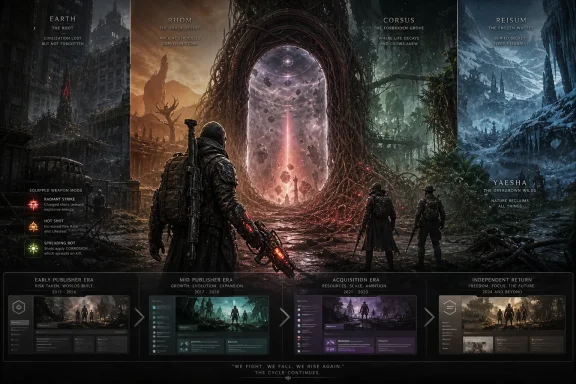
The “four worlds” description is accurate only when discussing the original campaign structure. Ward 13 serves as the hub, while the base game sends players through Earth, Rhom, Corsus, and Yaesha. Each has a distinct visual theme and enemy pool: ruined urban Earth, Rhom’s desert and machinery, Corsus’ hostile swamps, and Yaesha’s lethal jungle.The full game is larger than that snapshot suggests. The Swamps of Corsus expansion, released in April 2020, expanded that biome with additional content and added Survival Mode. Subject 2923, released in August 2020, added a story continuation, new locations on Earth, Ward Prime, and the frozen world of Reisum.
Gunfire’s current game page and THQ Nordic’s official site both list Reisum alongside the original locations. So a player buying or revisiting the Complete Edition is dealing with five named worlds or realms beyond Ward 13, not merely the four-area campaign described in many launch-era summaries.
The DLC split also matters narratively. The base campaign reaches a conclusion, but Subject 2923 is the expansion that follows the Dreamer program and pushes the Root conflict toward a more definitive ending. Players who only finish the original campaign have seen the foundation of the story; they have not seen all of the game’s authored conclusion.
That is a useful distinction in 2026, because the original game is now often approached backward through Remnant II. The first game stands on its own mechanically, but Subject 2923 is the content most relevant to players who want the fullest bridge into the sequel’s setting.
Gunplay and mods are the real reason the formula holds up
The “Souls-like with guns” label is convenient but incomplete. Remnant: From the Ashes borrows checkpoint structure, dodge invulnerability timing, punishing bosses, and a deliberate death loop from action RPGs. Its actual rhythm is closer to a third-person shooter built around pressure: aim under threat, manage incoming enemies, choose when to heal, and avoid getting trapped in cramped arenas.The game’s strongest system is the weapon-mod layer. Mods charge through combat and give firearms secondary abilities, including healing fields, elemental attacks, summons, defensive tools, and crowd-control effects. Boss materials can be converted into weapons or mods, so victories often feed directly into build experimentation rather than simply increasing a damage number.
GameSpot’s original review found that this system becomes more consequential in co-op, where three players can combine survivability, status effects, direct damage, and support abilities. The official game site confirms the limit: it is the host plus up to two other players, for three players total, not three teammates in addition to the host.
Co-op is not an automatic easy mode. Enemy health and encounter pressure scale for the group, and boss fights frequently demand cleaner positioning rather than indiscriminate damage output. A coordinated team can make difficult content more manageable, but an unprepared three-player party can create a louder, more chaotic version of the same fight.
There is one recurring criticism worth retaining from the game’s launch reviews. Several reviewers praised the moment-to-moment combat while finding the story and some boss design less consistent. PC Gamer and Game Informer both noted that the game can lean heavily on additional enemies during boss encounters. That is not a trivial complaint: the player is often managing the arena as much as learning a boss’s core moveset.
Windows players should read the storefront requirements carefully
On PC, Steam still lists a 64-bit Windows requirement and DirectX 11 support for Remnant: From the Ashes. Its older published minimum operating-system line includes Windows 7, Windows 8, and Windows 10, but that should not be mistaken for a current platform-support promise. Steam itself ended client support for Windows 7 and Windows 8 on January 1, 2024.For a modern install, Windows 10 or Windows 11 is the sensible baseline. The game’s age means its official requirements are modest by current standards, but older requirements are not a guarantee that every modern GPU driver, overlay, controller configuration, cloud-save state, or multiplayer setup will behave identically to a 2019 PC.
The larger point is that Remnant: From the Ashes has reached the stage where its strengths are clearer than its marketing category. It is a compact action shooter with a persistent character, mutable campaign structure, and a gear chase designed around deliberately seeing less than the whole game on a first run.
Players should enter expecting a campaign that can withhold bosses, events, and equipment until they reroll—not a game that reinvents itself every loading screen. And anyone tracking the franchise should follow THQ Nordic’s stewardship of the publishing rights, even while Arc Games remains visible in older store listings.
References
- Primary source: games.gg
Published: 2026-08-02T21:40:30.542831
Loading…
games.gg - Related coverage: gunfiregames.com
Loading…
gunfiregames.com - Related coverage: gamespot.com
Loading…
www.gamespot.com - Related coverage: news.xbox.com
Loading…
news.xbox.com - Related coverage: gameinformer.com
Loading…
gameinformer.com - Related coverage: remnant.thqnordic.com
Loading…
remnant.thqnordic.com - Related coverage: pcgamer.com
Embracer Group sells publisher Arc Games and Star Trek Online developer Cryptic Studios, but once again clings on to the publishing rights for Remnant 2 | PC Gamer
Old-school MMO Fellowship has its rights transferred to Coffee Stain.www.pcgamer.com - Related coverage: gamesradar.com
Barely 4 years after buying them, Embracer Group sells Remnant publisher and Star Trek Online developer in a deal that'll net it $30 million | GamesRadar+
Arc Games and Cryptic Studios are being sold to Project Golden Arc Inc.www.gamesradar.com - Related coverage: pcgamer.com
Remnant: From the Ashes review | PC Gamer
The latest Review,,,reviews, breaking news, comment, reviews and features from the experts at PC Gamerwww.pcgamer.com - Related coverage: gameinformer.com
Remnant: From The Ashes Review - Remnant: From The Ashes Review –
Strong systems and a satisfying gameplay loop give Remnant: From The Ashes a powerful foundation, even if the experience is mired by repetitive andgameinformer.com - Related coverage: rpgamer.com
Remnant: From the Ashes Review - RPGamer
Remnant: From the Ashes came out of nowhere but quickly managed to leave an impression. Fortunately, it's a good one.rpgamer.com - Related coverage: waytoomany.games
Review - Remnant: From the Ashes - WayTooManyGames
Remnant: From the Ashes is the latest game from the Darksiders developer and quite possibly one of my favourite co-op in recent years.waytoomany.games - Related coverage: gamespot.com
- Related coverage: store.steampowered.com
Steam DLC Page: Remnant: From the Ashes
store.steampowered.com
- Related coverage: savingcontent.com
Remnant: From the Ashes Review - Saving Content
Every so often a game sneaks up on you with practically no warning. No fanfare, no bombastic media campaign; one day it's just there, lurking in thewww.savingcontent.com - Related coverage: theouterhaven.net
Remnant: From the Ashes Review – Soulsbornes with Guns | The Outerhaven
Remnant: From the Ashes finds a nice balance of emulating Soulsborne games while retaining what makes a great third-person shooter set in an Action RPG world.www.theouterhaven.net - Related coverage: destructoid.com
Review: Remnant: From the Ashes – Destructoid
Ashy Slashy Monster Hunter-esque, quick-service co-op games are popping up like a cottage industry. The angle isn’t new, but with releases like Dauntless gracing the neon lights of gaming marketplaces so frequently (and becoming overnight successes), you know the audience is primed and ready...www.destructoid.com - Related coverage: geeksundergrace.com
- Related coverage: newgamenetwork.com
Remnant: From the Ashes Review - New Game Network
Middle-tier amusement with shockingly sharp third-person shootingwww.newgamenetwork.com - Related coverage: cdn.cloudflare.steamstatic.com
- Related coverage: gunfiregames.com
Remnant: From the Ashes — Gunfire Games
gunfiregames.com
- Related coverage: store.steampowered.com
Remnant: From the Ashes on Steam
The world has been thrown into chaos by an ancient evil from another dimension. As one of the last remnants of humanity, you must set out alone or alongside up to two other survivors to face down hordes of deadly enemies to try to carve a foothold, rebuild, and retake what was lost. - Related coverage: highgroundgaming.com
Remnant: From the Ashes Review | High Ground Gaming
Blood clouds my vision as I stagger toward the twisted metal beams of a long-abandoned hotel. Collapsing into cover, I press the pulsing dragon heart to my chest and sigh in relief as its warmth seeps into my aching bones. This momentary peace is interrupted by a ragged breath behind me that...www.highgroundgaming.com
- Related coverage: gamersheroes.com
- Related coverage: dreadcentral.com
REMNANT: FROM THE ASHES Review - New School Souls With That Old School Kick
REMNANT: FROM THE ASHES Review - New School Souls With That Old School Kickwww.dreadcentral.com - Related coverage: psu.com
Remnant: From The Ashes PS4 Review - PlayStation Universe
Gunfire Games' latest work simplifies the looter-shooter genre, but does it work? Find out in our Remnant: From The Ashes PS4 review.www.psu.com