
A report published on August 3, 2026 saying Renault and Nissan had partnered with Microsoft on connected-car technology is a decade-old announcement presented with a current timestamp, not a newly disclosed deal. Microsoft, Renault-Nissan, and Reuters all documented the agreement on September 26, 2016; the partnership was a multiyear plan to build cloud-backed vehicle services on Microsoft Azure.
The distinction is more than editorial housekeeping. Connected-car programs determine which company receives vehicle telemetry, delivers software updates, operates remote-control features, and maintains the back-end services that can outlive a model’s original infotainment hardware. Readers encountering the item as fresh news would reasonably expect a new Renault-Nissan cloud commitment in 2026. The record instead shows an early Azure partnership that later became a real production platform, though in a narrower and more complicated form than the original “future of connected driving” language suggested.
Microsoft’s original news release is dated September 26, 2016 and identifies the counterpart as the Renault-Nissan Alliance, before Mitsubishi Motors was formally incorporated into the alliance’s connected-vehicle effort. Reuters reported the same day that Renault and Nissan were turning to Microsoft for cloud services as part of their then-ambitious autonomous-driving plans.
The supplied article’s headline closely matches Reuters’ 2016 wording, including its focus on “connected car technology.” But neither Microsoft nor Renault-Nissan has announced a new version of that partnership dated August 3, 2026 in the material available on the public record. The publication date attached to the resurfaced story is therefore misleading.
This is a familiar problem with vehicle-technology news. An automaker can sign a cloud agreement years before a buyer sees the related service in a car, and the services can be altered, region-limited, paid, discontinued, or moved to a different technical stack afterward. Reposting the signing announcement without its 2016 date erases the most useful information: whether drivers can buy or use anything new today.
In practical terms, Azure was positioned as the control plane behind the car: a scalable place to ingest telemetry, run analytics, manage customer identities and service requests, and distribute data or software to vehicles. That is materially different from Windows running the dashboard. The original announcement also stressed that Azure supported multiple operating systems, development languages, and tools, a sign that Renault and Nissan wanted a shared back-end without committing every screen, ECU, or supplier to Microsoft software.
For IT professionals, the appeal is obvious. A global manufacturer selling across multiple markets does not want a separate hosted service, data pipeline, authentication model, and update mechanism for every brand and model year. Consolidating those functions can reduce the cost of maintaining legacy telematics systems and can make fleet-scale diagnostics possible.
It also creates a long-lived dependency. Once remote lock, vehicle location, battery-status reporting, service reminders, or firmware delivery run through a central cloud platform, the useful life of those functions depends on three separate things: the automaker continuing the service, the vehicle retaining a working cellular connection, and the owner’s account remaining eligible. The announcement spoke broadly about convenience and personalization, but it did not disclose service terms, regional availability, subscription pricing, retention periods for vehicle data, or what customers could expect when older networking hardware was retired.
The next major milestone came on March 20, 2019, when Renault-Nissan-Mitsubishi announced the Alliance Intelligent Cloud. Microsoft and Mitsubishi Motors said the jointly developed Azure platform would first power connected services in the all-new Renault Clio and selected Nissan Leaf models sold in Europe and Japan later that year.
That launch provides the missing outcome behind the 2016 reporting. Renault-Nissan’s announcement was followed by a production-oriented platform, and not simply by a research project. The Alliance Intelligent Cloud was intended to consolidate multiple connected-vehicle solutions under one infrastructure spanning almost 200 markets, with cloud, AI, and Internet of Things components supplied through Azure.
However, the early rollout scope was more concrete than the global rhetoric. The first named vehicles were a new Renault Clio and selected Nissan Leaf models, with Europe and Japan explicitly identified. The United States was not named in the 2019 launch announcement. This matters for WindowsForum readers because a headline about Renault and Nissan can imply broad North American relevance when Renault has not sold its core Renault passenger-car line in the U.S. market and the cited rollout did not promise U.S. availability.
Automakers have learned that a connected service cannot be treated like a one-time vehicle option. Cellular-network retirements can strand telematics control units. App platforms can be retired. Owners may find that remote climate controls, charge scheduling, trip information, or location services vanish even though the car itself remains mechanically sound.
Nissan’s own support material for older Leaf and e-NV200 vehicles illustrates the point. The NissanConnect EV app service for Leaf vehicles produced through May 2019 and e-NV200 models produced through 2022 is scheduled to cease on March 30, 2026 in the affected market. That notice is not proof that Azure itself failed; it is evidence that connected functionality has an end-of-service lifecycle independent of the vehicle’s ability to drive.
The original Renault-Nissan-Microsoft announcement did not set an end-of-support policy for the resulting services, nor did it say whether owners would receive hardware upgrades as wireless standards changed. Such omissions were common in 2016, but they are hard to ignore now. A cloud-connected vehicle should be evaluated partly as a service subscription with hardware attached, even when the features are bundled into the purchase price at launch.
Those words require careful reading. “Autonomous drive technology” in an automaker roadmap did not mean that ten consumer models would operate as unrestricted driverless vehicles. The company’s offerings were driver-assistance systems, and Nissan’s subsequent 2020 business plan described an intention to introduce its ProPILOT system in more than 20 models across 20 markets by the end of fiscal 2023. That later date and framing show the shift from a broad 2020 autonomy message toward staged advanced-driver-assistance deployment.
Cloud connectivity is useful to advanced driver-assistance development because it supports telemetry collection, fleet diagnostics, map and service updates, and continuous improvement of vehicle software. It does not, by itself, solve perception, decision-making, safety validation, legal liability, or the requirement for a human driver to supervise the car. The 2016 partnership should therefore be understood as enabling infrastructure, not as proof that Renault or Nissan had solved autonomous driving.
But this is historical reporting, not a fresh 2026 strategic move. Anyone assessing a current Renault, Nissan, or Mitsubishi vehicle should look past the old partnership headline and verify the specific model year, market, telematics hardware, app availability, renewal cost, cellular-support date, and remote-service terms. In connected vehicles, the cloud agreement is only the beginning; the support policy determines how long the promised features remain usable.
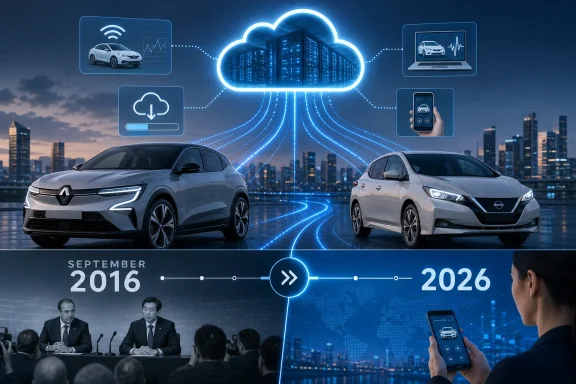 The announcement dates to September 2016, not August 2026
Microsoft’s original news release is dated September 26, 2016 and identifies the counterpart as the Renault-Nissan Alliance, before Mitsubishi Motors was formally incorporated into the alliance’s connected-vehicle effort. Reuters reported the same day that Renault and Nissan were turning to Microsoft for cloud services as part of their then-ambitious autonomous-driving plans.The supplied article’s headline closely matches Reuters’ 2016 wording, including its focus on “connected car technology.” But neither Microsoft nor Renault-Nissan has announced a new version of that partnership dated August 3, 2026 in the material available on the public record. The publication date attached to the resurfaced story is therefore misleading.
This is a familiar problem with vehicle-technology news. An automaker can sign a cloud agreement years before a buyer sees the related service in a car, and the services can be altered, region-limited, paid, discontinued, or moved to a different technical stack afterward. Reposting the signing announcement without its 2016 date erases the most useful information: whether drivers can buy or use anything new today.
Azure was intended as the back-end, not the car’s operating system
The 2016 agreement covered cloud-connected services rather than a Microsoft-built in-car operating system. Microsoft said Azure would underpin advanced navigation, predictive maintenance, remote monitoring of vehicle features, mobile applications, over-the-air updates, and services related to remote diagnostics and preventive maintenance.In practical terms, Azure was positioned as the control plane behind the car: a scalable place to ingest telemetry, run analytics, manage customer identities and service requests, and distribute data or software to vehicles. That is materially different from Windows running the dashboard. The original announcement also stressed that Azure supported multiple operating systems, development languages, and tools, a sign that Renault and Nissan wanted a shared back-end without committing every screen, ECU, or supplier to Microsoft software.
For IT professionals, the appeal is obvious. A global manufacturer selling across multiple markets does not want a separate hosted service, data pipeline, authentication model, and update mechanism for every brand and model year. Consolidating those functions can reduce the cost of maintaining legacy telematics systems and can make fleet-scale diagnostics possible.
It also creates a long-lived dependency. Once remote lock, vehicle location, battery-status reporting, service reminders, or firmware delivery run through a central cloud platform, the useful life of those functions depends on three separate things: the automaker continuing the service, the vehicle retaining a working cellular connection, and the owner’s account remaining eligible. The announcement spoke broadly about convenience and personalization, but it did not disclose service terms, regional availability, subscription pricing, retention periods for vehicle data, or what customers could expect when older networking hardware was retired.
The partnership did reach production vehicles
The 2016 deal was not merely a press-release exercise. In January 2017, Microsoft described Renault-Nissan as the first automaker to commit to its Microsoft Connected Vehicle Platform, the Azure-based set of services designed for automakers to assemble their own connected offerings.The next major milestone came on March 20, 2019, when Renault-Nissan-Mitsubishi announced the Alliance Intelligent Cloud. Microsoft and Mitsubishi Motors said the jointly developed Azure platform would first power connected services in the all-new Renault Clio and selected Nissan Leaf models sold in Europe and Japan later that year.
That launch provides the missing outcome behind the 2016 reporting. Renault-Nissan’s announcement was followed by a production-oriented platform, and not simply by a research project. The Alliance Intelligent Cloud was intended to consolidate multiple connected-vehicle solutions under one infrastructure spanning almost 200 markets, with cloud, AI, and Internet of Things components supplied through Azure.
However, the early rollout scope was more concrete than the global rhetoric. The first named vehicles were a new Renault Clio and selected Nissan Leaf models, with Europe and Japan explicitly identified. The United States was not named in the 2019 launch announcement. This matters for WindowsForum readers because a headline about Renault and Nissan can imply broad North American relevance when Renault has not sold its core Renault passenger-car line in the U.S. market and the cited rollout did not promise U.S. availability.
“Connected” services carry a support-life obligation
The 2016 statements included features that are operationally significant: vehicle location, remote access, remote diagnostics, predictive maintenance, and even functionality intended to help locate a stolen car and disable it at an appropriate opportunity. These functions move part of the ownership experience from hardware installed in the vehicle to services operated outside it.Automakers have learned that a connected service cannot be treated like a one-time vehicle option. Cellular-network retirements can strand telematics control units. App platforms can be retired. Owners may find that remote climate controls, charge scheduling, trip information, or location services vanish even though the car itself remains mechanically sound.
Nissan’s own support material for older Leaf and e-NV200 vehicles illustrates the point. The NissanConnect EV app service for Leaf vehicles produced through May 2019 and e-NV200 models produced through 2022 is scheduled to cease on March 30, 2026 in the affected market. That notice is not proof that Azure itself failed; it is evidence that connected functionality has an end-of-service lifecycle independent of the vehicle’s ability to drive.
The original Renault-Nissan-Microsoft announcement did not set an end-of-support policy for the resulting services, nor did it say whether owners would receive hardware upgrades as wireless standards changed. Such omissions were common in 2016, but they are hard to ignore now. A cloud-connected vehicle should be evaluated partly as a service subscription with hardware attached, even when the features are bundled into the purchase price at launch.
The autonomous-driving timetable was much more aggressive than reality
Reuters framed the 2016 Azure deal against Renault-Nissan’s plan to launch more than 10 vehicles with autonomous-drive technology by 2020. The Alliance had separately announced that target in January 2016, describing planned availability in the United States, Europe, Japan, and China.Those words require careful reading. “Autonomous drive technology” in an automaker roadmap did not mean that ten consumer models would operate as unrestricted driverless vehicles. The company’s offerings were driver-assistance systems, and Nissan’s subsequent 2020 business plan described an intention to introduce its ProPILOT system in more than 20 models across 20 markets by the end of fiscal 2023. That later date and framing show the shift from a broad 2020 autonomy message toward staged advanced-driver-assistance deployment.
Cloud connectivity is useful to advanced driver-assistance development because it supports telemetry collection, fleet diagnostics, map and service updates, and continuous improvement of vehicle software. It does not, by itself, solve perception, decision-making, safety validation, legal liability, or the requirement for a human driver to supervise the car. The 2016 partnership should therefore be understood as enabling infrastructure, not as proof that Renault or Nissan had solved autonomous driving.
What readers should take from the resurfaced report
Renault, Nissan, and Microsoft did establish a real connected-vehicle partnership, and it produced the Azure-based Alliance Intelligent Cloud rollout announced in 2019. The meaningful news was the move to centralize back-end connected services across alliance brands and markets, beginning with named vehicles in Europe and Japan.But this is historical reporting, not a fresh 2026 strategic move. Anyone assessing a current Renault, Nissan, or Mitsubishi vehicle should look past the old partnership headline and verify the specific model year, market, telematics hardware, app availability, renewal cost, cellular-support date, and remote-service terms. In connected vehicles, the cloud agreement is only the beginning; the support policy determines how long the promised features remain usable.
References
- Primary source: eghtesadonline.com
Published: 2026-08-03T00:30:08.719556
Loading…
www.eghtesadonline.com - Related coverage: news.microsoft.com
Loading…
news.microsoft.com - Related coverage: microsoft.com
Loading…
www.microsoft.com - Related coverage: microsoft.com
Loading…
www.microsoft.com - Related coverage: news.microsoft.com
Loading…
news.microsoft.com - Related coverage: prnewswire.co.uk
Loading…
www.prnewswire.co.uk - Related coverage: foxbusiness.com
Loading…
www.foxbusiness.com - Related coverage: ca.sports.yahoo.com
Loading…
ca.sports.yahoo.com - Related coverage: be.media.renaultgroup.com
Loading…
be.media.renaultgroup.com - Related coverage: noticias.uol.com.br
Loading…
noticias.uol.com.br - Related coverage: nissan-global.com
Loading…
www.nissan-global.com - Related coverage: nissan-global.com
Loading…
www.nissan-global.com - Related coverage: download.microsoft.com
- Related coverage: alliance-renault-nissan.com
Loading…
www.alliance-renault-nissan.com - Related coverage: be.media.renaultgroup.com
Loading…
be.media.renaultgroup.com - Related coverage: windowsreport.com
Loading…
www.windowsreport.com - Related coverage: download.microsoft.com
Loading…
download.microsoft.com - Related coverage: digitaltrends.com
Loading…
www.digitaltrends.com - Related coverage: media.renaultgroup.com
Loading…
media.renaultgroup.com - Related coverage: press.mitsubishi.pl
Loading…
press.mitsubishi.pl - Related coverage: media.renaultgroup.com
Loading…
media.renaultgroup.com - Related coverage: renaultgroup.com
Loading…
www.renaultgroup.com - Related coverage: autotechinsight.spglobal.com
Loading…
autotechinsight.spglobal.com - Related coverage: blogs.microsoft.com
Loading…
blogs.microsoft.com - Related coverage: assets.renaultgroup.com
Loading…
assets.renaultgroup.com - Related coverage: nissan.com.cn
Loading…
www.nissan.com.cn - Related coverage: presse.renault.de
Loading…
presse.renault.de - Related coverage: alliance-renault-nissan.com
Loading…
www.alliance-renault-nissan.com - Related coverage: nissan.com.my
Loading…
nissan.com.my - Related coverage: nissan.com.my
Loading…
nissan.com.my - Related coverage: annualreports.com
Loading…
www.annualreports.com