
TwistedVoxel reported the new requirements on August 14, but Steam itself now carries the same minimum and recommended configurations on the game’s official store page. Focus Entertainment lists the game for PC alongside PlayStation 5 and Xbox Series X|S, while confirming an August 27 release. It will also arrive in Xbox Game Pass on day one and support Xbox Play Anywhere, according to Focus’s June launch announcement.
The immediate takeaway is encouraging for owners of midrange PCs from the late 2010s and early 2020s: the published minimum target is 1080p at 30 frames per second on Low, while the recommended target is 1080p at 60 fps on Ultra. But those targets are only useful when read exactly as written. Steam does not say whether either target uses native rendering, dynamic resolution, DLSS, FSR, XeSS, or frame generation. Claims that the results are specifically “without upscaling or frame generation” go beyond what the current official store entry states.
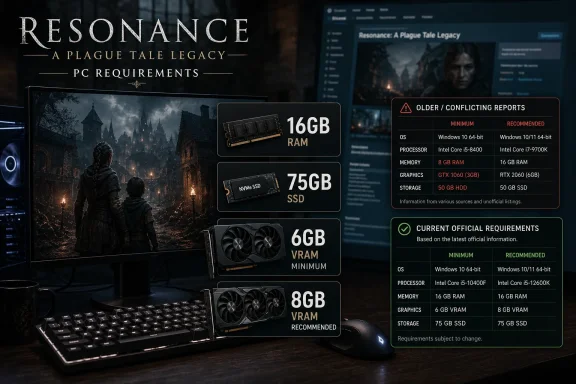 The current Steam requirements
The minimum specification is built around an AMD Ryzen 3 3100 or Intel Core i3-12100, 16GB of RAM, and either an AMD Radeon RX 5500 XT or Nvidia GeForce GTX 1060. Steam specifies 6GB of VRAM, Windows 10 or Windows 11 in 64-bit form, DirectX 12, and 75GB of available space.
The listing adds three requirements that are easy to overlook in comparison tables:
- An SSD is required rather than merely recommended.
- The processor must have at least four cores and eight threads.
- The graphics hardware must support DirectX 12.1 and Shader Model 6.6.
For its minimum benchmark, Steam specifies 1920×1080 resolution, the Low preset, and 30 fps. That is a playability floor, not a promise of a consistently high-refresh experience. Players on 120Hz or 144Hz displays should not mistake a “minimum” label for a configuration suited to their screen’s refresh rate.
The recommended tier retains 16GB of RAM and 75GB of SSD storage but raises the CPU requirement to a Ryzen 5 5600X or Core i5-12400F. On the GPU side, Steam names the Radeon RX 6700 XT and GeForce RTX 3060 Ti, with at least 8GB of VRAM. Its stated target is 1080p, 60 fps, and the Ultra preset.
Those recommendations have practical limits. An RTX 3060 Ti fits the 8GB figure precisely, but the RX 6700 XT actually carries 12GB of VRAM. The listing is therefore establishing an 8GB minimum for the class of GPU rather than implying that both named cards have equal memory capacity. It also provides no equivalent Intel Arc model, no 1440p tier, no 4K tier, and no ray-tracing performance target.
Watch the VRAM capacity, not only the card name
The 6GB VRAM minimum is more restrictive than the card names alone may suggest. Nvidia sold both 3GB and 6GB versions of the GeForce GTX 1060; only the 6GB card satisfies Steam’s explicit memory requirement. Likewise, the Radeon RX 5500 XT was sold in 4GB and 8GB versions. A 4GB RX 5500 XT is below the stated VRAM floor even though it carries the same product name as the listed card.
That distinction matters particularly for second-hand upgrades. A search result or local listing that says “GTX 1060” or “RX 5500 XT” is insufficient. Buyers should check the precise VRAM configuration before treating those GPUs as compatible. Steam’s wording makes memory capacity a separate condition, not a rough suggestion.
The processor guidance is similarly more useful than a generic “quad-core CPU required” label. The Ryzen 3 3100 is a four-core, eight-thread Zen 2 processor, while the Core i3-12100 is a four-core, eight-thread Alder Lake chip. Systems with four physical cores but only four threads do not meet the developer’s stated threshold, even if their clock speeds appear competitive on paper.
The storage requirement also deserves budgeting beyond the raw 75GB. Windows needs free space for temporary files, shader caches, paging, patches, and restore points. Installing a game listed at 75GB onto an SSD with only 75GB remaining is a reliable way to invite update failures and degraded system behavior. Leaving additional space on the drive is not an optional luxury for a modern Windows gaming PC.
The numbers have changed—or the public information has not caught up
The complication is that the current Steam specifications are not the only set published for Resonance. Polish hardware outlet PurePC reported a substantially more demanding chart on June 24, attributing it to Asobo Studio. That table listed a Ryzen 3 3100 and Core i3-12100 for minimum CPU requirements, but paired them with an RTX 2060 or Radeon RX 5600 XT, 79GB of SSD space, and a 1080p Low 30 fps target. Its recommended tier was far higher: a Ryzen 5 7600X or Core i5-12600K with an RTX 3080 or Radeon RX 7800 XT for 1080p Ultra at 60 fps.
AMD’s current game-promotion page adds a third, incompatible set of numbers. It recommends a Ryzen 5 3600 and Radeon RX 5700 XT at the minimum end, then a Ryzen 7 5800X and Radeon RX 6800 at the recommended end. AMD’s page says 50GB of storage, describes an SSD as recommended at minimum and required at recommended, and does not include resolution or performance targets.
Those three configurations cannot all describe the same testing standard. The active Steam page is the only source directly tied to the PC version’s pre-purchase storefront and is therefore the one prospective players should use. But Focus Entertainment and Asobo have not published a visible explanation for the mismatch, a revised-requirements notice, or an accompanying testing methodology.
That omission leaves meaningful questions unanswered. If Steam’s current recommended target supersedes the June chart reported by PurePC, it represents a major reduction in GPU and CPU requirements for 1080p Ultra. If the old chart used a different rendering configuration, build, scene, or internal benchmark, neither developer nor publisher has said so. AMD’s 50GB listing appears particularly stale beside Steam’s present 75GB requirement.
Until Asobo clarifies the record, readers should avoid treating older requirement tables as launch guidance and should also avoid assuming that any one published 60 fps number translates automatically to every location in the game.
What the listing does—and does not—promise
There are two good signs in the present specification. First, the 16GB RAM requirement is unchanged between minimum and recommended tiers. That means 16GB remains the advertised standard configuration rather than a bare-minimum compromise, although players who multitask heavily with browsers, recording tools, mods, or background applications may still benefit from 32GB.
Second, the recommended GPUs are no longer flagship-era hardware. The RTX 3060 Ti and RX 6700 XT are much more attainable reference points than the RTX 3080 and RX 7800 XT named in PurePC’s June report. That could make Resonance less intimidating for owners of established 1080p gaming systems—if the Steam listing holds through release.
There is no reason yet to extrapolate those 1080p targets to higher resolutions. The listing does not promise 1440p at 60 fps, 4K operation, ultrawide support, or a particular frame rate with maximum effects enabled. It also does not state whether the game will provide built-in benchmark tools, shader-compilation options, adjustable texture-memory settings, ray tracing, or any vendor-specific upscaling technologies.
Those omissions are normal for a pre-launch store page, but they matter more here because the game’s publicly visible requirements have already varied. The benchmark review period after release will be the first opportunity to compare the stated tiers against repeatable gameplay results across Nvidia, AMD, and Intel hardware.
A PC readiness check before August 27
For a Windows gaming PC that already meets the current recommended tier, the sensible preparation is straightforward: update the GPU driver shortly before launch, confirm adequate free SSD space, and verify that the system is actually using the discrete GPU rather than integrated graphics. Laptop owners should be particularly careful, as a desktop RTX 3060 Ti or RX 6700 XT is not directly comparable to every mobile GPU sharing a similar name.
For systems near the minimum tier, the important check is the full combination of 16GB RAM, an SSD, four cores and eight threads, and a GPU with both the required feature support and sufficient VRAM. Replacing only one part may not resolve a shortfall elsewhere. A machine with a 3GB GTX 1060, a 4GB RX 5500 XT, an HDD-only game drive, or a four-thread processor remains outside the current specification even if another component looks close.
Resonance: A Plague Tale Legacy is scheduled to unlock on August 27, thirteen days after Steam posted the current details. Unless Asobo or Focus publishes a clarifying update before then, Steam’s 75GB SSD, 16GB RAM, 6GB minimum-VRAM and 8GB recommended-VRAM requirements are the figures to plan around—and the older, conflicting charts should be treated as historical rather than definitive.
