
The modder’s premise was brutally simple: remove the copper cold plate, thermal paste, and most of the water block, then make the coolant itself the material touching the silicon. A 3D-printed chamber fastened to the original cooler’s retention points routed water across the bare die. It leaked during early work on a dead RTX 3060, then leaked again around its tubing fittings after the central seal was improved. Epoxy, gaskets, washers, hose clamps, and a PCIe riser cable eventually turned the rig into a live test bench rather than an immediate electronics casualty.
The headline number is real within that experiment. The broader lesson is narrower: the dangerous part of a GPU water block is not the copper base; it is the seal. TrashBench removed the copper interface while retaining the same difficult engineering problem that commercial blocks spend most of their design effort solving.
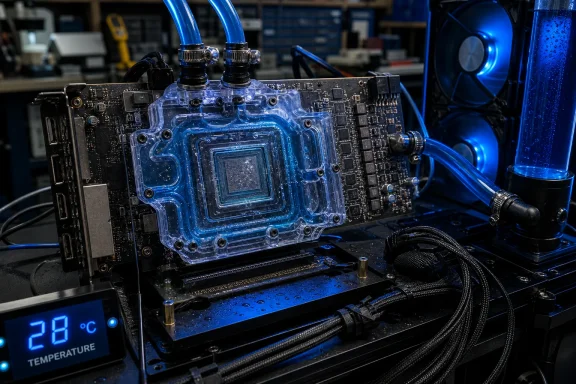 A 28°C GPU Core Is Not a Complete Cooling Result
A 42°C drop against the stock cooler is a striking figure, and a 28°C reported core temperature under Heaven suggests that direct liquid contact can move heat away from a small GPU die very quickly. The 8°C lead over the improvised AIO mount is more revealing than the stock comparison because both were liquid-cooling arrangements. But it is also the comparison that needs more control before anyone can call the direct-water design superior in a general sense.
The published results do not provide a complete thermal test methodology: coolant temperature, ambient temperature, flow rate, radiator capacity, pump specification, GPU power draw, hotspot temperature, memory temperature, VRM temperature, noise level, run duration, and repeated-run variance are all necessary to turn one eye-catching graph into a useful cooler comparison. Heaven is also an aging benchmark with a workload profile that does not necessarily expose the limits of GPU power delivery or memory cooling the way a long modern game, a stress test, or a compute workload might.
That omission is important because the 28°C number may reflect more than the absence of copper. A conventional water block has a cold plate, internal microfins or channels, a carefully controlled standoff height, a seal around the die area, and usually thermal pads or a secondary plate for memory and power components. TrashBench’s test is best read as a comparison between three entire cooling assemblies, not an isolated measurement of whether water beats copper at the die surface.
Direct water contact reduces the layers between the silicon package and coolant. In a normal loop, heat crosses the die surface, thermal paste, copper cold plate, then coolant. Removing paste and copper can reduce interface resistance if the water chamber maintains close, even contact and high flow. But those same parts also distribute clamping pressure, keep fluid contained, and make it possible to cool nearby components without spraying coolant across an energized PCB.
The project demonstrates the thermal upside of eliminating an interface. It does not show that copper was the reason a normal water block ran warmer, nor that an engineered direct-die block using the same pump, coolant temperature, flow rate, and measurement method would sustain an 8°C advantage.
The Leaks Were the Result, Not a Footnote
TrashBench did the sensible thing by starting on a non-working RTX 3060. The initial 3D-printed block leaked, and after the central chamber was sealed with epoxy, the tube fittings became a second leak path. Those failures are not a minor early-stage inconvenience; they are the central finding of the experiment.
A GPU die is surrounded by tiny surface-mounted components, solder joints, capacitors, resistors, exposed traces, and power circuitry. TrashBench coated nearby components with nail polish as an insulating measure and used a PCIe riser to keep the GPU physically away from the motherboard during powered testing. Those precautions reduced the consequences of a leak, but neither changes the fact that the card was operated outside the conditions Nvidia specifies for GeForce hardware. Nvidia’s RTX 2060 Super documentation explicitly warns users not to operate the product near water.
Water also does not stay electrically benign just because it began clean. Once it travels through tubing, fittings, pumps, radiators, 3D-printed surfaces, metal connectors, dust, and residues left on a PCB, it can accumulate contaminants. The immediate risk is an electrical short. The slower risk is corrosion, residue, degradation of coatings or adhesives, and a failure that appears weeks or months later rather than during a successful benchmark run.
There is an added weak point here that conventional blocks avoid: 3D-print porosity and layer seams. TrashBench found that print material selection was not cosmetic; some materials seeped at edges while others were slightly porous. That means the block body itself can be part of the leak path even when the gasket and fittings appear sound. Epoxy may solve an individual prototype, but it turns a serviceable cooling loop into a permanently bonded experiment whose reliability depends on adhesion, thermal cycling, and material compatibility.
A commercial block can leak too, of course. The difference is that it is designed around sealing surfaces, specified fasteners, known materials, pressure-tested fittings, and a geometry that isolates coolant from the board. TrashBench’s device uses the GPU’s existing mounting system for retention, but that system was designed to compress a heatsink or cold plate against a die, not to contain pressurized fluid in a printed chamber.
GPU Cooling Includes More Than the GPU Die
The main visual trick works because the GPU core is the easiest component to identify and measure. Yet the graphics processor is only one thermal problem on an RTX 2060 Super board. GDDR6 memory chips and the voltage-regulator modules need cooling too, particularly under prolonged gaming, rendering, or overclocking loads.
A stock GPU cooler manages those parts with baseplate contact, thermal pads, heatsink surface area, and airflow. A full-cover water block generally does it with precisely placed cold plates and pads. A die-only chamber can produce an excellent reported GPU core temperature while leaving memory and VRM temperatures unmeasured, poorly cooled, or dependent on incidental airflow.
That is why the missing hotspot, VRM, and memory data matters more than another few degrees of core temperature. A stable 28°C GPU core does not prove the card is thermally healthy as a whole. It simply proves that the exposed die was cold under the selected test. For a daily-use GPU, the memory and power stages are not optional passengers.
The same applies to performance. Lower temperatures can preserve GPU Boost behavior and create overclocking headroom, but Tom’s Hardware did not report a controlled performance or clock-speed gain for the RTX 2060 Super direct-water test. Without clocks, power limits, frame rates, and repeated benchmarks, there is no basis for claiming this modification makes the card meaningfully faster. It made the reported core temperature much lower; any performance conclusion remains unproven.
What the Experiment Actually Proves
TrashBench has shown that a carefully aimed flow of coolant across a live, bare GPU die can cool an RTX 2060 Super extremely well for a benchmark run. The project also shows why that idea has not displaced copper water blocks: keeping water precisely where it belongs is harder than removing the metal in the first place.
The 8°C gap versus the improvised AIO mount is interesting enough to justify more rigorous testing. The next useful version would retain a purpose-built sealed chamber but add coolant inlet and outlet temperature probes, a fixed ambient temperature, flow measurement, power logging, GPU hotspot and memory measurements, a controlled conventional-block baseline, and multi-hour soak tests. It would also need to demonstrate that the seal survives repeated heat cycles — not merely that it stays dry for one session.
For everyone else, the actionable takeaway is much less dramatic. If an RTX 2060 Super is running hot, replace aged thermal paste and pads where appropriate, improve case airflow, tune the fan curve, consider an undervolt, or use a compatible air or water cooler designed for the board. A 28°C benchmark screenshot is a memorable achievement; a water-tight GPU still alive after months of normal use is the result that would make this cooling method worth copying.
References
- Primary source: Tom's Hardware
Published: August 9, 2026 at 2:15 PM UTC
Loading…
www.tomshardware.com - Related coverage: techspot.com
Loading…
www.techspot.com - Related coverage: tomshardware.com
Loading…
www.tomshardware.com - Related coverage: nvidia.com
Loading…
www.nvidia.com - Related coverage: videocardz.com
Loading…
videocardz.com - Related coverage: nvidia.com
Loading…
www.nvidia.com