
Japanese retailer Sofmap is warning that restocks of GeForce RTX 5070 Ti and RTX 5080 cards may become unreliable as prices rise, while the RTX 5070 is already selling above ¥110,000 in its market. The immediate message is a retailer’s: buyers who have already decided should not assume the same card will be on the shelf at the same price next week. But the evidence supports a narrower conclusion than the most urgent headlines suggest: Japan’s channel is repricing and stock is tightening; a U.S.-wide RTX 50 shortage has not been established.
TweakTown reported the warning on August 7 after Sofmap’s social-media post, and VideoCardz separately reported that the retailer specifically described future RTX 5070 Ti and RTX 5080 deliveries as unstable. The post followed a documented Japanese distributor notice from CFD Sales that raised prices for Gigabyte graphics cards by an expected 20% to 40% for orders placed from August 1.
For Windows gamers, creators, and local-AI users shopping for an NVIDIA upgrade, the practical implication is straightforward: a card available today at a tolerable price may be the last unit sourced under a distributor’s old terms. What the reports do not show is that every RTX 5070, RTX 5070 Ti, or RTX 5080 has vanished from retail, or that NVIDIA has announced a global allocation cut.
Sofmap’s notice says GeForce RTX sales accelerated following reports of higher prices and component constraints. According to VideoCardz’s account of the post, the retailer highlighted the RTX 5070 Ti and RTX 5080 as models whose future shipments could become inconsistent, while advising customers who already intend to buy not to wait.
That distinction is material. A retailer saying its future deliveries are unstable is reporting what it sees in its own purchasing channel; it is not evidence that NVIDIA has discontinued those products, reduced worldwide output, or placed the entire RTX 50 family on allocation. Sofmap also used the moment to point customers toward used graphics cards, where it offers members a three-month initial-defect warranty. That is a commercial response to a higher-priced new-card market, and it suggests the store expects price-sensitive buyers to stay in the market rather than simply absorb another new-card increase.
TweakTown’s headline includes the RTX 5070 alongside the RTX 5070 Ti and RTX 5080. The underlying reporting is more precise: VideoCardz says the RTX 5070 has climbed past ¥110,000 in Japan, while the specific warning about irregular future supply was directed at the Ti and 5080 models. That does not make the RTX 5070 immune to price pressure, but it does mean buyers should not read the Sofmap notice as confirmation that all three SKUs face the same restocking status.
The retailer has not published shipment quantities, a list of affected add-in-board brands, a timetable for replenishment, or a benchmark price for the next shipment. Those omissions matter more than the word “hurry.” Without them, nobody outside Sofmap can calculate whether the store is facing a short delay, a few missing board-partner models, or a sustained reduction in availability.
That is a consequential shift because it changes the value of inventory already sitting in stores. Boards obtained before the distributor’s revised pricing can remain available at the old shelf price until they sell. The next batch, however, may arrive at a substantially higher wholesale cost, and retailers have little incentive to preserve an earlier price once replacement inventory costs more.
The notice applies to Gigabyte cards distributed through CFD Sales in Japan. It does not itself prove identical increases at Asus, MSI, PNY, Zotac, or other board partners, nor does it set U.S. pricing. Yet it is more concrete than generalized claims that “graphics cards are getting more expensive,” because it names the distributor, the manufacturer, the effective date, and the expected scale of the adjustment.
There is corroborating evidence that this is not an isolated Japanese retail event. Tom’s Hardware also reported price increases of up to 30% for desktop RTX 50-series cards in South Korea, citing local importer and distributor sources. The report tied the rise to more expensive advanced-node wafers and GDDR7 memory, and listed the lowest RTX 5070 price in that market at roughly 1.1 million won, about $770 at the reported conversion.
Those regional reports do not establish a single coordinated global retail price. They do show that board partners and distributors in multiple Asian markets are working through higher costs at roughly the same time. That raises the risk that replacement pricing will travel, even if it arrives unevenly by country, brand, and model.
GDDR6 price pressure can affect other GeForce and Radeon products, particularly older or lower-tier designs. It is not the direct memory type inside the three desktop RTX 50-series cards at the center of Sofmap’s warning. For this trio, the relevant component cost is GDDR7.
That correction changes how the story should be read. The RTX 5070 is a 12GB card on a 192-bit memory interface, whereas the RTX 5070 Ti and RTX 5080 each use 16GB across a 256-bit interface. If GDDR7 becomes more expensive or harder to secure, the two 16GB products expose board makers to more memory content per card. That does not guarantee that the 5070 Ti or 5080 will rise by a larger percentage than the RTX 5070 — cooler design, GPU package pricing, exchange rates, and retailer margins also matter — but it explains why higher-end 16GB models are especially exposed to a GDDR7 shock.
NVIDIA launched the RTX 5080 at $999, the RTX 5070 Ti at $749, and the RTX 5070 at $549. Those are launch MSRPs, not price ceilings. They also apply most cleanly to baseline models; factory-overclocked cards with oversized coolers and premium board designs routinely start higher even before a supply squeeze.
The result is a damaging form of price compression. When an RTX 5070 starts moving far above its $549 reference point, it begins encroaching on the level at which shoppers would normally weigh an RTX 5070 Ti. When the Ti moves up as well, the buyer does not get a better deal by climbing the stack; the entire comparison moves upward.
That is the best available dividing line as of August 7: price pressure is visible and formally documented in Japan, while no broad U.S. distributor announcement has been publicly confirmed. Buyers should therefore distinguish between a normal retail price increase and opportunistic listings built around fear.
A sensible purchase decision depends on whether the card is needed now and whether the current price is defensible against alternatives. The RTX 5070 Ti and RTX 5080 have the same 16GB GDDR7 capacity, while the RTX 5070 has 12GB. For users running larger local models, GPU-accelerated creative workloads, or memory-heavy games at higher settings, the 16GB models retain a practical advantage. For a gaming PC that already performs adequately, paying a panic premium for a 12GB RTX 5070 simply because a Japanese retailer expects uncertain deliveries is harder to justify.
The missing information is still the key one: NVIDIA has not publicly announced a new MSRP, a production reduction for these desktop cards, or a region-by-region supply plan. CFD Sales has documented a Japanese Gigabyte pricing change, and Sofmap has warned that its RTX 5070 Ti and RTX 5080 replenishment is uncertain. Until a U.S. distributor or major retailer publishes comparable terms, the evidence supports buying a fairly priced in-stock card if the upgrade is already planned — not treating every RTX 50 listing as the last chance to buy one.
For Windows gamers, creators, and local-AI users shopping for an NVIDIA upgrade, the practical implication is straightforward: a card available today at a tolerable price may be the last unit sourced under a distributor’s old terms. What the reports do not show is that every RTX 5070, RTX 5070 Ti, or RTX 5080 has vanished from retail, or that NVIDIA has announced a global allocation cut.
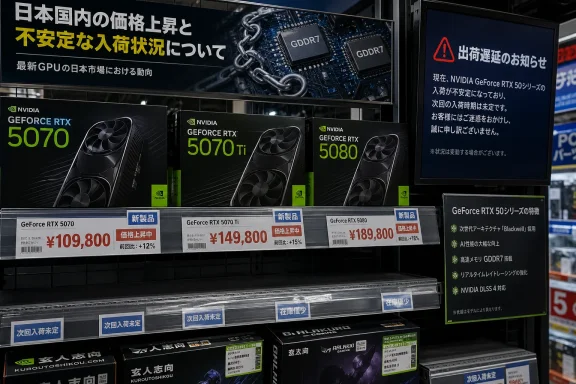 Sofmap’s Warning Is About Restock Predictability, Not an Official End of Supply
Sofmap’s notice says GeForce RTX sales accelerated following reports of higher prices and component constraints. According to VideoCardz’s account of the post, the retailer highlighted the RTX 5070 Ti and RTX 5080 as models whose future shipments could become inconsistent, while advising customers who already intend to buy not to wait.That distinction is material. A retailer saying its future deliveries are unstable is reporting what it sees in its own purchasing channel; it is not evidence that NVIDIA has discontinued those products, reduced worldwide output, or placed the entire RTX 50 family on allocation. Sofmap also used the moment to point customers toward used graphics cards, where it offers members a three-month initial-defect warranty. That is a commercial response to a higher-priced new-card market, and it suggests the store expects price-sensitive buyers to stay in the market rather than simply absorb another new-card increase.
TweakTown’s headline includes the RTX 5070 alongside the RTX 5070 Ti and RTX 5080. The underlying reporting is more precise: VideoCardz says the RTX 5070 has climbed past ¥110,000 in Japan, while the specific warning about irregular future supply was directed at the Ti and 5080 models. That does not make the RTX 5070 immune to price pressure, but it does mean buyers should not read the Sofmap notice as confirmation that all three SKUs face the same restocking status.
The retailer has not published shipment quantities, a list of affected add-in-board brands, a timetable for replenishment, or a benchmark price for the next shipment. Those omissions matter more than the word “hurry.” Without them, nobody outside Sofmap can calculate whether the store is facing a short delay, a few missing board-partner models, or a sustained reduction in availability.
The Japanese Price Increase Has a Paper Trail
The stronger part of this story is not the retailer’s urgency language. It is CFD Sales’ notice to customers that Gigabyte VGA products would be repriced for orders beginning August 1, 2026. Tom’s Hardware reported the distributor projected pricing at roughly 120% to 140% of current levels — effectively a 20% to 40% increase — and said the distributor would cancel outstanding orders that could not be fulfilled at the old price.That is a consequential shift because it changes the value of inventory already sitting in stores. Boards obtained before the distributor’s revised pricing can remain available at the old shelf price until they sell. The next batch, however, may arrive at a substantially higher wholesale cost, and retailers have little incentive to preserve an earlier price once replacement inventory costs more.
The notice applies to Gigabyte cards distributed through CFD Sales in Japan. It does not itself prove identical increases at Asus, MSI, PNY, Zotac, or other board partners, nor does it set U.S. pricing. Yet it is more concrete than generalized claims that “graphics cards are getting more expensive,” because it names the distributor, the manufacturer, the effective date, and the expected scale of the adjustment.
There is corroborating evidence that this is not an isolated Japanese retail event. Tom’s Hardware also reported price increases of up to 30% for desktop RTX 50-series cards in South Korea, citing local importer and distributor sources. The report tied the rise to more expensive advanced-node wafers and GDDR7 memory, and listed the lowest RTX 5070 price in that market at roughly 1.1 million won, about $770 at the reported conversion.
Those regional reports do not establish a single coordinated global retail price. They do show that board partners and distributors in multiple Asian markets are working through higher costs at roughly the same time. That raises the risk that replacement pricing will travel, even if it arrives unevenly by country, brand, and model.
The GDDR6 Explanation Does Not Fit These Three RTX 50 Cards
One detail in the coverage needs correcting. TweakTown described a DRAM squeeze affecting both GDDR6 and GDDR7 memory in the same report that named the RTX 5070, RTX 5070 Ti, and RTX 5080. NVIDIA’s own specifications show that all three of those desktop Blackwell cards use GDDR7, not GDDR6: the RTX 5070 carries 12GB, and the RTX 5070 Ti and RTX 5080 each carry 16GB.GDDR6 price pressure can affect other GeForce and Radeon products, particularly older or lower-tier designs. It is not the direct memory type inside the three desktop RTX 50-series cards at the center of Sofmap’s warning. For this trio, the relevant component cost is GDDR7.
That correction changes how the story should be read. The RTX 5070 is a 12GB card on a 192-bit memory interface, whereas the RTX 5070 Ti and RTX 5080 each use 16GB across a 256-bit interface. If GDDR7 becomes more expensive or harder to secure, the two 16GB products expose board makers to more memory content per card. That does not guarantee that the 5070 Ti or 5080 will rise by a larger percentage than the RTX 5070 — cooler design, GPU package pricing, exchange rates, and retailer margins also matter — but it explains why higher-end 16GB models are especially exposed to a GDDR7 shock.
NVIDIA launched the RTX 5080 at $999, the RTX 5070 Ti at $749, and the RTX 5070 at $549. Those are launch MSRPs, not price ceilings. They also apply most cleanly to baseline models; factory-overclocked cards with oversized coolers and premium board designs routinely start higher even before a supply squeeze.
The result is a damaging form of price compression. When an RTX 5070 starts moving far above its $549 reference point, it begins encroaching on the level at which shoppers would normally weigh an RTX 5070 Ti. When the Ti moves up as well, the buyer does not get a better deal by climbing the stack; the entire comparison moves upward.
U.S. Buyers Should Watch Replacement Prices, Not Japanese Shelf Labels
The Sofmap warning is real, but it is not a reason for U.S. buyers to pay any asking price for a random marketplace listing. Japan’s distribution chain, consumption tax, currency conditions, product mix, and board-partner arrangements differ from North American retail. Tom’s Hardware reported on August 4 that one U.S. retailer had not received a formal notice of graphics-card price adjustments, even though it had heard reports from Taiwan of NVIDIA-related increases.That is the best available dividing line as of August 7: price pressure is visible and formally documented in Japan, while no broad U.S. distributor announcement has been publicly confirmed. Buyers should therefore distinguish between a normal retail price increase and opportunistic listings built around fear.
A sensible purchase decision depends on whether the card is needed now and whether the current price is defensible against alternatives. The RTX 5070 Ti and RTX 5080 have the same 16GB GDDR7 capacity, while the RTX 5070 has 12GB. For users running larger local models, GPU-accelerated creative workloads, or memory-heavy games at higher settings, the 16GB models retain a practical advantage. For a gaming PC that already performs adequately, paying a panic premium for a 12GB RTX 5070 simply because a Japanese retailer expects uncertain deliveries is harder to justify.
The missing information is still the key one: NVIDIA has not publicly announced a new MSRP, a production reduction for these desktop cards, or a region-by-region supply plan. CFD Sales has documented a Japanese Gigabyte pricing change, and Sofmap has warned that its RTX 5070 Ti and RTX 5080 replenishment is uncertain. Until a U.S. distributor or major retailer publishes comparable terms, the evidence supports buying a fairly priced in-stock card if the upgrade is already planned — not treating every RTX 50 listing as the last chance to buy one.
References
- Primary source: TweakTown
Published: August 7, 2026 at 5:59 AM UTC
Loading…
www.tweaktown.com - Related coverage: guru3d.com
Loading…
www.guru3d.com - Related coverage: gazlog.com
Loading…
gazlog.com - Related coverage: nvidia.com
NVIDIA GeForce RTX 5080 Graphics Cards
Gear up for game-changing experiences with the NVIDIA GeForce RTX 5080 and AI-powered DLSS 4. Built with NVIDIA Blackwell.www.nvidia.com - Related coverage: nvidia.com
Loading…
www.nvidia.com - Related coverage: marketplace.nvidia.com
Loading…
marketplace.nvidia.com - Related coverage: images.nvidia.com