
BGR’s explanation of Nvidia Founders Edition cards gets the broad buying distinction partly right — an Asus, MSI, Gigabyte, or PNY model can add its own cooler, board design, power limits, and factory tuning — but it misstates what “Founders Edition” means and uses an RTX 5090 comparison that reverses the clock-speed facts.
A Founders Edition card is Nvidia’s own branded retail implementation of a GeForce GPU. It is not called Founders Edition because it is physically manufactured first, and Nvidia has never presented the label as a production-order designation. The term arrived with the GeForce GTX 1080 and GTX 1070 in May 2016, when Nvidia replaced much of its consumer-facing “reference card” language with the new branding. Contemporary reporting from Tom’s Hardware confirmed that those cards were not limited runs and were intended to remain available through the product lifetime.
For Windows PC builders, the useful way to read the label is much less romantic: Founders Edition identifies the Nvidia-designed card you are buying, while an add-in-board partner, or AIB, card identifies the particular company’s engineering choices around the same Nvidia GPU. Neither label alone tells a buyer which card is faster, quieter, cooler, smaller, or better value.
The RTX 5090 makes that distinction unusually important because Nvidia’s Founders Edition design is not simply a plain baseline board with a generic cooler bolted on.
BGR describes the GeForce RTX 5090 Founders Edition as a two-fan card with 21,760 CUDA cores and a 2.01 GHz “basic” clock, then contrasts it with the Asus TUF RTX 5090’s three fans and a claimed starting clock speed of 2.41 GHz. Nvidia’s and Asus’ own specification sheets show why that comparison does not support the article’s conclusion.
Nvidia lists the RTX 5090 Founders Edition with 21,760 CUDA cores, a 2.01 GHz base clock, and a 2.41 GHz boost clock. Asus lists the standard TUF Gaming GeForce RTX 5090 at a 2.407 GHz default boost clock, or 2.437 GHz in its selectable OC mode. In other words, the stock Asus TUF model’s published boost specification is fractionally below the Founders Edition’s 2.41 GHz figure; its optional OC setting is only 27 MHz higher, roughly a 1% paper difference.
The important error is not a rounding issue. BGR compares Nvidia’s base clock with Asus’ boost clock, then presents the mismatch as proof that the Asus card starts faster. Those are different operating points. Modern Nvidia GPUs dynamically adjust frequency based on workload, temperature, available power, and voltage conditions, so even two models with the same advertised boost clock will not necessarily run at identical sustained clocks inside two different PCs.
The cards do share the elements that determine the RTX 5090’s fundamental capability: the same Blackwell GPU, 21,760 CUDA cores, 32GB of GDDR7 memory, and 512-bit memory interface. They also use the same 575W-class flagship power envelope and call for a 1000W power supply in their official guidance. A three-fan cooler cannot change the underlying GPU into a different performance tier.
It can, however, change how the card behaves under a sustained load. That is the point vendors are selling.
Nvidia itself muddies the terminology. Its RTX 5090 product page says its listed specifications represent the GPU in a “Founders Edition or reference graphics card design,” then warns that board-partner specifications can differ. That statement is adequate for GPU-level facts such as core count, memory capacity, and rated boost clock. It is not a claim that every partner card copies the Founders Edition’s physical construction.
The RTX 5090 Founders Edition is a clear counterexample. Nvidia built it around a compact, centrally positioned main PCB, a separate display-output board connected by flex cable, a dual flow-through cooling arrangement, a vapor chamber, and liquid metal thermal interface material. Gamers Nexus, which tested and tore down the card, found that this arrangement enabled Nvidia to fit a 575W cooler into a nominal two-slot design — an engineering decision that is very much a custom product design, not a generic placeholder for partners to duplicate.
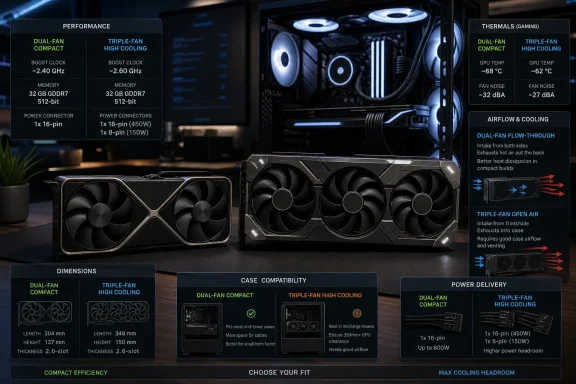
Nvidia’s own dimensions put the Founders Edition at 304 mm long and 137 mm wide. The company still asks builders to reserve the equivalent of three expansion slots and 36 mm of cable clearance, because physical fit is more complicated than the “two-slot” specification on the product sheet suggests.
Asus took a different route with its TUF Gaming RTX 5090. Its card is 348 mm long, 146 mm tall, 72 mm thick, and occupies 3.6 slots. It uses a substantially larger physical envelope, three fans, and includes a support bracket. That is not an inherently superior arrangement; it is a different compromise. The larger card may offer thermal or acoustic headroom in an adequately ventilated ATX tower, but it also rules out many compact cases and can crowd adjacent PCIe slots.
The cooler, dimensions, and case airflow matter more than the number of fans printed on the box. A two-fan design can be excellent; a three-fan design can be loud, obstructive, or poorly tuned. Fan count is a component count, not a benchmark result.
That puts most same-tier Founders Edition-versus-AIB comparisons in perspective. A card sold as an “OC” model may gain some performance in a long gaming load, but a modest advertised clock advantage usually produces a modest real-world frame-rate difference. The purchase decision should not rest on whether one RTX 5090’s box advertises 2.41 GHz and another advertises 2.44 GHz.
Independent testing reinforces where the Founders Edition does and does not distinguish itself. Gamers Nexus measured the RTX 5090 Founders Edition at roughly 72 degrees Celsius on the GPU core in its controlled stress test, a strong result for a compact high-power card. But it also recorded memory temperatures around 89–90 degrees Celsius and flagged that result as less comfortable, particularly for higher-ambient or smaller cases. That is the kind of product-specific tradeoff buyers should evaluate — not an assumption that Nvidia’s own card is automatically the best or that a partner card is automatically an “upgrade.”
A larger Asus TUF, MSI Suprim, Gigabyte Aorus, or water-cooled model can justify its price where it demonstrably improves sustained noise, thermals, fit, BIOS flexibility, or power headroom. It can be a worse purchase if it costs far more, blocks needed expansion slots, does not fit the chassis, or provides only a negligible performance change.
For an RTX 5090 buyer, the decisive question is whether Nvidia’s unusually compact 304 mm Founders Edition suits the case and cooling plan better than a 348 mm, 3.6-slot Asus TUF or another partner design. The silicon is the same. The system integration is where the cards meaningfully diverge.
For Windows PC builders, the useful way to read the label is much less romantic: Founders Edition identifies the Nvidia-designed card you are buying, while an add-in-board partner, or AIB, card identifies the particular company’s engineering choices around the same Nvidia GPU. Neither label alone tells a buyer which card is faster, quieter, cooler, smaller, or better value.
The RTX 5090 makes that distinction unusually important because Nvidia’s Founders Edition design is not simply a plain baseline board with a generic cooler bolted on.
 The RTX 5090 example exposes the real difference
BGR describes the GeForce RTX 5090 Founders Edition as a two-fan card with 21,760 CUDA cores and a 2.01 GHz “basic” clock, then contrasts it with the Asus TUF RTX 5090’s three fans and a claimed starting clock speed of 2.41 GHz. Nvidia’s and Asus’ own specification sheets show why that comparison does not support the article’s conclusion.Nvidia lists the RTX 5090 Founders Edition with 21,760 CUDA cores, a 2.01 GHz base clock, and a 2.41 GHz boost clock. Asus lists the standard TUF Gaming GeForce RTX 5090 at a 2.407 GHz default boost clock, or 2.437 GHz in its selectable OC mode. In other words, the stock Asus TUF model’s published boost specification is fractionally below the Founders Edition’s 2.41 GHz figure; its optional OC setting is only 27 MHz higher, roughly a 1% paper difference.
The important error is not a rounding issue. BGR compares Nvidia’s base clock with Asus’ boost clock, then presents the mismatch as proof that the Asus card starts faster. Those are different operating points. Modern Nvidia GPUs dynamically adjust frequency based on workload, temperature, available power, and voltage conditions, so even two models with the same advertised boost clock will not necessarily run at identical sustained clocks inside two different PCs.
The cards do share the elements that determine the RTX 5090’s fundamental capability: the same Blackwell GPU, 21,760 CUDA cores, 32GB of GDDR7 memory, and 512-bit memory interface. They also use the same 575W-class flagship power envelope and call for a 1000W power supply in their official guidance. A three-fan cooler cannot change the underlying GPU into a different performance tier.
It can, however, change how the card behaves under a sustained load. That is the point vendors are selling.
Founders Edition is no longer synonymous with a bare reference card
Calling every Founders Edition card “the stock model that subsequent versions are based on” is increasingly misleading. There is a difference between a reference specification — Nvidia’s baseline electrical and performance requirements for a GPU — and the particular card Nvidia elects to sell under its own branding.Nvidia itself muddies the terminology. Its RTX 5090 product page says its listed specifications represent the GPU in a “Founders Edition or reference graphics card design,” then warns that board-partner specifications can differ. That statement is adequate for GPU-level facts such as core count, memory capacity, and rated boost clock. It is not a claim that every partner card copies the Founders Edition’s physical construction.
The RTX 5090 Founders Edition is a clear counterexample. Nvidia built it around a compact, centrally positioned main PCB, a separate display-output board connected by flex cable, a dual flow-through cooling arrangement, a vapor chamber, and liquid metal thermal interface material. Gamers Nexus, which tested and tore down the card, found that this arrangement enabled Nvidia to fit a 575W cooler into a nominal two-slot design — an engineering decision that is very much a custom product design, not a generic placeholder for partners to duplicate.
Nvidia’s own dimensions put the Founders Edition at 304 mm long and 137 mm wide. The company still asks builders to reserve the equivalent of three expansion slots and 36 mm of cable clearance, because physical fit is more complicated than the “two-slot” specification on the product sheet suggests.
Asus took a different route with its TUF Gaming RTX 5090. Its card is 348 mm long, 146 mm tall, 72 mm thick, and occupies 3.6 slots. It uses a substantially larger physical envelope, three fans, and includes a support bracket. That is not an inherently superior arrangement; it is a different compromise. The larger card may offer thermal or acoustic headroom in an adequately ventilated ATX tower, but it also rules out many compact cases and can crowd adjacent PCIe slots.
The cooler, dimensions, and case airflow matter more than the number of fans printed on the box. A two-fan design can be excellent; a three-fan design can be loud, obstructive, or poorly tuned. Fan count is a component count, not a benchmark result.
The performance gap is usually small unless the board changes the limits
AIB partners can alter several variables: cooler capacity, heat-sink mass, fan curves, PCB layout, voltage regulation, BIOS options, display outputs, and permitted board power. They can also ship a mild factory overclock. What they cannot do is add CUDA cores or memory bandwidth that Nvidia did not enable for that specific GPU model.That puts most same-tier Founders Edition-versus-AIB comparisons in perspective. A card sold as an “OC” model may gain some performance in a long gaming load, but a modest advertised clock advantage usually produces a modest real-world frame-rate difference. The purchase decision should not rest on whether one RTX 5090’s box advertises 2.41 GHz and another advertises 2.44 GHz.
Independent testing reinforces where the Founders Edition does and does not distinguish itself. Gamers Nexus measured the RTX 5090 Founders Edition at roughly 72 degrees Celsius on the GPU core in its controlled stress test, a strong result for a compact high-power card. But it also recorded memory temperatures around 89–90 degrees Celsius and flagged that result as less comfortable, particularly for higher-ambient or smaller cases. That is the kind of product-specific tradeoff buyers should evaluate — not an assumption that Nvidia’s own card is automatically the best or that a partner card is automatically an “upgrade.”
A larger Asus TUF, MSI Suprim, Gigabyte Aorus, or water-cooled model can justify its price where it demonstrably improves sustained noise, thermals, fit, BIOS flexibility, or power headroom. It can be a worse purchase if it costs far more, blocks needed expansion slots, does not fit the chassis, or provides only a negligible performance change.
What Windows PC builders should actually compare
The Founders Edition name should be treated as a manufacturer and design identifier. Before selecting one against a partner model with the same GPU, compare the practical constraints that affect the finished PC:- Confirm the exact card length, height, thickness, and required connector bend clearance against the case, front-mounted radiator, and nearby PCIe slots.
- Check the power-supply requirement and whether the system has a native high-wattage PCIe 5 power cable or will rely on the included adapter.
- Read reviews that measure sustained gaming noise and temperatures rather than relying on fan count or boost-clock marketing.
- Compare the card’s actual price against the Founders Edition MSRP, because a premium AIB model should provide a measurable benefit for its premium.
- Verify display outputs and physical features such as dual-BIOS switches, fan-stop behavior, included anti-sag support, and warranty terms.
For an RTX 5090 buyer, the decisive question is whether Nvidia’s unusually compact 304 mm Founders Edition suits the case and cooling plan better than a 348 mm, 3.6-slot Asus TUF or another partner design. The silicon is the same. The system integration is where the cards meaningfully diverge.
References
- Primary source: bgr.com
Published: 2026-08-01T03:17:00+00:00
Loading…
www.bgr.com - Related coverage: nvidia.com
NVIDIA GeForce RTX 5090 Graphics Cards
The most powerful GeForce GPU ever made, bringing game-changing capabilities to gamers and creators, powered by the NVIDIA Blackwell architecture.www.nvidia.com - Related coverage: marketplace.nvidia.com
Loading…
marketplace.nvidia.com - Related coverage: asus.com
Loading…
www.asus.com - Related coverage: nvidia.com
Loading…
www.nvidia.com - Related coverage: blogs.nvidia.com
NVIDIA Partners With AI Infrastructure Ecosystem to Unveil Reference Design for Giga-Scale AI Factories | NVIDIA Blog
At this week’s AI Infrastructure Summit in Silicon Valley, NVIDIA’s VP of Accelerated Computing Ian Buck unveiled a bold new vision: the transformation of traditional data centers into fully integrated AI factories. As part of this initiative, NVIDIA is developing reference designs to be shared...blogs.nvidia.com - Related coverage: nvidianews.nvidia.com
NVIDIA Partners with World's Top Server Manufacturers to Advance AI Cloud Computing | NVIDIA Newsroom
Computex -- NVIDIA today launched a partner program with the world's leading original design manufacturers (ODM) -- Foxconn, Inventec, Quanta and Wistron -- to more rapidly meet the demands for AI cloud computing.nvidianews.nvidia.com - Related coverage: tomshardware.com
Graphics Card Face-Off: Founders Edition or Reference GPUs vs 3rd-Party Design | Tom's Hardware
Should you buy a reference or Founders Edition graphics card, or one built around AMD or Nvidia's tech, but made by a third-party partner like MSI or Asus?www.tomshardware.com - Related coverage: blogs.nvidia.com
NVIDIA and Partners Build in America, for America | NVIDIA Blog
NVIDIA and its partners are investing in American manufacturing, supply chains, energy grids and skilled workforces so the U.S. can produce the infrastructure needed for better healthcare, breakthrough scientific discovery, stronger industrial productivity and global technology leadership.blogs.nvidia.com - Related coverage: techspot.com
Nvidia's Founders Edition graphics cards are just reference designs | TechSpot
When Nvidia announced the GeForce GTX 1080 and GTX 1070 on Friday, there was a bit of confusion surrounding the "Founders Edition" cards that were listed alongside...www.techspot.com - Related coverage: nvidia.custhelp.com
- Related coverage: developer.nvidia.com
Powering AI Factories with NVIDIA Enterprise Reference Architectures | NVIDIA Technical Blog
The next wave of enterprise productivity is being built on AI factories. As organizations deploy agentic AI systems capable of reasoning, automation…developer.nvidia.com
- Related coverage: docs.nvidia.com
- Related coverage: nvidianews.nvidia.com
- Related coverage: images.nvidia.com
- Related coverage: tomshardware.com
Nvidia's RTX 5090 Founders Edition just got restocked in the UK, undercuts AIB cards by over £200 — GPU available directly from Nvidia marketplace | Tom's Hardware
A Cyber Monday miracle.www.tomshardware.com - Related coverage: pcgamer.com
It's taken a long time to get here but you can now buy a non-Founders Edition GeForce RTX 5090 at Nvidia's MSRP | PC Gamer
That's still $2,000 for a graphics card, mind...www.pcgamer.com - Related coverage: windowscentral.com
NVIDIA RTX 5000: Everything you need to know | Windows Central
NVIDIA's RTX 5000 "Blackwell" GPUs are on the market, and there's lots of news to keep track of. I rounded up the biggest bits right here.www.windowscentral.com - Related coverage: gamersnexus.net
NVIDIA GeForce RTX 5090 Founders Edition Review & Benchmarks: Gaming, Thermals, & Power | GamersNexus
GPUs NVIDIA GeForce RTX 5090 Founders Edition Review & Benchmarks: Gaming, Thermals, & Power January 24, 2025 Last Updated: 2025-01-24 We take a deep dive and look at the 5090’s value, thermals, acoustics, airflow, frequency, and numerous game benchmarks that includes ray-tracing tests Thegamersnexus.net - Related coverage: gamingnexus.com
NVIDIA GeForce RTX 5090 - Gaming Nexus
Go to GamingNexus.com for news and reviews on video games, consoles, and PCs.www.gamingnexus.com
- Related coverage: notebookcheck.net
Nvidia GeForce RTX 5090 Founders Edition Review: The desktop GPU performance beast that eclipses everything! - Notebookcheck Review
Notebookcheck reviews the Nvidia GeForce RTX 5090 Founders Edition desktop graphics card with 32 GB of VRAM based on the Blackwell architecture. www.notebookcheck.net
- Related coverage: gamersnexus.net
Difference Between GTX 1080 'Founder's Edition,' Reference, & AIBs | GamersNexus
stub NVidia's bombastic GTX 1080 & GTX 1070 release signified the shift from “Reference” card nomenclature to one more fitting of a Kickstarter campaign, branding its $700 version of the 1080 the “Founder's Edition.” In our ensuing video coverage of the card, viewer comments indicated a cleargamersnexus.net
- Related coverage: wired.com
Nvidia’s GeForce RTX 5090 Review: A Video Card With AI | WIRED
This super premium graphics card might not be cheap, but it offers a glimpse into Nvidia’s AI-powered future.www.wired.com - Related coverage: pny.com
- Related coverage: vgamuseum.info